


Broadcom Inc. (AVGO) entered March 2026 with a blockbuster Q1 earnings beat, reporting record revenue of $19.3 billion, a 29% year-over-year increase. The story of 2026 is no longer just about software integration following the VMware acquisition; it is about Broadcom’s total transformation into an AI hardware powerhouse. With AI semiconductor revenue surging 106% to $8.4 billion, the company now generates nearly 43% of its top line from AI-related demand.
By mid-2026, Broadcom has solidified its Big Six customer base, including Google, Meta, ByteDance, and new heavyweight partners Anthropic and OpenAI. While the AVGO stock has seen recent volatility, dropping to the $322 level after a mid-March pullback, institutional sentiment remains fiercely bullish. JP Morgan and Morgan Stanley have recently raised price targets toward the $470–$500 range, citing dramatically improved visibility into a $100 billion AI chip run rate by 2027.
The Broadcom stock forecast for 2026 is defined by two competing narratives:
- The ASIC Hegemony: Broadcom controls an estimated 60%–80% of the custom AI processor market. As hyperscalers shift from expensive, power-hungry GPUs to energy-efficient, custom-tailored silicon (ASICs), Broadcom is the primary beneficiary.
- The Margin Compression: To win massive rack-scale deals from Anthropic and OpenAI, Broadcom is increasingly selling full systems, including compute, networking and cooling. These hardware-heavy deals carry lower gross margins than pure software or standalone chips, leading to a sequential margin dip that has some bears cautious.
For traders, AVGO in 2026 offers a unique high-growth tech play paired with a 0.81% dividend yield. This guide breaks down the AVGO stock price prediction for 2026 using data from Zacks, JP Morgan, and Investing.com.
Top 5 Things for Broadcom Investors to Know in March 2026
- The $100 Billion Vision: CEO Hock Tan has confirmed line of sight to $100 billion in AI chip revenue by 2027, implying a quarterly run rate of $25 billion, nearly quintupling from 2025 levels.
- The 2nm Milestone: Broadcom has begun shipping the industry's first 2nm custom AI SoCs, maintaining a technical lead over rivals like Marvell and internal projects from hyperscalers.
- The OpenAI & Anthropic Ramps: OpenAI is expected to deploy 1GW of Broadcom-designed compute in 2027, while Anthropic is tripling its deployment to 3GW, providing multi-year revenue stability.
- Wireless Headwinds: The Apple Risk has materialized, as Apple begins replacing Broadcom’s Wi-Fi/Bluetooth chips with its own internal silicon in the iPhone 17, creating a $2-3 billion annual drag.
- Capital Returns: Despite heavy R&D, Broadcom continues its shareholder-friendly policy with a $10 billion share buyback program and a quarterly dividend of $0.65 per share.
What Is Broadcom (AVGO)?
Broadcom is a global technology leader that designs, develops, and supplies a broad range of semiconductor and infrastructure software solutions. In 2026, it operates as the backbone of the AI data center. Its business is split into two massive pillars: Semiconductor Solutions, such as networking, XPUs, and optical interconnects, and Infrastructure Software centered around the transformed VMware cloud platform.
In the 2026 landscape, Broadcom acts as the architect for the world's most powerful AI clusters. Unlike Nvidia, which sells off-the-shelf GPUs, Broadcom works with companies like Google (TPU) and Meta (MTIA) to co-design custom chips that are optimized for specific AI workloads, offering superior performance-per-watt.
Broadcom vs. Nvidia: Which AI Titan Should You Trade in 2026?
While both dominate the AI space, their 2026 profiles cater to different trading strategies:
|
Feature |
Broadcom (AVGO) |
Nvidia (NVDA) |
|
Primary AI Product |
Custom ASICs & Networking |
General Purpose GPUs (H100/Blackwell) |
|
Business Model |
High-Margin Software + Custom Hardware |
Hardware Dominance + Software Ecosystem |
|
2026 Context |
2nm Ramp & OpenAI Partnership |
Blackwell Ultra & AI "Foundries" |
|
Valuation (Fwd P/E) |
~31x (Reasonable for Growth) |
~39x (Premium Branding) |
|
Yield/Buybacks |
Consistent Dividends + $10B Buyback |
Aggressive Buybacks; Minimal Yield |
Practical Tip: In 2026, AVGO is the preferred instrument for trading the Energy Efficiency and Custom Silicon narrative. Nvidia remains the bet for those tracking raw training power and sovereign AI clouds.
Read more: Nvidia (NVDA) Stock Price Outlook for 2026: Can Blackwell and Vera Rubin Take NVDA Back to $300?
Broadcom (AVGO) Stock Performance in 2025: A Recap
Reflecting on its recent history, AVGO’s 2025 performance was defined by a shift from speculative growth to high-margin industrial scaling. The stock delivered a 49% annual return, notably outpacing Nvidia’s 39% as investors pivoted toward the efficiency phase of the AI cycle. This outperformance was fueled by Broadcom surpassing $20 billion in annual AI revenue, driven by the mass deployment of Google’s TPU v5 and the initial ramp of Meta’s MTIA. Financially, the company maintained a stellar 41% free cash flow margin, generating over $20 billion in cash which allowed for the simultaneous reduction of VMware-related debt and a double-digit dividend hike.
The integration of VMware proved to be a critical stabilizer in 2025, contributing roughly $12 billion in high-margin infrastructure software revenue. This recurring cash cow effectively subsidized the massive R&D expenditure required for the 3nm-to-2nm transition, insulating Broadcom from the typical boom-bust cycles of the semiconductor industry. Practically, 2025 served as the proof of concept for Broadcom’s hybrid model, showing that its software profits could de-risk its aggressive hardware ambitions, setting the stage for the $73 billion backlog reported entering 2026.
Read more: Top AI Tokenized Stocks to Watch in 2026
Broadcom (AVGO) 2026 Investment Outlook: Bull vs. Bear
The 2026 forecast for Broadcom is a high-stakes tug-of-war between the unprecedented demand for AI custom silicon and the inherent risks of a hardware-heavy revenue mix.
Broadcom Stock Price Forecasts for 2026
|
Source/Institution |
2026 Price Target |
Market Outlook |
|
JP Morgan |
$500.00 |
Super-Bullish: ASIC market share leads to record EPS. |
|
Morgan Stanley |
$470.00 |
Bullish: Networking demand outstrips supply. |
|
Simply Wall St |
$467.80 |
Consensus: Trading 27% below fair value estimates. |
|
FundSupermart |
$390.00 |
Neutral: Margin dilution from hardware mix is a concern. |
|
Technical Support |
$310.00 |
Baseline: Key psychological and volume support level. |
The Bull Case: The $500 AI Super-Cycle
The bull thesis centers on Broadcom’s transition from an AI enabler to the dominant architect of the Inference Era. As global compute shifts from training massive models to executing them at scale, Broadcom’s custom ASICs, specifically the 2nm SoCs for OpenAI and Meta, offer a 3x performance-per-watt advantage over general-purpose GPUs. With a verified $73 billion backlog and JP Morgan’s $500 price target, bulls argue that Broadcom’s networking toll bridge is irreplaceable; their Tomahawk 5 and 6 switches are currently the only silicon capable of managing the 800G and 1.6T data throughput required for 100,000-node clusters.
Practically, the bull case rests on revenue pull-forward. If Broadcom converts its backlog faster than the projected 18-month cycle, the line of sight to $100 billion in AI revenue could be realized by late 2026 rather than 2027. For traders, this scenario suggests a massive valuation re-rating as AVGO's PEG ratio, which is currently around 0.77, aligns with high-growth peers. Investors should watch for sequential growth in the Semiconductor Solutions segment exceeding 15% as a primary signal that the bull cycle is accelerating.
The Bear Case: The Margin Trap to $280
The bear narrative warns that Broadcom is becoming a captive supplier to a few massive Whales. With Google, Meta, and Anthropic potentially accounting for over 70% of AI chip revenue, any capex pivot, or a successful internal chip design shift (COT), could leave Broadcom with stranded R&D costs. Furthermore, the shift toward selling integrated rack-scale systems (including memory and cooling) is a double-edged sword; while it locks in customers, it forces Broadcom to pass through high third-party component costs, dragging gross margins down toward the 74%–76% range from their historic 80%+ software-boosted peaks.
From a technical perspective, bears highlight the valuation ceiling at 31x forward earnings. If the loss of Apple’s wireless business, a $3 billion headwind, coincides with a slowdown in hyperscaler spending, Broadcom’s high fixed-cost structure could lead to an earnings miss. Traders should monitor the $310 psychological support level; a high-volume break below this floor, coupled with rising memory prices that further squeeze margins, would likely trigger a de-risking event toward the $250–$280 bear zone.
How to Trade Broadcom (AVGO) Stock on BingX
Leverage BingX AI’s real-time sentiment analysis and institutional liquidity tracking to precisely time your entries into the 2026 Broadcom AI infrastructure cycle.
Buy or Sell Ondo Tokenized Broadcom Stock (AVGOON) on BingX Spot
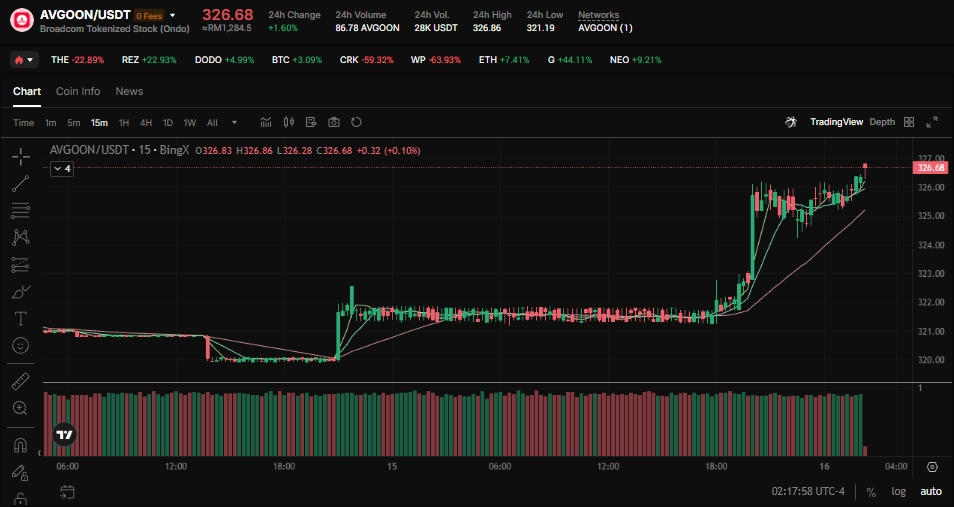
AVGOON/USDT trading pair on the spot market
In 2026, the speed of AI news cycles, such as a surprise chip order from OpenAI or a shift in TSMC production, often triggers massive price swings outside of standard trading hours. By utilizing the AVGON/USDT pair on BingX, you can react to these global catalysts instantly, leveraging the security of tokenized real-world assets (RWAs).
- Fund Account: Top up with USDT.
- Locate Pair: Search for AVGOON/USDT trading pair.
- Execute Trade: Use a Limit Order to catch entries during pullbacks.
5 Key Risks for Broadcom Traders to Monitor in 2026
While Broadcom's $100 billion AI roadmap offers a clear path for growth, traders must navigate a complex landscape of shifting customer dynamics and hardware cycles.
- Whale Customer Concentration: With Google, Meta, and OpenAI potentially contributing the majority of custom silicon revenue, a single capex pivot or chip holiday from one of these giants could cause a massive quarterly revenue miss.
- The Margin Squeeze: The transition from selling individual chips to integrated rack-scale systems forces Broadcom to pass through high-cost components like HBM (High Bandwidth Memory), which threatens to keep gross margins pinned below the historic 78% software-driven threshold.
- The Apple Risk Realization: As Apple successfully integrates its own in-house Wi-Fi and Bluetooth chips into the iPhone 17 series, traders must monitor the speed at which Broadcom's $2–3 billion wireless revenue stream evaporates.
- Hyperscaler COT (Customer-Owned Tooling): While Broadcom leads in performance, hyperscalers continue to invest in internal chip design teams; any breakthrough in their DIY silicon could reduce Broadcom from a co-designer to a secondary consultant.
- Supply Chain Choke Points: Broadcom remains heavily dependent on TSMC's 2nm and 3nm nodes; any geopolitical tension in the Taiwan Strait or a bottleneck in advanced CoWoS packaging could delay deliveries of the $73 billion backlog.
Conclusion: Should You Invest in Broadcom (AVGO) in 2026?
Broadcom’s 2026 trajectory represents a calculated bet on the industrialization of AI through custom silicon. As hyperscalers prioritize power efficiency and tailored performance over general-purpose hardware, Broadcom’s position as the primary architect for Google, Meta, and OpenAI provides a unique competitive moat. For long-term investors, the combination of a $73 billion backlog, a line of sight to $100 billion in AI revenue by 2027, and a disciplined capital return policy makes it a premier hybrid play for both aggressive growth and consistent income.
However, the $AVGO stock is not a low-risk instrument; it is a high-conviction play on the sustainability of the AI capex super-cycle. Traders should focus on the quality of earnings, specifically monitoring whether revenue growth is outpacing the gross margin dilution caused by hardware system sales. Success in 2026 requires an agile approach, balancing the potential for a $500 bull breakout against the structural headwinds of customer concentration and the loss of legacy mobile sockets.
Risk Reminder: Semiconductor stocks are subject to extreme cyclicality and geopolitical sensitivities. Even with a strong backlog, AVGO can experience high volatility due to shifts in AI spending or trade restrictions. Always utilize stop-losses and maintain a diversified portfolio.
Related Reading
- Nvidia (NVDA) Stock Price Outlook for 2026: Can Blackwell and Vera Rubin Take NVDA Back to $300?
- Palantir (PLTR) Stock Outlook for 2026: Can the AI-Driven Enterprise Supercycle Take PLTR Stock to $235+?
- Oracle (ORCL) Stock Outlook for 2026: Can the AI Cloud Infrastructure Buildout Take ORCL to $300?
- Apple (AAPL) Stock Outlook for 2026: MacBook Neo Growth or AI Valuation Trap?
- Alibaba (BABA) Stock Forecast for 2026: Can AI and Cloud Growth Push BABA Past $200?
