
In April 2026, Morgan Stanley (MS) is reaping the rewards of a massive cyclical tailwind in global markets. While the broader financial sector grapples with high-floor consolidation, MS has leveraged its integrated business model to post a staggering 27.1% Return on Tangible Common Equity (ROTCE). Despite trading near its 52-week high of $194.59, the stock faces a tug-of-war: Bulls point to the 36% surge in investment banking revenue as proof of a new deal-making supercycle, while skeptics highlight a 6.53% volatility spike and heavy insider selling as signals of a looming correction.
As the second quarter of 2026 begins, Morgan Stanley is evolving beyond its traditional wealth-management-heavy narrative. With CEO Ted Pick signaling strong execution across institutional securities, specifically a record $5.15 billion in equities trading, the bank is positioning itself as the premier high-beta play in the financial sector. This guide breaks down the MS stock price prediction for 2026 using data from Zacks Research, Trefis, and BingX technical analysis.
You will also discover how to trade Morgan Stanley (MS) stock futures through BingX TradFi.
Top 5 Things for Morgan Stanley Investors to Know in 2026
- Investment Banking Supercycle: Institutional Securities revenue hit a record $10.7 billion in Q1 2026, with advisory fees up 36%, signaling a robust return of M&A activity.
- Wealth Management Momentum: The firm captured a record $118.4 billion in net new assets last quarter, reinforcing its status as a client-gathering powerhouse with a 30% pre-tax margin.
- The Fear Disconnect: While technical indicators are 100% bullish, the Fear & Greed Index sits at 39 (Fear), suggesting retail investors are wary of the stock's 75% gain over the past year.
- Insider Selling Flags: Over $11 million in stock has been offloaded by top executives in early 2026, including a $2.12 million sale by the Chief Legal Officer near current highs.
- Technical Support Levels: As of April 2026, MS is trading around 7.4% above its immediate 5-day forecast. Key support sits at the 50-day SMA a $169.24 and the 200-day SMA at $163.38.
What Is Morgan Stanley (MS)?
Forged in the fallout of the 1933 Glass-Steagall Act, Morgan Stanley emerged when Henry S. Morgan and Harold Stanley transitioned from J.P. Morgan to establish a powerhouse dedicated exclusively to investment banking and securities. Over the nearly nine decades since its 1935 debut, the firm has evolved from a traditional white shoe advisory house into a systemic pillar of global finance. Its significance lies in its role as a premier intermediary for the world's most complex transactions, from underwriting the Ford Motor Company IPO in 1956 to navigating the 2008 financial crisis by pivoting into a bank holding company. Today, it stands as a high-margin Fortress of Capital, distinguished by a strategic move away from high-risk commercial lending toward a high-fidelity, fee-based model that anchors the global financial ecosystem.
Operating as a sophisticated triumvirate of Institutional Securities, Wealth Management, and Investment Management, the firm currently oversees a staggering $7.5 trillion in client assets. Under the precision-led leadership of CEO Ted Pick, Morgan Stanley has mastered operating leverage, a strategy that weaponizes its massive scale to ensure profit growth outpaces revenue gains, evidenced by a 29% surge in net profit during Q1 2026. By integrating its world-class equities trading desk with an industry-leading wealth management engine, the bank has created a self-sustaining alpha flywheel. This allows it to capture value in all market conditions, serving as the ultimate flight-to-quality destination for sovereign wealth funds, institutional giants, and ultra-high-net-worth individuals alike.
Morgan Stanley (MS) Stock Performance in 2025: A Review
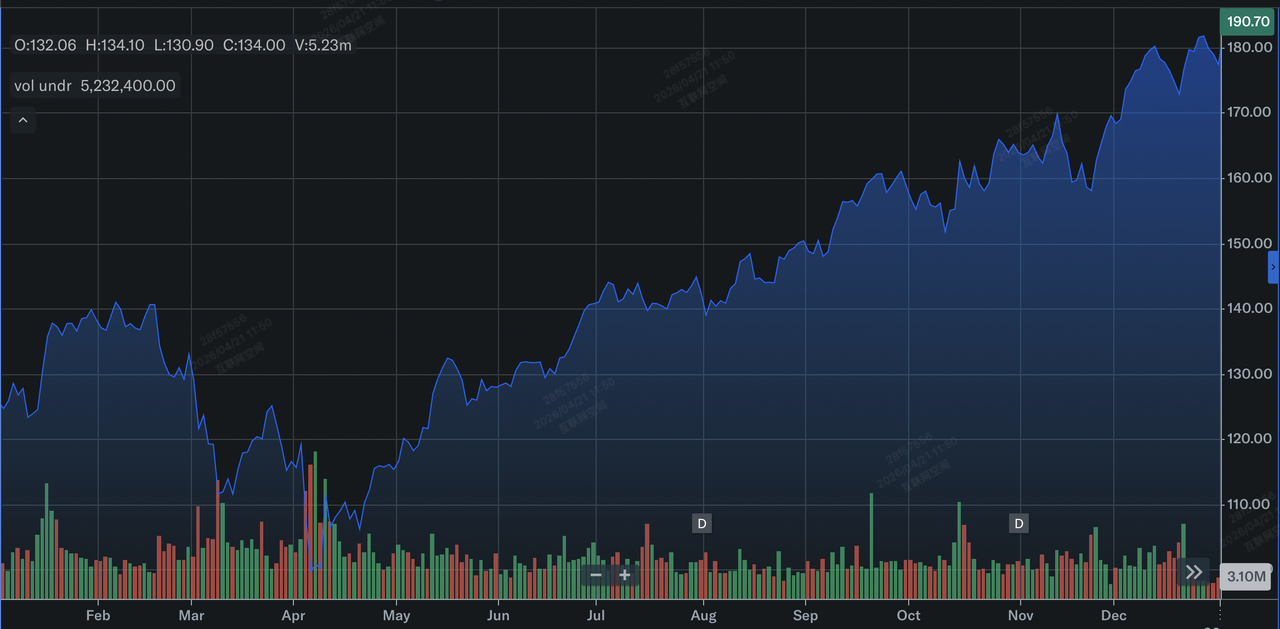
Morgan Stanley (MS) stock's performance in 2025 | Source: Yahoo Finance
In 2025, Morgan Stanley (MS) delivered a standout performance, characterized by record-breaking financials and strong stock price appreciation. The firm reported full-year net revenues of $70.6 billion and a net income of $16.9 billion, fueled by a resurgent investment banking sector and a massive $356 billion in net new assets within its Wealth Management division. This integrated firm strategy allowed Morgan Stanley to achieve an impressive Return on Tangible Common Equity (ROTCE) of 21.6%, consistently exceeding its long-term targets and demonstrating significant operating leverage throughout the year.
The MS stock reflected this fundamental strength, ending 2025 with a gain of approximately 42%. Starting the year at around $124.78, the price climbed steadily as deal-making activity rebounded and client engagement hit record highs. Despite mid-year volatility, shares surged in the fourth quarter to hit a year-end price of $177.53. This rally was supported by a series of earnings beats, including a notable Q4 EPS of $2.68 against a $2.41 forecast, solidifying Morgan Stanley’s position as a premier high-growth pillar in the global financial landscape.
Morgan Stanley’s 2026 Strategy: The Integrated Alpha
- Equities Dominance: MS has edged out rival Goldman Sachs in prime brokerage and derivatives, capitalizing on market volatility to generate record trading volumes.
- Wealth Management Scale: The bank is leveraging its $8.5 billion wealth revenue to cross-sell institutional products, creating a flywheel effect that lowers customer acquisition costs.
- Capital Returns: With a 2.12% dividend yield and a history of 12 consecutive years of dividend growth, the firm remains a top choice for income-seeking growth investors.
Morgan Stanley (MS) Stock 2026 Investment Outlook: $230 Breakout vs. $165 Pullback
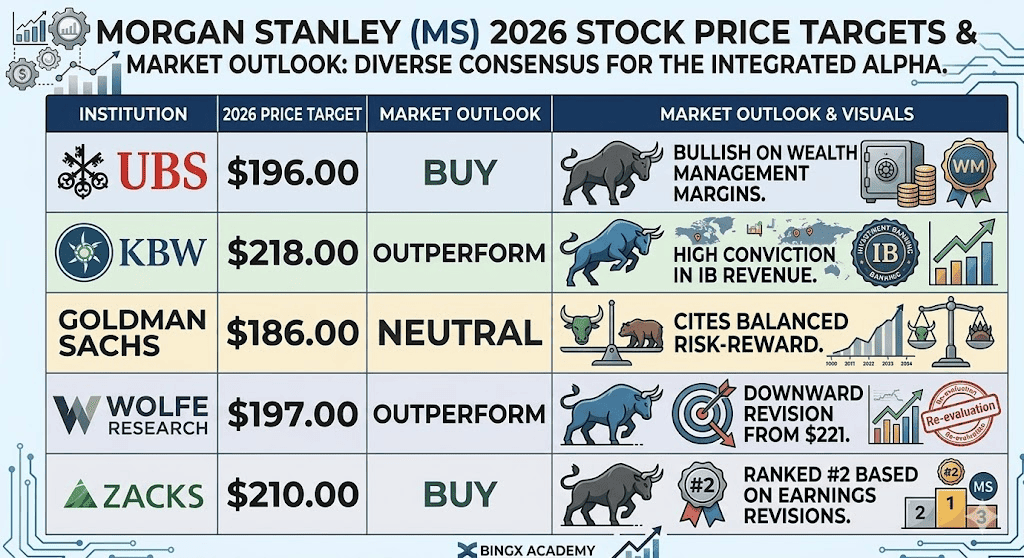
Morgan Stanley stock forecasts for 2026 by various Wall Street analysts
The 2026 outlook for MS stock is a balance between its record-breaking earnings power and the overbought signals appearing on technical charts.
The Bull Case: MS Targets $230 on the Alpha Flywheel Breakout
The bullish narrative is anchored by a fundamental valuation re-rating as Morgan Stanley successfully sheds its label as a slow-growth wealth manager. By weaponizing its record $10.7 billion Institutional Securities revenue, the firm is entering a deal-making supercycle. If the M&A pipeline continues its current trajectory, fueled by a 36% surge in advisory fees and a 25% jump in equities trading, the consensus EPS is projected to climb toward $12.42 by 2027. This shift suggests that MS is moving from a defensive asset to a high-beta growth engine, supporting a target of $230, a 20% upside from current levels.
To sustain this $230 trajectory, Morgan Stanley must prove its record $118.4 billion in quarterly Wealth Management inflows is a structural shift rather than a post-war anomaly. The primary KPI for this scenario is a sustained ROTCE above 27%, a feat that would likely trigger a forward P/E expansion toward 19x–20x. In this high-conviction environment, the bank’s integrated firm strategy creates a self-reinforcing loop where investment banking deals feed the wealth management platform, providing the necessary operating leverage to hit the $500 milestone by the early 2030s.
The Base Case: Morgan Stanley's $195 Fair Value and the Fortress Consolidation
The base case positions Morgan Stanley as the ultimate market compounder, expected to reach a mean analyst target of $195. This outlook assumes the stock enters a healthy consolidation phase, holding the $185–$195 range as it absorbs the current Fear sentiment with Fear & Greed Index at 39 as of April 2026. With a forward P/E of around 17.3x, the stock is priced fairly against its 5-year historical average. Revenue is projected to track steadily at $76.7 billion for 2026, supported by a 4.8% improvement in annual revenue that aligns with the broader capital markets industry growth of 5.4%.
Technically, the Fortress base case for Morgan Stanley's stock outlook in 2026 is defended by powerful support at the 50-day SMA at $169.24 and 200-day SMA at $163.38. While immediate price action may feel stagnant after the Q1 earnings surge, the 2.12% dividend yield and 12 consecutive years of dividend growth provide a high floor for investors. In this scenario, MS tracks the S&P 500 Financials Index but remains the gold standard for risk-adjusted returns, offering a reliable flight-to-quality destination as global liquidity levels stabilize through the remainder of 2026.
The Bear Case for Morgan Stanley Stock: $170 Correction Amid Insider Warning Signals
The bear case is triggered by a macro-skunk entering the market: an energy-driven inflation shock that forces a hard landing. In this environment, Morgan Stanley’s high-beta institutional business, which generated 50% of Q1 revenue, would be the first to retract as trading volumes dry up. The primary catalyst for a downward spiral is negative divergence: while technicals remain bullish, the $11 million in recent insider selling near $194 suggests that smart money is taking profits. A dip below the 5-day prediction of $177.52 would likely accelerate into a 10% correction toward the $170.82 one-month forecast.
Under this pressure, MS stock would test its 52-week intrinsic value floor near $165. Bears focus on the fact that MS is currently trading 7.4% above its immediate forecast, leaving little room for error if the $2 trillion private credit market faces a redemption surge. Furthermore, if free cash flow does not improve to better cover the $1.00 quarterly dividend, investors may penalize the stock's premium multiple. In this scenario, the integrated flywheel grinds to a halt as wealth management margins compress and the bank is forced to hike loss reserves, erasing the gains of the post-earnings rally.
Morgan Stanley Stock Price Forecasts for 2026 By Wall Street Analysts
|
Institution |
2026 Price Target |
Market Outlook |
|
UBS |
$196.00 |
Buy: Bullish on Wealth Management margins. |
|
KBW |
$218.00 |
Outperform: High conviction in IB revenue. |
|
Goldman Sachs |
$186.00 |
Neutral: Cites balanced risk-reward. |
|
Wolfe Research |
$197.00 |
Outperform: Downward revision from $221. |
|
Zacks |
$210.00 |
Buy: Ranked #2 based on earnings revisions. |
How to Trade Morgan Stanley (MS) Stock on BingX
Navigate the volatility of the financial sector using BingX TradFi and BingX AI-driven insights. Whether you are hedging against a short-term pullback or longing the IB supercycle, BingX provides the tools for precision execution. By leveraging advanced BingX AI predictive analytics, you can better anticipate market sentiment shifts and price action ahead of macro triggers, ensuring your strategy remains data-driven in a high-volatility environment.
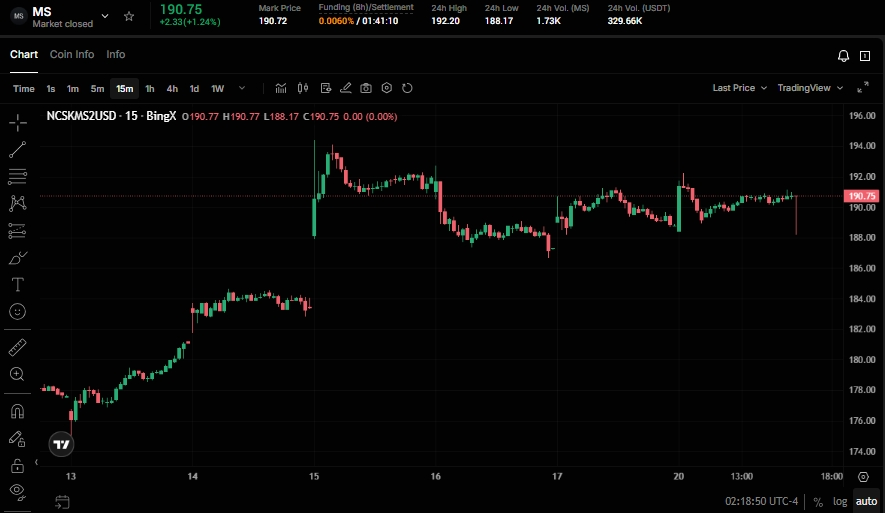
MS/USDT perpetuals on BingX futures market
Long or Short MS Stock Futures on BingX
- Navigate to BingX TradFi and select Stock Futures.
- Select the MS/USDT perpetual contract.
- Set your leverage, e.g., 2x–5x.
- Select Open Long if you anticipate a breakout, or Open Short to capitalize on a forecast dip.
- Set Take-Profit (TP) and Stop-Loss (SL) based on key moving averages and support/resistance levels.
Top 5 Considerations Before Trading Morgan Stanley (MS) Stock
Success in trading Morgan Stanley (MS) during 2026 requires a balanced evaluation of its high-octane investment banking recovery against underlying macroeconomic and internal governance signals.
- The Investment Banking Supercycle: Institutional Securities revenue hit a record $10.7 billion in Q1 2026, driven by a 36% surge in advisory fees; traders should monitor if this M&A momentum sustains or if it was a temporary release of pent-up deal demand.
- Wealth Management Retention: With a record $118.4 billion in net new assets captured in a single quarter, the key metric for 2026 is whether the firm can maintain its 30% pre-tax margin amidst fluctuating global liquidity.
- Technical Overextension: MS is currently trading approximately 7.4% above its immediate 5-day forecast and nearly 10% above its 1-month target of $170.82, suggesting that the post-earnings rally may be due for a mean-reversion correction.
- Insider Sentiment Divergence: While technical indicators remain 100% bullish, significant insider selling totaling over $11 million by top executives near the 52-week high provides a cautionary signal that smart money may be taking profits.
- Macro-Volatility and Fear Levels: The Fear & Greed Index sits at 39 (Fear), indicating that while MS has individual strength, the broader market environment remains jittery due to energy-driven inflation and geopolitical tensions, which could trigger high-beta volatility for financial stocks.
Final Thoughts: Should You Invest in Morgan Stanley Stock in 2026?
Morgan Stanley enters mid-2026 as a high-performance financial engine, having successfully transitioned from a defensive wealth management play into a resurgent investment banking powerhouse. The firm's ability to maintain a 27.1% ROTCE while capturing record-breaking trading volumes suggests that its integrated alpha model is functioning at peak efficiency. However, the current 7.4% premium over short-term forecasts and the Fear reading on the sentiment index indicate that the stock is in a period of high-floor consolidation. For investors, the immediate challenge is timing: while long-term targets of $385+ remain intact, the technical data points to a potential entry window near the $169–$171 support zone, where the 50-day SMA provides a historical safety net.
Practically, MS remains a premier flight-to-quality asset for those seeking exposure to global liquidity and institutional deal-flow. Navigating the remainder of 2026 requires balancing the bullish 100% technical buy signals against the cautionary $11 million in insider selling. Conservative traders may find the most value in a buy-the-dip strategy, targeting the $170 level identified by BingX AI models, while momentum-driven investors should monitor for a breakout above the $195.61 resistance. By utilizing BingX TradFi to manage leverage and risk, investors can position themselves to capture the growth of this diversified financial titan while remaining shielded from near-term volatility.
Risk Reminder: Trading and investing in equities like MS involves a significant risk of capital loss. The firm’s performance is highly sensitive to Federal Reserve interest rate pivots, global M&A volumes, and shifting regulatory capital requirements. Historical performance is not indicative of future results; always conduct independent due diligence or consult a financial advisor before allocating capital.
Related Reading
- JPMorgan Chase (JPM) Price Prediction 2026: Fortress Defense or AI-Driven Alpha at $330?
- Goldman Sachs (GS) Price Prediction 2026: Strategic Renaissance or Value Trap at $860?
- Nasdaq 100 (NAS100) Forecast 2026: 27,000 AI Breakthrough or 22,000 Stagflation Trap?
- S&P 500 Forecast 2026: 7,600 Bull Run or a 6,000 Energy-Driven Crash?
- Crude Oil Price Forecast 2026: $140 War Premium or $60 Surplus Baseline?
- Is Gold a Good Investment in 2026? Risks & Returns Explained