


SoFi Technologies, Inc. (SOFI) is a digital financial-services company combining banking, lending, investing, payments, and crypto access in one member platform. Its business is driven mainly by net interest income from lending and deposits, with growing fee revenue from origination, brokerage, interchange, enterprise technology, and the Loan Platform Business. Because credit quality and funding determine lending economics, results are closely tied to consumer health, interest rates, deposit growth, capital, and loan demand. SoFi Plus, SoFi Coach, enterprise products, and stablecoin infrastructure are becoming more important as the company seeks a more diversified revenue mix.
In 2026, the main question is whether SoFi can turn rapid member growth into durable, capital-efficient earnings. In Q2 2026, adjusted net revenue rose 40% to $1.21 billion and adjusted EPS reached $0.12, while Technology Platform revenue declined 23% year over year. SoFi is also expanding cross-buy, Loan Platform Business, SoFi Plus, AI guidance, and enterprise financial infrastructure. For investors, the key question is whether fee-based initiatives can scale fast enough to reduce lending dependence, improve predictability, and support durable growth over time.
The SOFI stock forecast for 2026 now centers on two competing views:
- The diversified financial-platform Bull case: Stronger cross-buy, deposits, capital-light fee revenue, and Technology Platform stabilization could support targets as high as $30
- The credit and valuation Bear case: Consumer-credit deterioration, weaker funding economics, technology-client pressure, or multiple compression could pull SOFI toward $12.
This guide breaks down the SOFI stock forecast, 2026 price scenarios, key risks, and analyst views, drawing on the July 29, 2026 earnings release, plus how to trade SOFI stock futures on BingX TradFi with USDT collateral.
Top 5 Things for SoFi Technologies, Inc. Investors to Know in August 2026
SOFI trades on Nasdaq and is sensitive to credit, rates, deposits, demand, fees, and multiples.
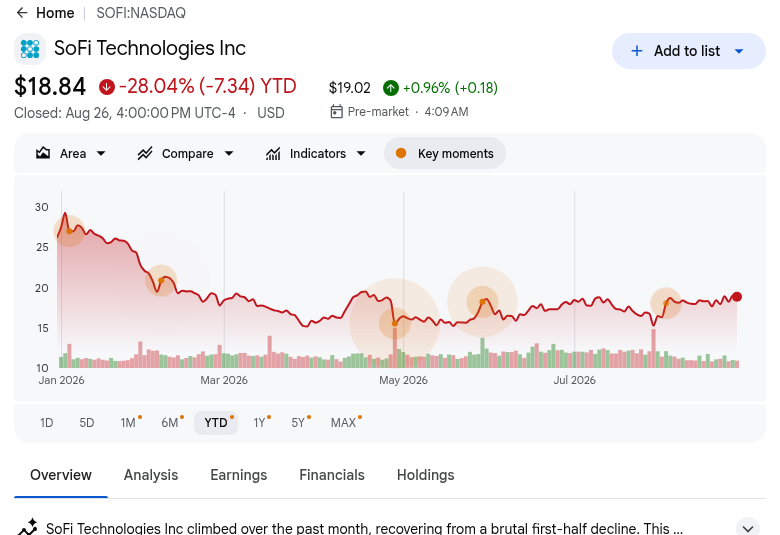
- Q2 adjusted revenue rose 41% to $1.21 billion and beat consensus. Revenue increased from $858.2 million a year earlier and came in above the roughly $1.11 billion estimate, with Lending and Financial Services offsetting weaker Technology Platform results. The beat reinforced SoFi’s broader growth story beyond lending.
- Products grew 42% to 24.4 million as cross-buy reached 51%. The increase shows members are using more products across SoFi’s ecosystem, creating a larger base for fee income and deeper customer engagement rather than relying only on new-member growth.
- Deposits reached $45.5 billion, strengthening SoFi’s funding base. The larger deposit base supports lower-cost funding and gives SoFi more flexibility to grow lending without relying as heavily on external financing. That remains an important advantage if credit conditions stay controlled.
- Full-year adjusted revenue guidance rose to $4.75-$4.85 billion. The higher outlook signaled confidence after Q2 and suggests management exp
- ects continued growth across lending, Financial Services, and fee-based businesses. Execution will depend on maintaining margins and credit quality as the company scales.
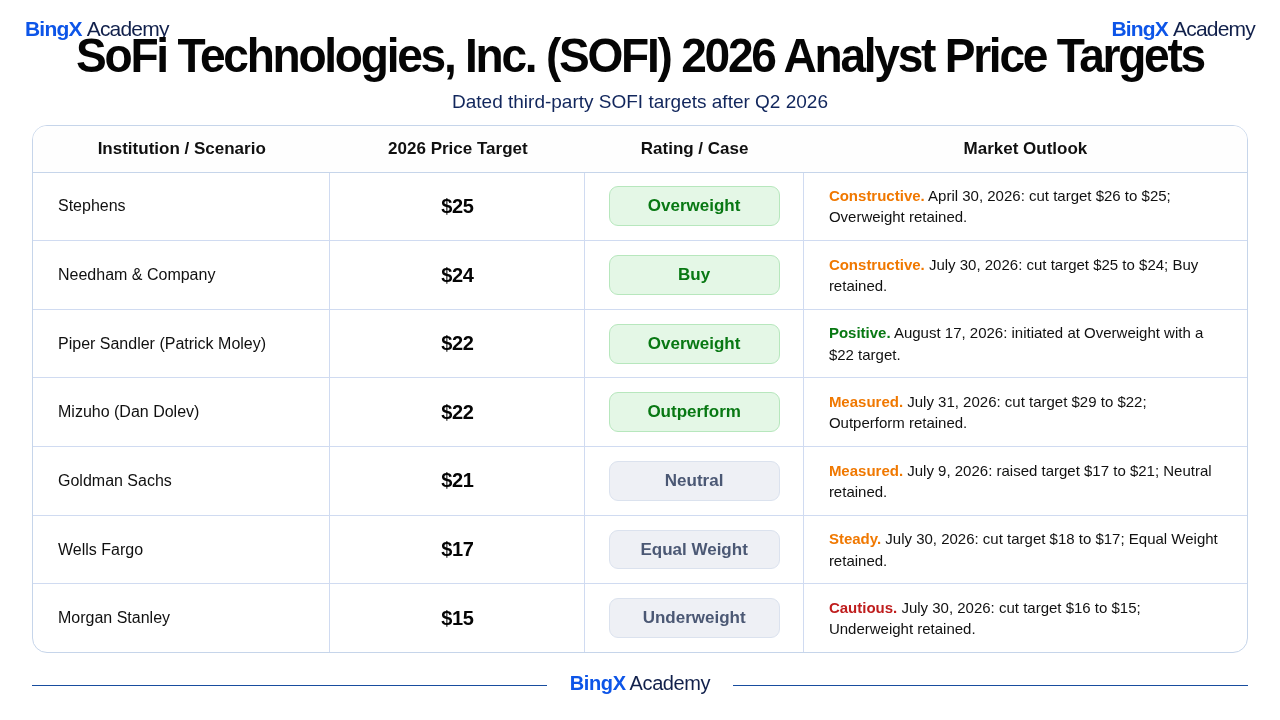
- Analyst targets remained divided between growth and valuation concerns. Published targets across seven named institutions ranged from about $15 to $25. The bullish case centers on cross-buy, deposits, and fee growth, while the cautious view focuses on consumer credit, Technology Platform weakness, and valuation.
What Is SoFi Technologies (SOFI)?

SoFi is a San Francisco digital financial-services company founded in 2011. Its platform combines lending, deposits, investing, payments, and guidance. Lending and net interest income remain central, supported by deposits. Financial Services and enterprise technology add fees, while results depend on underwriting, funding, credit, regulation, and technology.
SoFi is moving from lending-led fintech toward a broader financial platform. Loan Platform Business can add fees without retaining every partner loan. SoFi Plus, investing, payments, and enterprise infrastructure seek deeper engagement. Technology Platform weakness shows diversification is incomplete, so results still depend on credit, deposits, fees, and execution.
Read More: Top Financial Services and Fintech Stocks to Buy in 2026 Amid Agentic AI, Stablecoin Rails Shift
SoFi Technologies (SOFI) Q2 2026 Earnings: Can Deposit Growth Sustain Momentum?
- Adjusted revenue rose 40% to $1.21 billion and beat consensus by 9%. Revenue increased from $858.2 million a year earlier and topped the roughly $1.11 billion estimate, with Lending and Financial Services driving the expansion. The beat strengthened SoFi’s growth case heading into the second half of 2026.
- Adjusted EPS reached $0.12 and matched expectations. EPS increased from $0.08 a year earlier, showing continued profitability as the business scaled. Credit costs, provisions, and funding expenses remain important factors for future earnings.
- Originations reached $14.8 billion, led by personal loans. The total included $10.7 billion of personal loans and $3.1 billion through Loan Platform Business partners. Higher volume supports interest and fee growth, though retained loans also increase credit exposure.
- Deposits increased by $5.3 billion to $45.5 billion. The larger deposit base strengthens SoFi’s funding position and can reduce reliance on more expensive external financing. Deposit pricing, retention, and net interest margin remain key signals to watch.
- Adjusted EBITDA rose 44% to $357.8 million. The result represented a 30% margin and showed stronger operating leverage as revenue grew. Management maintained roughly $1.6 billion of full-year adjusted EBITDA guidance, keeping margin execution central to the outlook.
SoFi Q2 2026 Financial and Consensus Profile: Revenue, EPS and Funding Strength
SoFi's Q2 report combined record revenue, profit, and funding with Technology Platform weakness and credit exposure. The table separates reported figures from Zacks consensus, segments, liquidity, guidance, and diversification.
|
Financial Metric |
Guidance / Consensus |
Reported / Actual |
Surprise |
|
Q2 2026 adjusted net revenue |
$1.11 billion Zacks consensus |
$1.20555 billion; +40% year over year |
Beat. +9.01%; lending and fees drove upside. |
|
Q2 2026 adjusted diluted EPS |
$0.12 Zacks consensus |
$0.12 versus $0.08 prior year |
In line. +0.00%; operating leverage lifted earnings. |
|
Financial Services revenue |
— |
$466.3 million; +29% |
Strong. Member growth and cross-buy expanded it. |
|
Technology Platform revenue |
— |
$84.5 million; -23% |
Weak. A client transition remained a drag. |
|
Adjusted EBITDA |
— |
$357.8 million; 30% margin |
Strong. EBITDA rose 44%; leverage held. |
|
Deposits and funding |
— |
$45.5 billion deposits; +$5.3 billion in Q2 |
Strong. Deposits expanded the funding base. |
|
Full-year 2026 adjusted net revenue guidance |
Prior outlook of approximately 30% growth |
$4.75 billion-$4.85 billion; 32%-35% growth |
Raised. Management increased the range after Q2. |
|
Cross-buy and member engagement |
— |
51% of new products from existing members |
Strong. Existing-member adoption can improve efficiency. |
For context, SoFi uses deposits, cross-buy, Loan Platform Business, and fees to make growth efficient. Revenue supports the Bull thesis, while Technology Platform weakness and credit exposure keep valuation risk in focus. The key question is whether fees outgrow risk.
SoFi Technologies (SOFI) 2026 Investment Outlook: $30 Bull Case vs. $12 Bear Case
SoFi's outlook for the rest of 2026 depends on one central question: whether cross-buy, deposits, and fees diversify earnings, or whether credit and Technology Platform weakness keep pressure on the stock.
The Bull Case: Cross-Buy and Fee Growth Pushes SOFI Toward $30
The Bull Case assumes SoFi converts member scale into a diversified platform. Cross-buy, SoFi Plus, Loan Platform Business, and enterprise products expand fees while deposits lower funding costs. Controlled credit and Technology Platform recovery could earn a premium to traditional banks.
A move toward $30 would require durable member growth, cross-buy near 51%, deposit inflows, rising fees, stable losses, and Technology Platform stabilization. The strongest confirmation would be above-consensus quarters and higher EPS guidance.
The Base Case: Profitable Growth Keeps SOFI Between $18 and $25
The Base Case keeps lending as SoFi’s main earnings engine while Financial Services, Loan Platform Business, and cross-buy advance. Deposits support originations, but Technology Platform recovery remains gradual. Investors value SoFi as a profitable platform while discounting credit exposure.
Under this scenario, SOFI could trade mainly between $18 and $25 while investors await proof that fees reduce lending dependence. Key confirmation points would include stable credit, deposit growth, cross-buy, positive EPS revisions, and Technology Platform recovery.
The Bear Case: Credit and Valuation Pressure Pulls SOFI Toward $12
The Bear Case assumes record lending raises exposure to a softer consumer cycle. Technology Platform weakness would leave earnings more dependent on lending spreads and balance-sheet growth. Even with $45.5 billion of deposits, rising losses could force a lower bank-style valuation.
A move toward $12 would become more likely if delinquencies rise, deposits slow, Technology Platform revenue stays weak, and guidance falls. In that scenario, credit sensitivity and multiple compression would dominate the stock.
SOFI Stock Price Forecasts for 2026 By Wall Street Analysts
Dated third-party analyst actions on SoFi span $15 to $25 after the Q2 2026 release. The spread shows how differently institutions weigh profitable growth, consumer-credit sensitivity, funding advantages, Technology Platform weakness, and valuation.
|
Institution / Scenario |
2026 Price Target |
Rating / Case |
Market Outlook |
|
Stephens |
$25 |
Overweight |
Constructive. April 30, 2026: cut target $26 to $25; Overweight retained. |
|
Needham & Company |
$24 |
Buy |
Constructive. July 30, 2026: cut target $25 to $24; Buy retained. |
|
Piper Sandler (Patrick Moley) |
$22 |
Overweight |
Positive. August 17, 2026: initiated at Overweight with a $22 target. |
|
Mizuho (Dan Dolev) |
$22 |
Outperform |
Measured. July 31, 2026: cut target $29 to $22; Outperform retained. |
|
Goldman Sachs |
$21 |
Neutral |
Measured. July 9, 2026: raised target $17 to $21; Neutral retained. |
|
Wells Fargo |
$17 |
Equal Weight |
Steady. July 30, 2026: cut target $18 to $17; Equal Weight retained. |
|
Morgan Stanley |
$15 |
Underweight |
Cautious. July 30, 2026: cut target $16 to $15; Underweight retained. |
How to Trade SoFi Technologies (SOFI) Stock on BingX
Navigate SoFi's consumer-credit cycle, member growth, deposits, Technology Platform results, and earnings using BingX TradFi and BingX AI. AI analytics are supplementary context, not a prediction guarantee, for monitoring credit, rates, originations, guidance, and valuation.
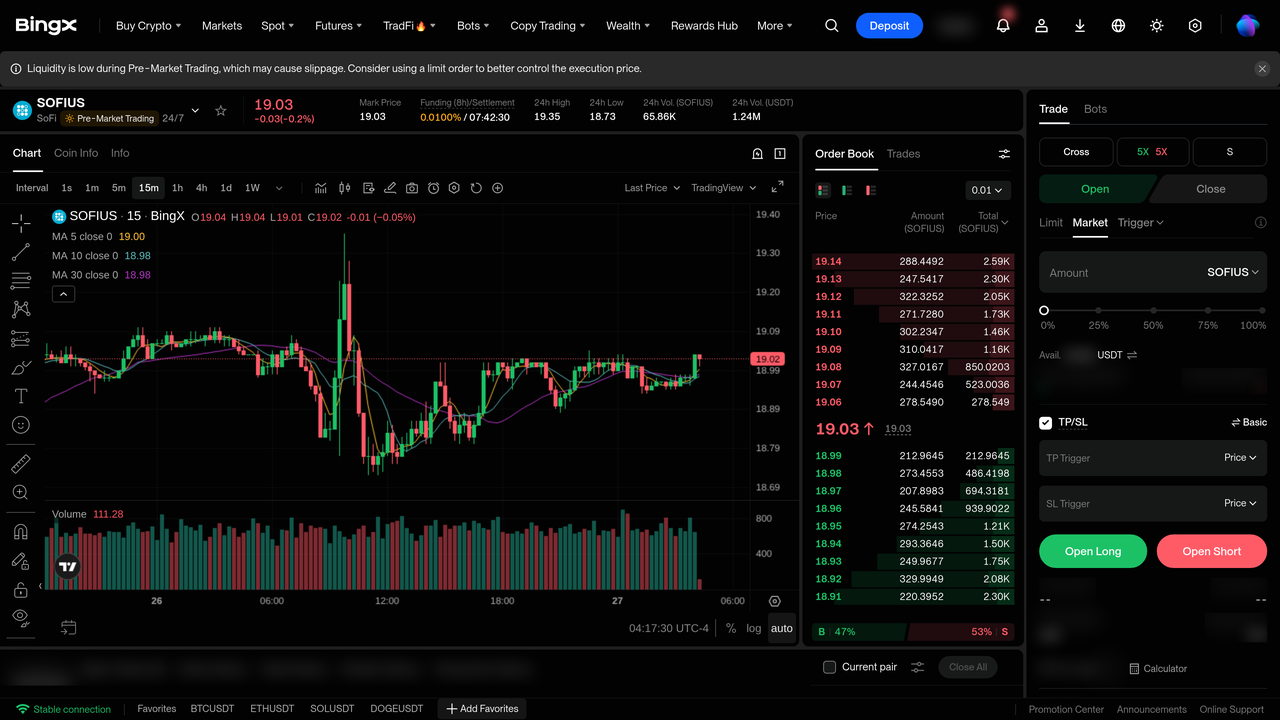
Step 1: Access BingX TradFi. Sign up and navigate to the specialized TradFi section on the main BingX exchange dashboard.
Step 2: Select SoFi Technologies (SOFI). Search for and select the SOFIUS-USDT perpetual futures contract.
Step 3: Choose your direction. Select Open Long if you expect deposit growth, cross-buy, fee revenue, and improving operating leverage to support further upside. Select Open Short if you expect rising credit losses, weaker funding economics, continued Technology Platform pressure, or valuation compression to weigh on SOFI.
Step 4: Select leverage and margin mode. Choose Isolated or Cross-Margin based on your risk tolerance. Because SOFI can react sharply to earnings, credit trends, rate expectations, and guidance changes, conservative leverage and clear position sizing are important.
Step 5: Execute strict risk protocols. Set Take-Profit and Stop-Loss (TP/SL) levels before or immediately after entering the trade. SOFI can move quickly around quarterly earnings, deposit growth, originations, charge-offs, Technology Platform results, interest-rate expectations, regulation, and analyst revisions.
Top 5 Risks to Watch for SOFI Investors in 2026
SoFi’s growth outlook depends on strong credit performance, efficient funding, and continued diversification beyond lending. These are the main risks to watch.
- Consumer weakness could increase credit losses. Personal loans remain a major earnings driver, so higher unemployment or financial stress could raise delinquencies, provisions, and charge-offs.
- Competition could pressure lending and deposit economics. Banks and fintechs compete aggressively on rates, rewards, and pricing, which could raise funding and acquisition costs while reducing margins.
- Technology Platform weakness could slow diversification. Revenue in the segment fell 23% year over year after a client transition. Continued weakness would leave SoFi more dependent on lending and Financial Services growth.
- Regulation could raise costs or limit growth. SoFi operates across banking, lending, investing, crypto, payments, and enterprise technology, leaving it exposed to changes in capital, consumer-protection, data, and product rules.
- A premium valuation leaves less room for disappointment. Slower growth, weaker guidance, higher rates, or renewed risk aversion could compress SOFI’s valuation even if earnings remain positive.
Final Thoughts: Should You Invest in SoFi Technologies (SOFI) in 2026?
SoFi enters the rest of 2026 with strong revenue growth, a $45.5 billion deposit base, rising cross-buy, and improving operating leverage. Those trends support the bull case, especially if Financial Services and fee-based revenue continue expanding and the Technology Platform begins to stabilize.
The main question is whether SoFi can keep growing without taking on too much credit risk or relying too heavily on lending. A move toward the $30 bull case would require continued deposit growth, stable credit, stronger fee revenue, and better Technology Platform results. The $12 bear case becomes more likely if charge-offs rise, funding economics weaken, or valuation compresses before earnings growth can catch up.
Risk Reminder: SOFI remains exposed to consumer credit, funding costs, Technology Platform execution, regulation, dilution, and valuation volatility
Related Reading
- Best Crypto Stocks to Watch in 2026: Top Picks to Know
- Top Financial Services and Fintech Stocks to Buy in 2026 Amid Agentic AI, Stablecoin Rails Shift
- Robinhood (HOOD) Stock Forecast 2026: Can the Super-App Strategy Push HOOD Toward $160?
- Mastercard (MA) Stock Price Forecast for 2026: Fintech Giant or Regulatory Target?
- Coinbase (COIN) Price Prediction 2026: Can New Revenue Streams Push COIN Toward $250?
- Circle (CRCL) Price Prediction 2026: Can Stablecoin and Arc Momentum Push CRCL Stock Toward $130?
