

The XRP Rich List is a ranking compiled from the XRP Ledger public ledger, displaying the amount of XRP held by various addresses, balance changes, and historical activities. Since all transactions and asset distributions on the XRPL are publicly accessible, anyone can view the fund status of the largest holding addresses in the market in real time.
Compared toBitcoin andEthereum, XRP's holding structure is more concentrated, with a few large addresses controlling a considerable proportion of the circulating supply, making fund movements from the top few holders often have an amplified impact on market liquidity and price. Through the Rich List, one can more clearly observe the concentration of market assets and identify which addresses have potential market influence. In practical applications, the Rich List can also be used to track changes in large holders' positions, observe whether long-term holders are starting to move funds, and identify key signals such as whether assets are flowing into exchanges.
This article will systematically introduce the main tools for querying the XRP Rich List from the perspective of holding scale classification, including blockchain explorers such as XRPScan and Bithomp, as well as auxiliary pages for observing the overall market such as CoinMarketCap and CoinGecko, explaining the differences between various platforms in tiered queries, long-term holder identification, alert settings, and liquidity influence analysis, and organizing practical methods for Taiwanese users to establish XRP Rich List monitoring habits.
Key Takeaways
- The core value of the XRP Rich List lies in distinguishing between "market whales" and "non-trading addresses" (such as exchange custody wallets and Ripple escrow accounts), where fund movements from the latter usually do not directly represent buying and selling behavior.
- XRPScan is currently the most accurate free tool for querying the XRP Rich List, directly reading XRPL raw data and providing complete holding rankings, address classifications, and historical activity records.
- Bithomp's address labeling system is more comprehensive, effectively identifying exchanges, Ripple official accounts, and personal wallets, making it an indispensable auxiliary tool for interpreting the Rich List.
- XRP holding structures are commonly classified into four categories by scale: "Whales" (over 100 million tokens), "Large Holders" (1 million to 100 million tokens), "Mid-tier Holders" (10,000 to 1 million tokens), and "Retail Users" (under 10,000 tokens), with different tiers showing significant differences in market influence.
- Currently, there are no free tools that can directly classify XRP holdings by region, but geographical sources of funds can be indirectly determined through exchange labels.
- After confirming on-chain fund movements, users can view XRP/USDT real-time quotes and set price alerts through BingX, combining Rich List observations with actual trading decisions.
What Is Ripple (XRP)? A Complete Beginner’s Guide
XRP is a cryptocurrency launched by Ripple Labs in 2012, with the core design goal of serving as a bridge asset for cross-border payments between financial institutions to improve the efficiency of fund flows between different currencies. Unlike Bitcoin, which generates new coins through mining, XRP's total supply of 100 billion tokens was pre-generated at its creation and is gradually released to the market through Ripple's established mechanisms. XRP operates on the XRP Ledger (XRPL), featuring high-efficiency transaction characteristics with an average settlement time of about 3-5 seconds and a transaction cost of approximately 0.00001 XRP per transaction, superior to most mainstream blockchains in both speed and cost.
From a market structure perspective, XRP has long maintained a position among the top cryptocurrencies by market cap, with its holding and supply mechanisms having distinctive characteristics. Ripple is the largest single holder, releasing XRP through escrow accounts on a monthly basis, making the market circulation somewhat predictable. On the other hand, XRP's price movements are relatively sensitive to regulatory developments and financial institution partnerships, making it a crypto asset with a high degree of fundamental event-driven behavior. For Taiwanese users, they can directly engage in XRP/USDT spot andperpetual futures trading through BingX exchange, and combine price alerts with real-time market tools to integrate on-chain information with market changes for investment decision-making.
Who Are the Biggest XRP Whales? Top Rich List Holders Revealed
Understanding the major whales in the XRP market is crucial for correctly interpreting large on-chain transfers. Compared to Bitcoin and Ethereum, XRP's holding structure is more concentrated, with the top few addresses controlling a considerable proportion of the supply, making large holder fund movements more likely to impact market liquidity and prices. Therefore, when observing whale signals, beyond transfer amounts, it's more important to determine which type of holder the funds come from and the behavioral logic behind them.
- Ripple Labs (approximately 33.9 billion XRP, about 33.9% of total supply): XRP's largest holder, with most assets locked in escrow accounts. Up to 1 billion XRP can be unlocked on the 1st of each month, with typically about 70%-80% being relocked, and approximately 200-300 million actually entering the market. Such operations frequently trigger whale alerts but represent regular supply releases that should not be misinterpreted as sell-off signals.
- Chris Larsen (approximately 2.5-2.7 billion XRP, about 4%-5%):Chris Larsen is Ripple's co-founder and Executive Chairman, one of the known individual whales with the largest holdings. His related addresses were previously involved in a security incident involving approximately 213 million XRP, but overall holdings remain at high levels, with his fund movements receiving long-term market attention.
- Brad Garlinghouse (estimated hundreds of millions to billions of XRP, undisclosed): Ripple's current CEO, with holdings distributed across multiple wallets, specific data undisclosed. The market generally considers him a long-term holder, with his address movements rarely viewed as short-term trading signals.
- Exchanges and Large Anonymous Addresses (single address or platform approximately 1-1.8 billion XRP, about 1%-2%+): Exchanges (such as Binance, Bithumb, BingX) hold large amounts of user assets, with inter-address transfers mostly being internal adjustments; meanwhile, there are also multiple unlabeled large addresses on the Rich List, possibly belonging to early investors or institutional funds. These addresses are typically low-activity for extended periods, and once continuous transfers to exchanges occur, the market often interprets this as potential selling pressure, making them the most valuable observation targets in on-chain monitoring.
- Jed McCaleb (historical holdings of approximately 9 billion XRP, fully sold by 2022): One of the early co-founders of XRP Ledger, who later left Ripple and founded Stellar (XLM). His holdings were gradually sold through a planned sale program lasting about 10 years, cashing out approximately $3.2 billion. The "tacostand" wallet was a long-term source of selling pressure in the market and no longer affects XRP's supply structure.
Extended Reading:Who Holds the Most XRP in 2026? Top 10 XRP Rich List Revealed
How Are XRP Holdings Classified? Whale, Large Holder & Retail Tier Breakdown
Before using the XRP Rich List, understanding the commonly used holding scale classifications in the market can help quickly assess the potential impact different addresses might have on the market. Although the XRP community doesn't have completely unified standards for classification, the following categories are the most common and practical reference framework.
- Whales: Holdings exceeding 100 million XRP Addresses at this level can significantly impact the market with a single holding. Once large transfers to exchanges, concentrated transfers, or holding changes occur, they often attract high market attention and may even cause short-term price volatility. Most of the top addresses on the XRP Rich List belong to this tier, commonly including Ripple escrow accounts, major exchange cold wallets, and founder-related addresses.
- Large Holders: Holdings between 1 million and 100 million XRP This tier has more addresses, and while individual address influence isn't as obvious as whales, collective accumulation or distribution can still potentially create trend-based market impacts. Many mid-tier addresses on the Rich List fall within this range, with common holders including institutional investors, OTC market makers, and some early adopters.
- Mid-tier Holders: Holdings between 10,000 and 1 million XRP This tier accounts for a considerable proportion of XRP address structure. Individual addresses usually don't cause obvious market impact, but if a large number of mid-tier holders simultaneously accumulate or distribute, it can still serve as important reference for observing market sentiment and fund flows. Changes at this tier are better interpreted from overall trends rather than individual addresses.
- Retail Users: Holdings below 10,000 XRP This is the tier with the most addresses, representing the broadest retail participation. Retail user impact usually doesn't directly reflect in changes among top Rich List addresses but is more commonly manifested in overall market sentiment, trading activity, and short-term volatility.
It's particularly important to note that many high-ranking addresses on the Rich List actually belong to exchange custody wallets, holding large amounts of user assets rather than being single holders. In actual analysis, it's recommended to first confirm address nature through address labels on Bithomp or XRPScan, then apply the above classification framework for interpretation to avoid misreading market signals.
XRP Holding Tier Classification Table
|
Classification |
Holding Threshold |
Rich List Rank Reference |
Typical Address Types |
Individual Address Market Impact |
|
Whale |
100 million+ tokens |
Top 50 |
Ripple escrow accounts, major exchange cold wallets, founder addresses |
High: Large transfers may directly affect market liquidity and prices |
|
Large Holder |
1 million - 100 million tokens |
Ranks 50-500 |
Institutional investors, OTC market makers, early adopters |
Medium: Collective fund movements may create trend-based impacts |
|
Mid-tier Holder |
10,000 - 1 million tokens |
Rank 500+ |
Active retail investors, small institutions, traders |
Low: Individual impact limited, but overall trends have reference value |
|
Retail User |
Under 10,000 tokens |
Bottom of Rich List |
General investors, long-term holders |
Very Low: Individual addresses have limited market impact |
What Are the Best XRP Rich List Tracking Tools? Features and Comparison
The following organizes the most practical XRP Rich List query tools, covering four aspects: native on-chain explorers, address label identification, holding group display, and dynamic monitoring. Since different tools have varying data sources and functional positioning, it's recommended to use them in cross-combination rather than relying on a single platform.
For Taiwanese users, the free combination of XRPScan, Bithomp, and Rich-List.info can cover most Rich List queries and address analysis needs, from holding rankings and address labels to historical activities; if further combined with Whale Alert as a real-time transfer monitoring tool, it can supplement fund flow observations, extending analysis from static holdings to dynamic fund changes.
In comparison, while on-chain analysis platforms like Nansen have relatively limited native support and address labeling completeness for XRP Ledger, they still have unique value, such as tracking historically better-performing addresses through Smart Money labels, observing cross-address fund flows, and conducting multi-chain fund comparison analysis. These tools are more suitable as supplementary perspectives for understanding broader fund behaviors rather than primary tools for XRP Rich List queries.
1. XRPScan
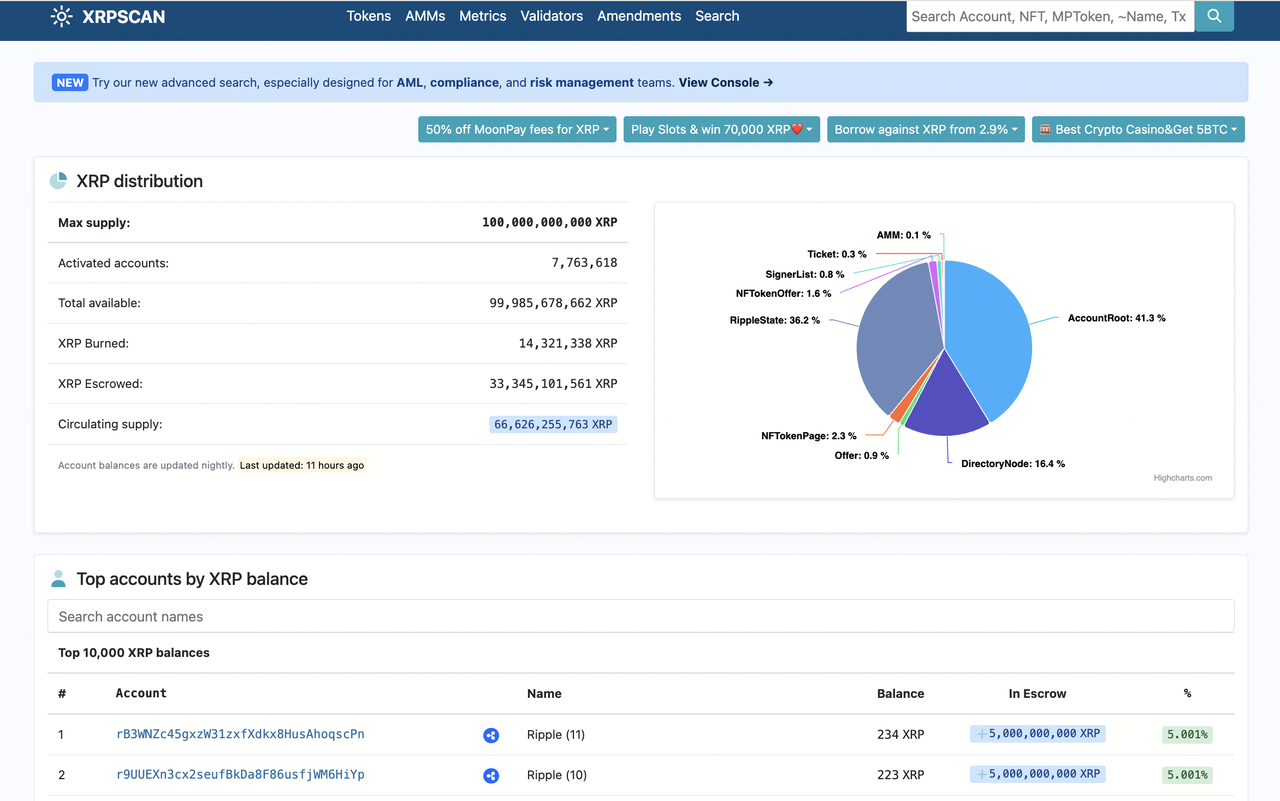
XRPScan is the native blockchain explorer for XRP Ledger, with Rich List functionality reading data directly from the XRPL ledger, offering the highest accuracy among all tools. The Rich List page lists the top few hundred addresses with the most holdings, displaying each address's XRP balance, percentage of total supply, account creation time, and most recent activity time, allowing users to quickly identify which large addresses have been inactive for long periods (potential long-term holders) and which have recent transaction activity.
For long-term holder identification, the "recent activity time" displayed by XRPScan is the most direct reference indicator. Large addresses with early account creation times (2013 to 2015) and distant recent activity times (no transactions for over a year) are usually considered long-term holding "sleeping whales" by the market, and sudden activity from such addresses often triggers market concerns. While XRPScan doesn't provide push notification features, Taiwanese users can regularly manually check specific addresses' activity records or combine with Whale Alert as a supplement for real-time alerts.
XRPScan Key Features
- Native Rich List with most accurate data: Reads directly from XRPL ledger, listing addresses with the most holdings, with balance figures representing actual ledger status without delays or aggregation errors.
- Account creation time and recent activity: Each address displays creation time and last transaction time, providing the most direct filtering criteria for identifying long-term holders and recently active addresses.
- Detailed address transaction history: Clicking any address provides complete transaction records, tracking historical inflow sources and outflow destinations, suitable for in-depth verification of specific address behavior patterns.
- XRPL network overall statistics: Provides ledger closing speed, 24-hour trading volume, active account numbers and other network health indicators, which can be combined with Rich List analysis to assess current network activity levels.
- Completely free, no account required: All features are free to query without registration, making it the lowest-cost starting tool for Taiwanese users' daily XRP Rich List queries.
2. Bithomp
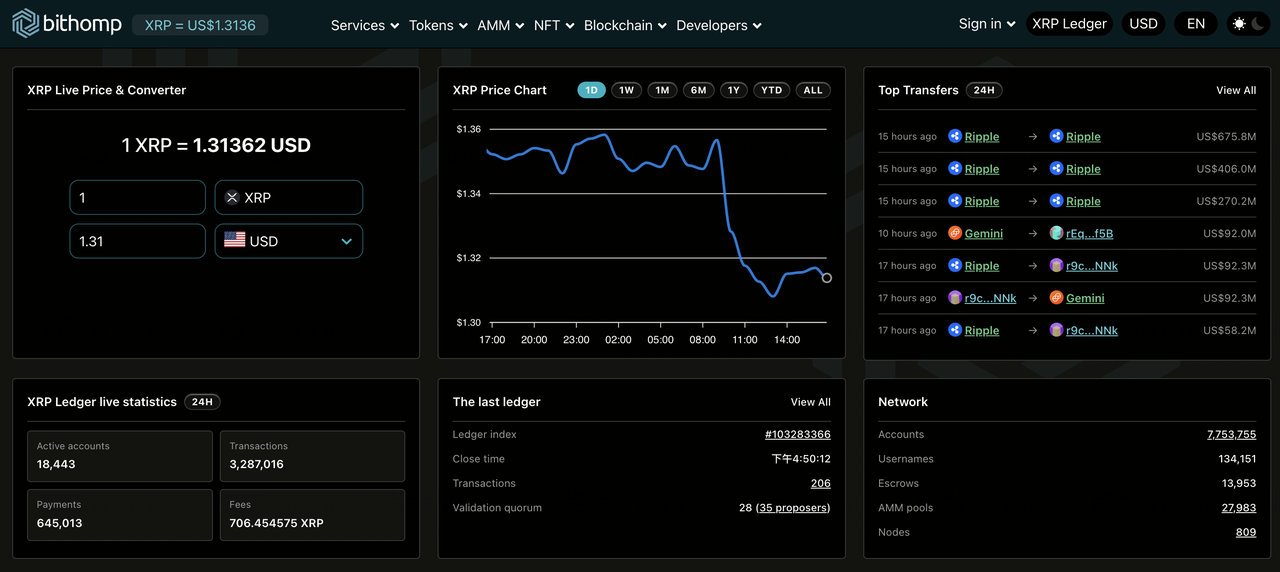
Bithomp's core differentiating advantage among Rich List query tools is its multi-year maintained XRP address label database. Each address on the Rich List with known labels (such as "Ripple Escrow," "Binance Hot Wallet," "Bithumb," etc.) is directly displayed, allowing users to quickly identify address nature without manual verification. For Taiwanese users, this feature is extremely important in practical use: a considerable proportion of the top 50 addresses on the Rich List belong to Ripple escrow accounts and exchange custody addresses, and without label identification, it's easy to misinterpret routine operations from these addresses as market-oriented large holder behavior.
Bithomp also supports custom address tracking, where users can add specific addresses of interest to their watchlist to regularly check balance changes and recent transactions. While Bithomp doesn't provide real-time push notifications, its interface design is relatively user-friendly for non-technical users, making it a practical tool for Taiwanese users to establish personal XRP address watchlists.
Bithomp Key Features
- Most comprehensive address label database: Covers Ripple series accounts, major global exchanges (including BingX), market makers, and some institutions, allowing instant identification of address nature during Rich List analysis, avoiding misinterpretation of routine operations.
- Rich List with direct label display: Each known address on the ranking directly shows institutional names, allowing users to quickly filter out exchange custody addresses and Ripple escrow accounts, focusing on genuine market-oriented large holders.
- Complete Ripple address identification: Specifically labels various Ripple accounts (escrow accounts, operational accounts, ecosystem funds), serving as the most effective tool for distinguishing Ripple routine unlocks from market-oriented large holder sell-offs.
- Address history queries: Can view complete transaction records for any address, and combined with address labeling features, provides more targeted identification of specific institutional fund movements.
- Free to use with intuitive interface: Core features are free, suitable for Taiwanese users to quickly verify actual identities of Rich List addresses without technical background.
3. Whale Alert (Best for Large XRP Transfers)
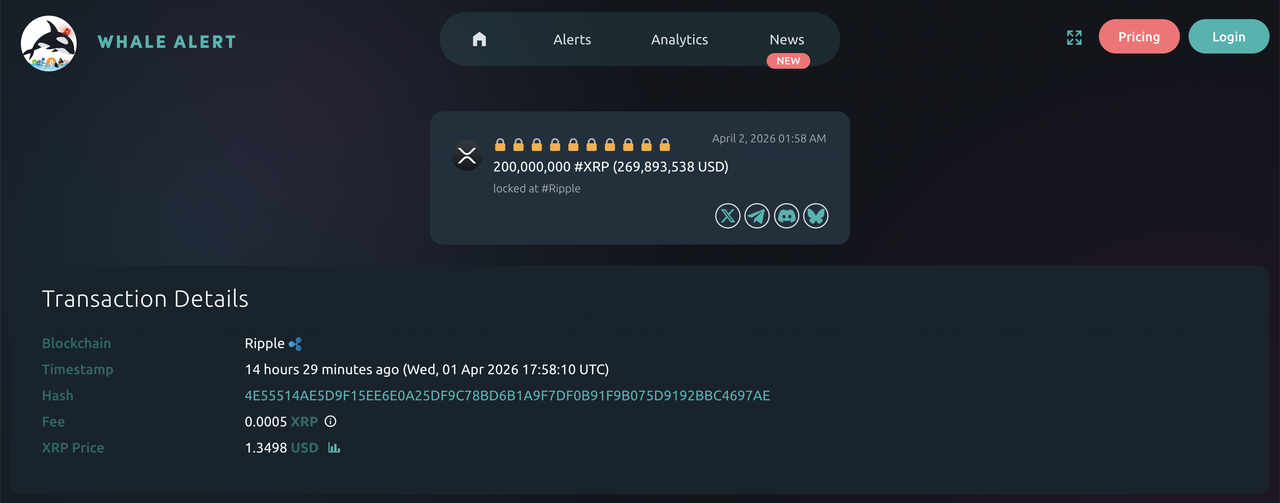
Whale Alert's main positioning is real-time large transfer alerts rather than Rich List queries, but for Taiwanese users, it's an important supplementary tool for Rich List analysis. The Rich List can tell you who holds the most XRP, while Whale Alert tells you when these large addresses moved funds, how much they moved, and where they went. Using both together forms a complete monitoring framework of "static holding structure analysis" plus "dynamic fund flow monitoring."
For Taiwanese users who have set custom monitoring addresses, Whale Alert's paid API can set transaction notifications for specific addresses, providing real-time push notifications when a monitored Rich List address conducts transactions exceeding threshold amounts. While the free Telegram channel cannot set specific addresses, it pushes all XRP large transfers exceeding preset thresholds, and combined with Rich List knowledge to determine transfer party identities, it offers high practical value.
Whale Alert Key Features
- Real-time alerts for Rich List address movements: When large addresses on the Rich List conduct large transfers, Whale Alert pushes notifications within seconds, serving as real-time dynamic supplement to static Rich List analysis.
- Free Telegram subscription: Join @whale_alert_io channel without any setup, all XRP large transfers are pushed in real-time, can be used by determining address identities with Rich List knowledge.
- Paid version custom address alerts: Can set transaction notifications for specific Rich List addresses, suitable for advanced Taiwanese users wanting precise monitoring of specific large holders (such as specific anonymous whale addresses).
- Historical large transfer queries: Can query XRP large transfers within specific time periods, suitable for retrospective analysis of Rich List address behavior patterns before and after specific market events.
4. Rich-List.info
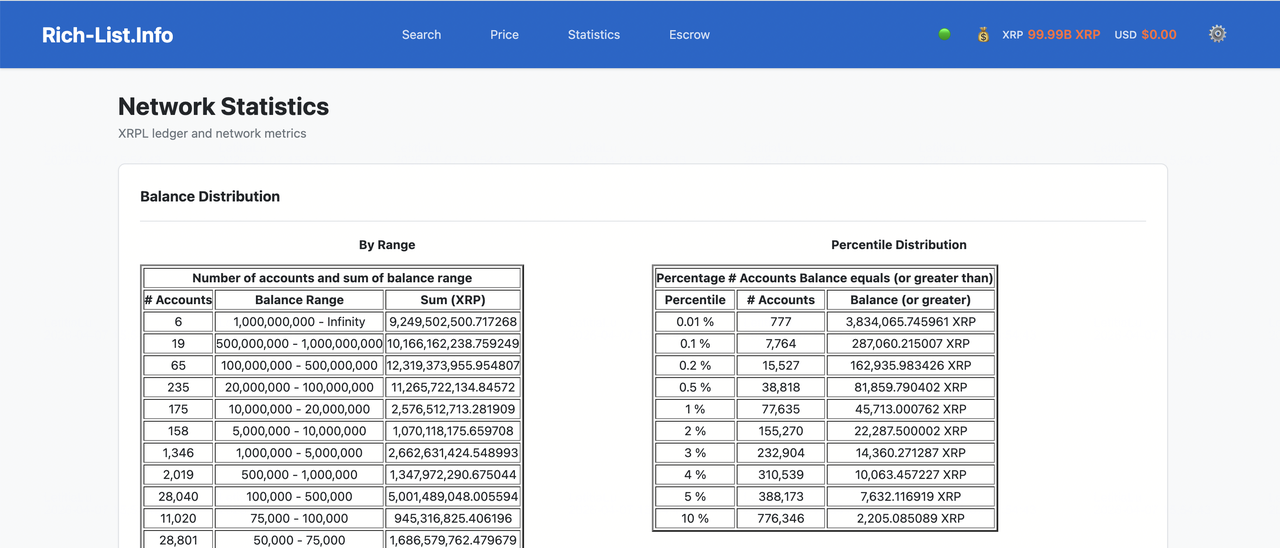
Rich-List.info is a monitoring tool specifically designed for XRPL Rich List, complementing XRPScan and Bithomp in functional positioning. The platform's core feature is grouped holding displays and balance change tracking, allowing viewing of address lists grouped by different holding levels (such as over 100 million tokens, 10-100 million tokens, etc.), enabling users to quickly filter holders of specific scales without manually screening through the complete Rich List. For Taiwanese users wanting direct access to "whale-tier address lists" or "large holder-tier address lists," Rich-List.info provides a more intuitive grouped entry point than XRPScan.
Rich-List.info also provides address balance change tracking functionality, allowing viewing of specific address holding increase/decrease trends over time periods, providing clearer historical perspective for determining whether a large address is continuously accumulating or gradually reducing holdings. While its label database completeness doesn't match Bithomp, as a supplementary tool for grouped queries and balance trend tracking, Rich-List.info fills the gap in tiered filtering functionality that XRPScan and Bithomp lack.
Rich-List.info Key Features
- Grouped display by holding tiers: Lists address groups by holding levels, directly filtering whales (100+ million tokens), large holders (10-100 million tokens) and other tiers, being the only free XRPL tool providing such intuitive grouped views.
- Address balance change tracking: Can view specific address holding increase/decrease trends over time periods, providing clearer directional judgment basis than XRPScan's single-point snapshots.
- XRPL native data: Reads data directly from XRP Ledger with reliable accuracy and update frequency similar to XRPScan.
- Completely free: No account required, all grouped query and tracking features are free, serving as an effective supplement to the free combination of XRPScan and Bithomp.
5. Nansen (Advanced XRP Whale Activity Monitoring)
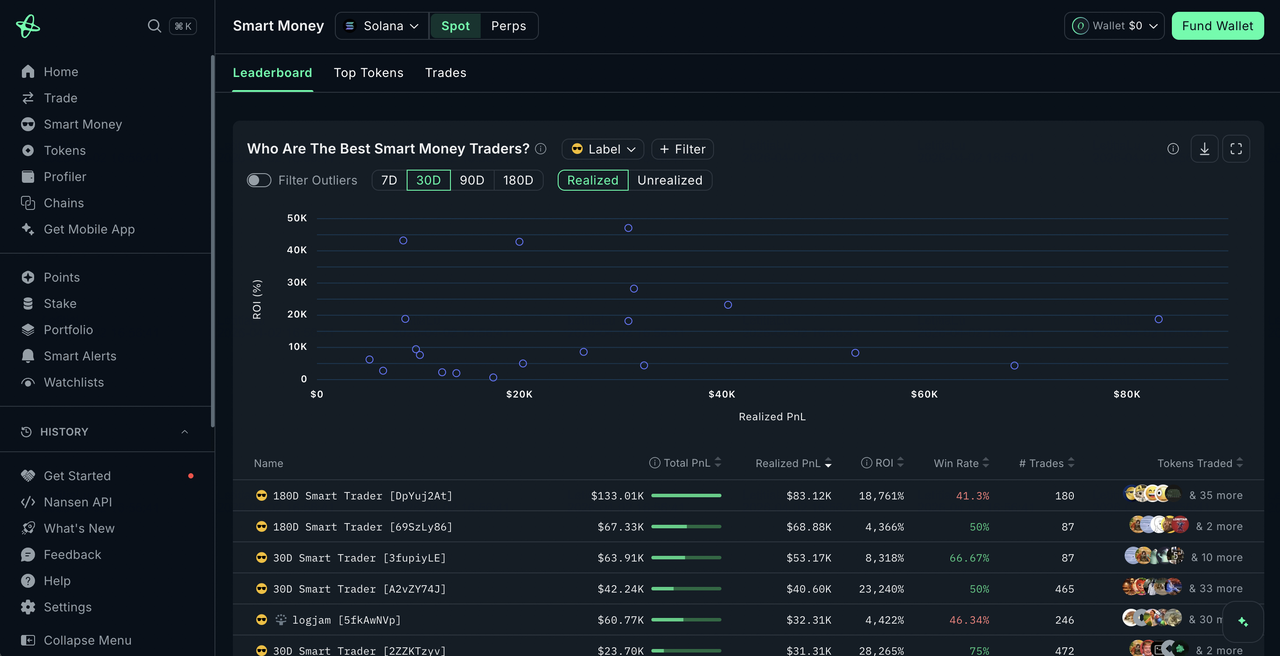
Nansen is an institutional-grade on-chain data platform known for its analytical capabilities on EVM chains (Ethereum and compatible chains), providing "Smart Money" tracking and extensive address labeling. However, Nansen's native support for XRP Ledger is quite limited, with the platform itself not providing XRPL Rich List functionality, and most XRP-related in-depth on-chain analysis tools remain underdeveloped. If Taiwanese users need to query XRP Rich List, track large holding addresses, or monitor holding distributions, the free combination of XRPScan, Bithomp, and Rich-List.info is far more suitable than Nansen. Nansen's reference value for XRP investors is currently mainly limited to observing whether broad market Smart Money is increasing XRP-related exposure, rather than direct XRPL Rich List analysis, and this feature requires paid subscription.
Nansen's Limitations for XRP Rich List Analysis
- No native XRPL Rich List: Nansen's strength lies in EVM chains and doesn't directly support XRP Ledger holding ranking queries. Taiwanese users needing Rich List functionality should use XRPScan or Rich-List.info.
- Limited XRP on-chain analysis features: Nansen's current XRP address label coverage is far lower than its performance on Ethereum. Bithomp is more professional and completely free for XRPL address labeling.
- Primarily paid subscription: Nansen's XRP-related features require paid subscription, but the XRP-specific functionality provided doesn't match free native XRPL tools in cost-effectiveness for Taiwanese individual users.
XRP Rich List Tracking Tools Comparison
|
Tool |
Rich List Query Capability |
Holdings Classification/Filtering |
Address Label Completeness |
Dynamic Monitoring/Alerts |
Cost |
|
XRPScan |
Supported (native ledger, most accurate data) |
Manual filtering |
Basic labels |
None |
Completely free |
|
Bithomp |
Supported (with address label display) |
Manual filtering |
High (most comprehensive) |
None |
Completely free |
|
Supported (holding tier display) |
Grouped filtering (built-in) |
Basic labels |
None |
Completely free |
|
|
Whale Alert |
No Rich List provided |
Not applicable |
Basic labels |
Telegram real-time push/API |
Free/Paid |
|
Nansen |
No XRPL Rich List support |
No XRPL support |
Primarily EVM chains, limited XRP support |
Advanced fund flows/Smart Money (paid) |
Primarily paid |
How Do XRP Whales Affect Price? Large Holder Flows and XRP Price Impact Explained
High Rich List ranking doesn't necessarily mean greater market price influence. Actual impact degree requires comprehensive assessment of holding scale, address nature, historical behavior, and market liquidity factors. The following are core dimensions for evaluating XRP large holder influence:
1. Holdings as Percentage of Circulating Supply: Basic Impact Indicator
XRP's current circulating supply is approximately 60.9 billion tokens. If a single address holds 1 billion XRP, it represents about 1.6% of circulating supply. Such holdings inherently possess potential market influence, but actual impact depends on selling pace. Concentrated sales within short timeframes will significantly amplify pressure on prices and liquidity, especially during low trading volume periods.
2. Address Historical Activity: Determines Market Interpretation
Market reactions differ dramatically between address types. Long-dormant large addresses showing fund movements are usually interpreted as potential sell-off signals, triggering market volatility; conversely, continuously active market makers or trading-related addresses see their fund flows mostly as routine operations with relatively limited market impact. In practice, low-activity but large-holding addresses deserve priority attention.
3. Address Nature: Key Determinant of Influence
Same holding sizes can have completely different market influence depending on address types. Ripple escrow account releases have highly predictable mechanisms that markets usually price in advance; exchange addresses mostly represent collections of user assets, with balance changes not representing unidirectional trading. In contrast, unlabeled large anonymous addresses, particularly those holding 500 million to 1 billion+ tokens with long-term low activity, are more easily viewed by markets as potential selling pressure sources once transfer activity occurs.
4. Market Liquidity: Amplifies or Cushions Price Impact
Same-scale fund movements have significantly different impacts under varying liquidity environments. When market trading volume is sufficient with higher order book depth, large transactions have relatively limited price impact; conversely, during low liquidity periods, prices are more prone to obvious volatility. Using Taiwan time (UTC+8) as example, daytime usually corresponds to active Asian market periods with better liquidity; while late night to early morning (after US East Coast market close), liquidity is relatively low, making large transfers more likely to amplifyslippage effects.
How to Monitor XRP Rich List: Best Workflow and Tool Combinations
For XRP holders in Taiwan, the following is a practically executable Rich List monitoring process that combines free tools with BingX's market tracking features, requiring no paid subscriptions to establish effective monitoring habits.
- Create Watchlist (Focus on Potential Market-Oriented Whales): Visit XRPScan Rich List page, browse top 100 addresses, and cross-reference with Bithomp for address labels. After excluding Ripple escrow accounts and exchange addresses, select 5-10 addresses marked as "unknown" large addresses as core long-term tracking targets.
- Subscribe to Whale Alert (Real-time Large Transfer Monitoring): Join Telegram channel @whale_alert_io, all XRP large transfers exceeding thresholds are pushed in real-time. After receiving notifications, quickly cross-reference with watchlist to determine if key addresses have fund anomalies.
- Regular Address Activity Checks (Observe Unusual Changes): Recommend checking watchlist addresses at least weekly through XRPScan to view "recent activity time." If long-term low-activity addresses show transactions, investigate transaction details and fund flows further.
- Combine with BingX Price Alerts (Integrate Market Quotes): Set XRP/USDT key price range alerts on BingX. When on-chain large fund anomalies occur while prices simultaneously reach important levels, use as cross-validation basis rather than single-signal decision-making.
- Maintain Behavioral Records (Accumulate Judgment Basis): Record watched addresses' fund flow directions (inflows or outflows to exchanges) and price positions at those times. As data accumulates, gradually establish specific whale behavioral patterns, improving future judgment stability and consistency.
How to Trade XRP on BingX: Complete Guide for Beginners
After confirming Rich List signals or whale movements, Taiwanese users can directly execute operations on BingX's XRP/USDT trading page. BingX provides a complete Traditional Chinese interface, from viewing quotes and setting alerts to placing orders, all can be completed on the same platform without switching tools.
If you don't have an account yet, you can first register for BingX, activate XRP spot and futures trading functions, then combine with whale monitoring tools for operations.
How to Buy XRP on BingX Spot Market (Lowest Fees)
Spot buying suits Taiwanese users wanting direct XRP ownership, with purchased XRP counted toward account balance, withdrawable to personal wallets anytime or transferable to MAX, BitoPro for TWD conversion.
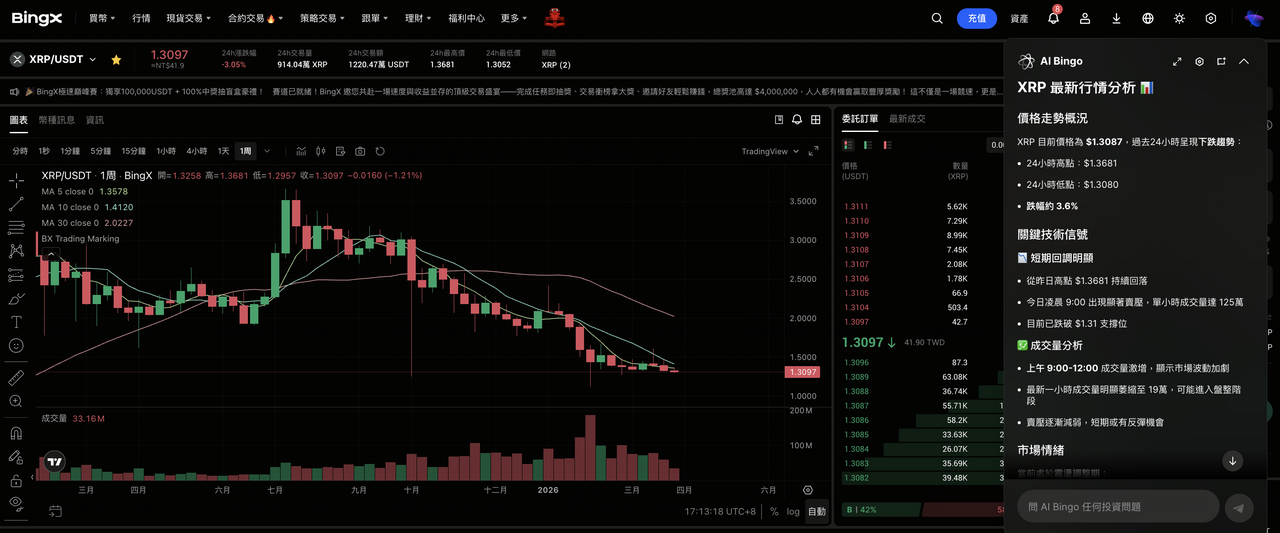
- Log into BingX and enter XRP/USDT spot page: Go to "Spot" trading page, search for XRP/USDT, confirm spot account has sufficient USDT balance. If not yet deposited, transfer in through deposit page, recommend choosing TRC-20 network to save fees.
- Confirm real-time quotes and order book depth: View current XRP/USDT quotes and order book, ensure bid-ask spreads are reasonable. In short timeframes after receiving Rich List anomaly signals, markets may experience brief liquidity volatility, recommend waiting for spreads to narrow before executing large trades.
- Select order type and place order: "Market orders" execute immediately at current best prices; "Limit orders" set target buy prices awaiting matching, both with same fees (0.1%). Enter XRP quantity or USDT amount, confirm fees and submit order.
- Set price alerts: Set key support and resistance level price alerts on XRP/USDT trading page. When whale signals and XRP prices simultaneously reach key positions, use as cross-confirmation basis for operations.
How to Long or Short XRP Perpetuals on BingX Futures
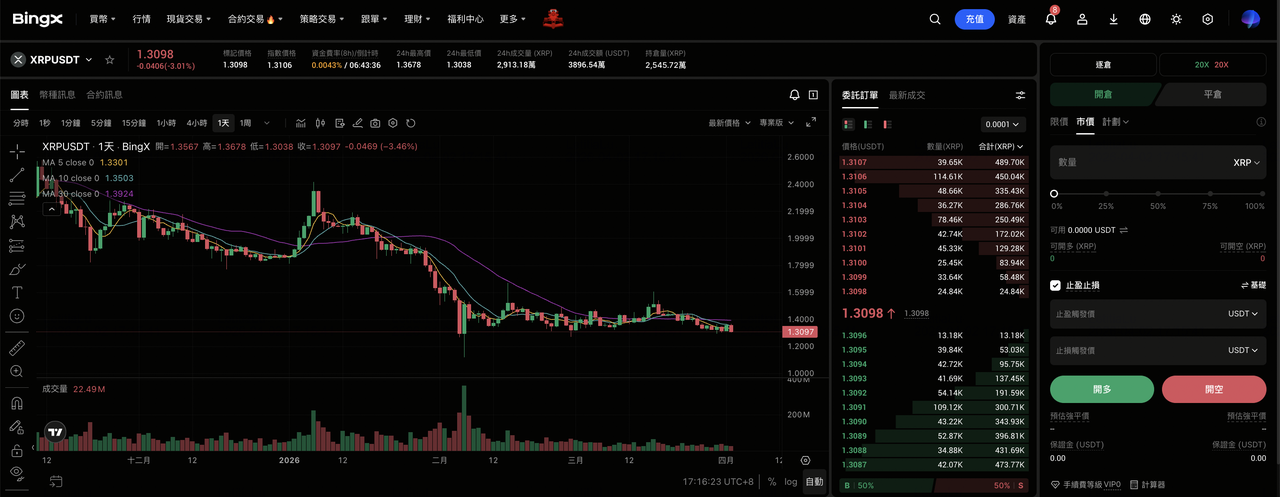
Perpetual futures suit users wanting to go long (expecting rises) or short (expecting falls) on XRP without actual ownership. When Rich List shows signals of large addresses concentratedly flowing into exchanges, some Taiwanese users choose futures shorting to hedge potential selling pressure risks. Futures fees are lower than spot but require attention to liquidation risks from leverage.
- Transfer USDT to futures account: On "Assets" page select "Fund Transfer," transfer USDT from spot account to futures account, with transferred amount being the margin ceiling for this trade.
- Go to XRP/USDT perpetual futures page: Select "Perpetual Futures," enter XRP/USDT trading pair, confirm current quotes and order book depth.
- Set leverage multiplier: Choose leverage based on personal risk tolerance. Rich List signal directional uncertainty is usually high, recommend using lower leverage (3-5x) to avoid excessive losses from signal misjudgment.
- Select long or short and place order: Choose "Buy Long" or "Sell Short," enter order quantity, confirm margin, fees, and estimated liquidation price before submitting.
- Set stop loss and take profit: After opening position, immediately set Stop Loss and Take Profit on positions page for automatic closure when conditions are met. Rich List signals often involve short-term volatility, making stop loss settings particularly important.
How to Use the XRP Rich List Effectively: 5 Common Mistakes and Pro Reading Tips
When using the XRP Rich List for analysis, be aware of the following common interpretation points to avoid judgment issues due to incomplete understanding of on-chain data:
- Exchange address balances don't represent institutional positions: Top Rich List addresses from Binance, Bithumb and other exchanges mostly hold collections of user assets, not representing the exchanges' own trading directions. Balance changes usually reflect deposit/withdrawal fund flows rather than institutional buying/selling behavior.
- Geographic distribution cannot be precisely determined: While some addresses can be geographically inferred through labels indicating exchange locations (like Korea or Japan), for most personal or anonymous addresses, currently no tools can precisely group by region, with related information mostly indirect speculation.
- Rich List represents static data, needs dynamic observation: Rich Lists show holding status at specific time points, cannot directly reflect fund change trends. To determine if large holders are accumulating or distributing, compare balance changes across different time points or combine with tools like Whale Alert to observe fund flows.
- Holding duration difficult to directly quantify: While long-term holders can be inferred through account creation times or historical activity, currently no public tools can directly sort by "holding days," requiring further interpretation through transaction records for related analysis.
- Tools can be used in functional combinations: XRPScan, Bithomp, Rich-List.info, and Whale Alert respectively provide holding rankings, address labels, and fund flow observations among different functions. Combined use forms complete Rich List analysis processes; for further data integration or multi-chain observation needs, other analysis tools can be added as appropriate.
Conclusion
The XRP Rich List provides a direct entry point for understanding market holding structures, but its value lies not in rankings themselves, but in how to interpret the fund behaviors behind them. The key is distinguishing different address types' natures, understanding which fund movements might impact markets and which are routine asset management. Only with this foundation does Rich List data have actual reference value, avoiding misinterpretation of general fund flows as market directional signals.
In practical application, through the combination of XRPScan, Bithomp, Rich-List.info, and Whale Alert, one can simultaneously grasp holding distributions and fund flows, establishing stable and sustainable observation methods; further combined with BingX's XRP/USDT real-time quotes and price alerts, on-chain signals and market changes can be integrated into the same workflow, making connections between observation, judgment, and execution smoother. Through continued recording and experience accumulation, understanding of specific addresses and fund behaviors gradually deepens, helping make relatively stable judgments during market volatility.
Extended Reading
- How to Track XRP Whale Activity in 2026? On-Chain Data Tools and Market Signals Guide
- Who Holds the Most XRP in 2026? Top 10 XRP Rich List Revealed
- Top 10 XRP Wallet Recommendations for 2026: Which Ripple Wallet is Most Secure?
- What is XRP Cloud Mining and How to Earn Rewards? (2026)
- Chris Larsen's Net Worth in 2026? Ripple Co-Founder's Asset Overview
- XRP Whale Monitoring Tool Recommendations (2026): Complete Guide to Large Transfer, On-Chain Data & Whale Tracking for Taiwan Users
