
In the XRP market, asset movements by a small number of large holding addresses (commonly known as "whales") often have a significant impact on short-term price trends. When large amounts of XRP are transferred to exchanges, the market typically interprets this as potential selling pressure; conversely, asset outflows from exchanges may represent a tendency toward long-term holding or asset reallocation. For XRP holders and traders in Taiwan, being able to promptly track these large capital movements often affects the judgment of entry and exit timing.
XRP operates on the XRP Ledger (XRPL), a blockchain promoted by Ripple that is renowned for its high efficiency, with transaction confirmation times of approximately 3 to 5 seconds and transaction fees of about 0.00001 XRP per transaction. All transaction records are publicly accessible, providing high transparency for on-chain data and making large capital flows easier to track and analyze. Compared to other public blockchains, whale behavior in XRP is more easily captured in real-time, offering more direct reference value for market observation.
This article will compile currently popular XRP whale monitoring tools, covering functions such as large transaction alerts, address holding changes, activity analysis, and capital flow inquiries, and explain the differences and applicable scenarios of various tools in practical use, helping to establish a more systematic approach to on-chain observation.
Key Takeaways
- The XRP Ledger's public ledger allows all large transfers and holding changes to be queried in real-time, with transparent and verifiable data, making whale monitoring relatively reliable without relying on additional calculations.
- Whale Alert is currently the most commonly used real-time alert tool for large transfers, allowing threshold-based Telegram or Twitter notifications, suitable as a first-layer monitoring entry point to quickly grasp market movements.
- XRPScan, as the native XRPL blockchain explorer, provides address activity records, rich lists, and ledger data, suitable for further querying the source and destination of funds for specific addresses.
- Bithomp provides address labels and holding rankings, enabling identification of exchanges, institutions, and personal wallets, which is more helpful in understanding the possible intentions behind large transfers.
- BingX provides real-time XRP/USDT quotes and price alert functions. After receiving whale alerts, users can directly check market changes and execute trades, allowing observation and operations to be completed on the same platform.
What Is Ripple (XRP)? Use Cases, How It Works, and Market Characteristics
XRP is a cryptocurrency launched by Ripple Labs in 2012, with the core design goal of serving as a "cross-border payment bridge asset" between global financial institutions. Simply put, XRP's role is not merely as a digital currency, but as an intermediary tool to improve the efficiency of capital flows between different countries and currencies. Unlike Bitcoin, which generates new coins through mining, XRP was pre-generated with a total supply of 100 billion coins at inception, which Ripple gradually releases into the market. This supply mechanism makes XRP's circulation rhythm and market supply significantly different from typical cryptocurrencies.
XRP operates on the XRP Ledger (XRPL), a distributed ledger with highly efficient transaction characteristics. Each transaction takes an average of 3-5 seconds to complete settlement, with extremely low fees (approximately 0.00001 XRP), making it superior to most mainstream public blockchains in both speed and cost. Therefore, it has long been considered one of the most suitable crypto assets for high-frequency, small-amount cross-border payments. From a market perspective, XRP has consistently maintained a position in the top ten cryptocurrencies by market cap, but its price movements have distinct event-driven characteristics. For example, Ripple's escrow release mechanism, regulatory progress with the US SEC, and partnership news with financial institutions often affect market sentiment. For Taiwanese users, they can trade XRP/USDT spot andperpetual contracts through BingX, combining on-chain information with real-time market data to more effectively grasp market rhythm.
Who Are the Most Notable XRP Whales?
Understanding the major whales in the XRP market is key to correctly interpreting on-chain large transfers. Compared toBitcoin andEthereum, XRP's holding structure is more concentrated, with the top addresses having substantial influence on market circulation. Therefore, when observing whale signals, besides the amount size, it's more important to identify "which type of holder is moving funds." The following summarizes the most representative XRP whale types in the current market and their holding scales, helping to quickly judge the market significance behind large transfers.
- Ripple Labs (approximately 33.9 billion XRP, about 33.9% of total supply): The largest XRP holder, with most assets locked in escrow accounts. Up to 1 billion XRP is unlocked on the 1st of each month, with typically about 70%-80% (approximately 700-800 million) re-locked, resulting in a net monthly market inflow of about 200-300 million XRP. Such operations frequently trigger whale alerts but are part of regular scheduled releases.
- Chris Larsen (approximately 2.5-2.7 billion XRP, about 4%-5% of total supply): Chris Larsen is Ripple's co-founder and executive chairman, one of the known individual whales with the largest holdings. His addresses were previously associated with a security incident involving approximately 213 million XRP, but overall holdings remain at high levels, with his movements often viewed as important market indicators.
- Brad Garlinghouse (estimated hundreds of millions to billions of XRP, proportion undisclosed): Ripple's current CEO, with holdings distributed across multiple wallet structures without clear public data. The market generally considers him a long-term holder, with address movements rarely interpreted as short-term trading signals.
- Centralized Exchanges (single platform approximately 1-1.8 billion XRP, about 1%-2%+): XRP held by exchanges is mostly user assets, with platforms like Binance and Bithumb each holding approximately 1.8 billion, while SBI Holdings holds XRP worth over $10 billion. Large transfers between exchanges are usually internal adjustments and don't represent market trading; however, if unknown addresses continuously transfer XRP to exchanges, it may represent potential selling pressure.
- Large Anonymous Addresses (single address commonly >1 billion XRP, about 1%+): Multiple large unmarked addresses exist in the rich list, possibly from early investors or institutional funds. These addresses are usually inactive for long periods, and when large transfers to exchanges occur, markets often interpret them as potential selling signals, making them one of the most important observation targets in whale monitoring.
- Jed McCaleb (historical holding of approximately 9 billion XRP, fully sold by 2022): One of XRP Ledger's early founders who later left Ripple to create Stellar (XLM), through a planned selling program lasting approximately 10 years, he cashed out approximately $3.2 billion in total. His "tacostand" wallet was a long-term source of market selling pressure but no longer affects market supply structure.
Extended Reading: Who Holds the Most XRP in 2026? Top Ten XRP Rich List Revealed
How to Read XRP Whale Activity: 4 Key Indicators and Signal Interpretation
Before introducing various tools, understanding the most important observation indicators when tracking XRP whales and the possible market implications behind different signals helps avoid common misinterpretations and makes tool usage more targeted.
- Large Transfer Direction: Large amounts of XRP transferred from non-exchange wallets to exchanges are usually viewed as potential selling pressure, as funds entering exchanges are often precursors to selling; conversely, outflows from exchanges to personal cold wallets mostly represent holding or asset transfers. However, direction alone is insufficient for complete judgment; it needs to be analyzed together with current price levels. For example, large inflows to exchanges at high price levels usually indicate clearer selling pressure signals; if occurring at low levels after significant drops, it may just be fund adjustments between exchanges rather than preparation for selling. The ability to identify address attributes (exchange or personal wallet) directly affects judgment accuracy.
- Rich List Holding Changes: Observing changes in XRP holdings of the top few hundred addresses can determine whether assets are concentrating or distributing. When holding concentration increases, it usually represents large holders accumulating; conversely, if holdings gradually disperse, it may indicate gradual exits or asset reallocation. However, note that top rankings often include exchange cold wallets, market makers, and project accounts, whose changes don't necessarily reflect market behavior. In actual interpretation, priority should be given to unmarked or individual large holding addresses.
- Address Activity Changes: Including transaction frequency, recent activity time, and capital inflow/outflow frequency. Large addresses that have been inactive for long periods often attract market attention when they resume transactions, especially in cases that have previously affected prices. Interpretation should consider the address's holding scale; if it represents a high proportion of circulating supply, market reactions are usually faster and more significant, making it more worthwhile to track complete transaction records.
- On-Chain Net Inflows and Outflows: This is an observation indicator that integrates multiple large transfers, better reflecting overall capital flows than individual transactions. When multiple large addresses simultaneously transfer XRP to exchanges, net inflow data usually shows significant increases, representing increased potential selling pressure; conversely, if continuous net outflows occur, it indicates assets are moving from exchanges to personal wallets, reducing available circulating supply for sale in the market, which tends to be bullish under stable demand. The focus of such indicators is on trend changes rather than values at single time points.
Top 5 XRP Whale Monitoring Tools for Real-Time Tracking of Large Holder Fund Flows
1. Whale Alert
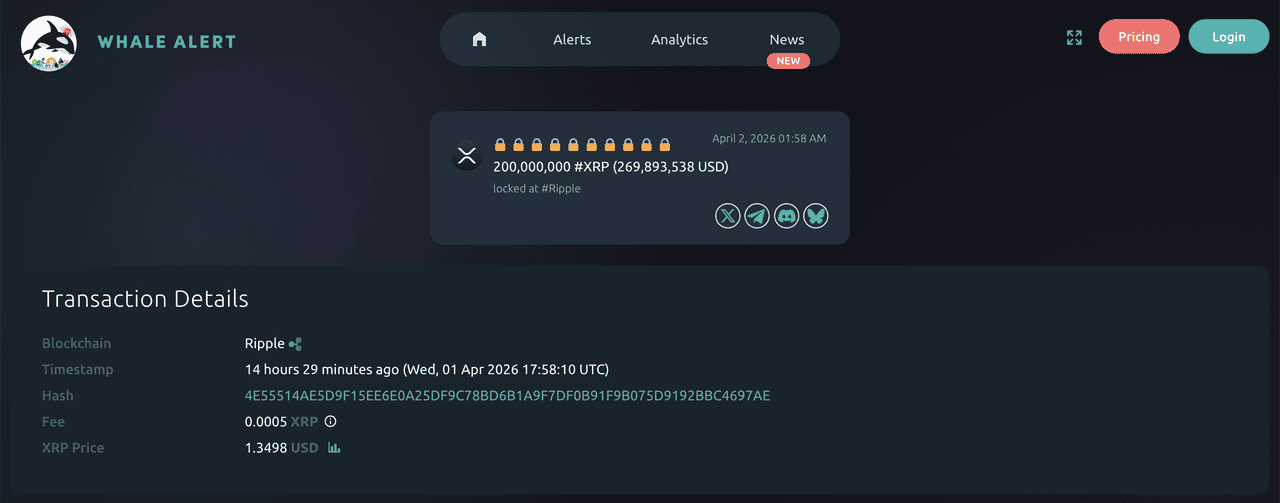
Whale Alert is currently the most widely used cross-chain large transfer real-time alert service, with comprehensive support for XRP, covering all large transfer records on XRPL that exceed set thresholds. The platform's Twitter (X) account and Telegram channel send notifications within seconds after large XRP transfers occur, with clear formatting showing transfer amounts, sender address type (such as "unknown wallet" or "Coinbase"), and receiver address type, allowing users to promptly track large holder movements without manually checking the ledger.
For Taiwanese users, subscribing to Whale Alert's Telegram channel is the lowest barrier entry point for XRP whale monitoring, requiring no active querying, with large transfer notifications pushed directly to mobile phones. Whale Alert also offers paid API services that allow custom threshold settings (such as receiving notifications only for transfers exceeding 5 million XRP), filtering out noise from numerous small transfers, suitable for advanced users who want precise monitoring of transfers above specific scales.
Whale Alert Key Features
- Real-Time Large Transfer Alerts: Notifications sent within seconds of large XRP transfers, including transfer amounts, sender address labels, and receiver address labels, making it the fastest tool for tracking large holder movements.
- Telegram Push Notifications: Taiwanese users can directly join Whale Alert's Telegram channel without installing additional apps, with large transfer notifications delivered directly to phones, suitable for daily background monitoring.
- Address Type Identification: Each transfer is labeled with address types (exchange, institution, unknown wallet, etc.), allowing users to directly judge whether fund direction has market significance rather than just looking at transfer numbers.
- Historical Large Transfer Query: The website provides searchable historical large transfer records, allowing queries of large XRP transfers within specific time periods, suitable for retrospective analysis of large holder movements before and after specific market events.
- Paid API Custom Thresholds: Custom amount thresholds can be set to filter out noise, receiving notifications only for transfers exceeding specific scales, suitable for advanced users with precise monitoring needs.
2. XRPScan
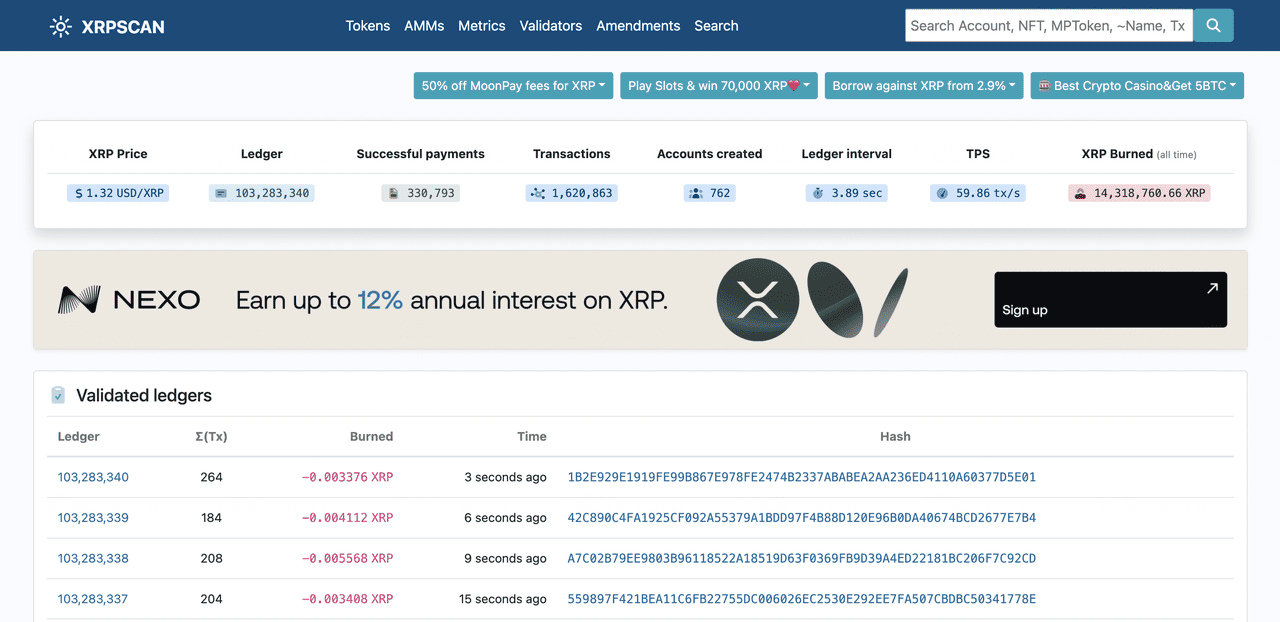
XRPScan is a native blockchain explorer built specifically for XRP Ledger, directly reading data from XRPL nodes and providing ledger-level query capabilities. The platform can view complete transaction records, balance changes, account creation time, and recent activity status for any address, also covering overall network ledger statistics and operational conditions. For scenarios requiring deep tracking of specific large addresses, XRPScan is one of the tools closest to original data sources.
Unlike some public blockchains, the XRP ecosystem doesn't have a fixed and official "rich list" page. In practice, most analysis relies on address queries and third-party tools to observe large address holdings and changes rather than directly browsing rankings. Therefore, XRPScan is more suitable as a "verification and extended analysis" tool: after discovering large transfers or specific addresses, return to XRPScan to query complete transaction history, confirming fund sources and destinations, such as whether they flow to exchanges or other large wallets. This "address-centric" query approach also makes XRPScan a key supplement after real-time alert tools like Whale Alert, used to clarify actual capital flows behind individual large transfers.
XRPScan Key Features:
- Complete Address Transaction History: Query all transaction records for any address, including time, amount, counterparty address, and transaction type, suitable for tracking complete fund flow trajectories.
- Balance and Activity Status Query: Shows current balance, account creation time, and recent activity time for addresses, helping judge whether addresses are long-term active or recently active.
- Ledger Statistics and Network Overview: Provides real-time XRPL ledger closing speed, transaction volume, active account numbers, and fee changes, allowing observation of overall network activity.
- Address Label Identification: Provides labels for some known exchange and institutional addresses, enabling quick identification of fund destinations in transaction records.
- Free Usage: All functions are directly accessible without account registration, making it one of the basic tools for querying XRP on-chain data.
3. Bithomp
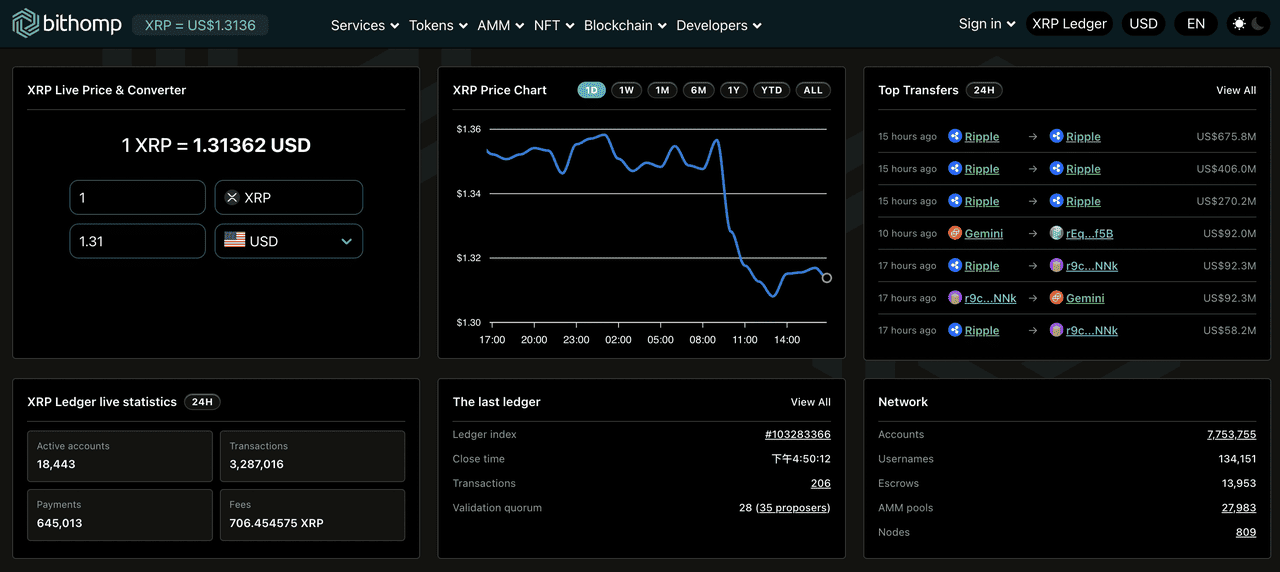
Bithomp is another blockchain explorer designed specifically for XRP Ledger, particularly useful in "address labeling and identity identification." The platform maintains a comprehensive address label database covering most mainstream exchanges (such as BingX, Kraken, Coinbase, etc.), institutions, and some market maker wallets. When large transfers occur, Bithomp helps quickly identify whether funds are flowing to exchanges, institutions, or unknown wallets, making judgments closer to actual scenarios rather than just focusing on transfer amounts.
Compared to simply viewing transaction records, Bithomp's value lies in "adding context to addresses." For example, when observing large holding distributions, the platform displays labels for some known addresses, allowing people to distinguish which belong to exchanges or institutional accounts and which might be unmarked large individual holdings. This is particularly important in interpreting the XRP market because Ripple itself holds large amounts of XRP and manages supply through escrow and regular release mechanisms. Through label identification, such expected asset releases can be avoided being misinterpreted as market selling. In practical use, Bithomp is often paired with XRPScan: the former for quickly identifying address nature, the latter for tracking complete transaction paths, combining both for more effective reconstruction of capital flow patterns.
Bithomp Key Features:
- Address Label Database: Covers most mainstream exchanges, market makers, and institutional XRP address labels, making it the most practical tool for judging the identity of large transfer parties, particularly crucial for identifying exchange inflows and outflows.
- Ripple Address Tracking: Labels some Ripple-related escrow and release addresses, distinguishing normal release mechanisms from market selling, avoiding misinterpretation of large transfer signals.
- Large Address Holding Observation: While lacking a fixed rich list page, it enables observation of large holding distributions through address data and labels, identifying differences between institutions and unmarked addresses.
- Address Transaction History Query: Can query complete transaction records for any address, combined with label information, helping more efficiently track capital movements.
- Free Usage with Intuitive Interface: Core functions are free with clear query processes, allowing quick basic interpretation even without on-chain experience.
4. Nansen
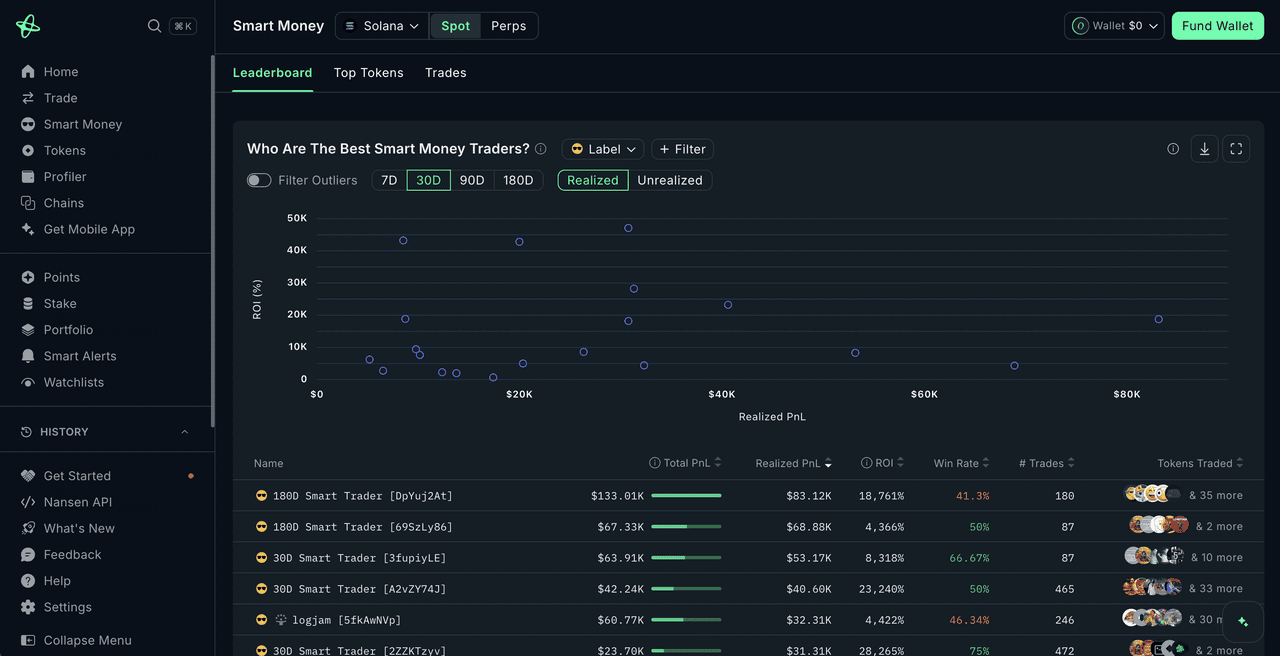
Nansen is an on-chain data analysis platform oriented toward institutions and professional users, significantly different from general blockchain explorers in data organization and signal extraction capabilities. Compared to XRPScan and Bithomp's focus on individual address queries, Nansen emphasizes organizing and grouping large amounts of on-chain data, transforming it into directly interpretable market signals, such as capital flow trends or behavioral patterns of specific address types.
For XRP applications, Nansen's core value lies in "aggregated analysis." Through labeling systems and data models, the platform can categorize different addresses into specific roles (such as trading funds or long-term holders) and observe behavioral changes of these groups across different price ranges. For example, when multiple large addresses show accumulation or reduction activities within similar timeframes, such signals usually have more reference value than individual large transfers.
However, most of Nansen's advanced features require paid subscriptions, with limited data available in the free version. For scenarios just beginning on-chain analysis, it's usually better to start with XRPScan and Bithomp; if more systematic capital flow observation and strategy analysis is needed, then Nansen becomes more suitable.
Nansen Key Features
- Smart Money Tracking: Identifies and tracks wallet addresses with outstanding historical trading performance, also applicable to XRP, allowing observation of whether these addresses continue accumulating or reducing at specific price ranges.
- Capital Flow Aggregated Analysis: Provides cross-address XRP on-chain net inflow and outflow trends, better reflecting overall large holder behavior than individual large transfers, suitable for judging whether capital is concentrating for entry or gradually exiting.
- Address Label Database: Broad label coverage including institutions, market makers, and some contract addresses, helping improve accuracy in interpreting fund sources and purposes.
- Mainly Paid Subscription: Most in-depth features require payment, with limited free version query scope, more suitable for scenarios that have already incorporated on-chain data into daily judgment.
5. CoinMarketCap and CoinGecko XRP Pages
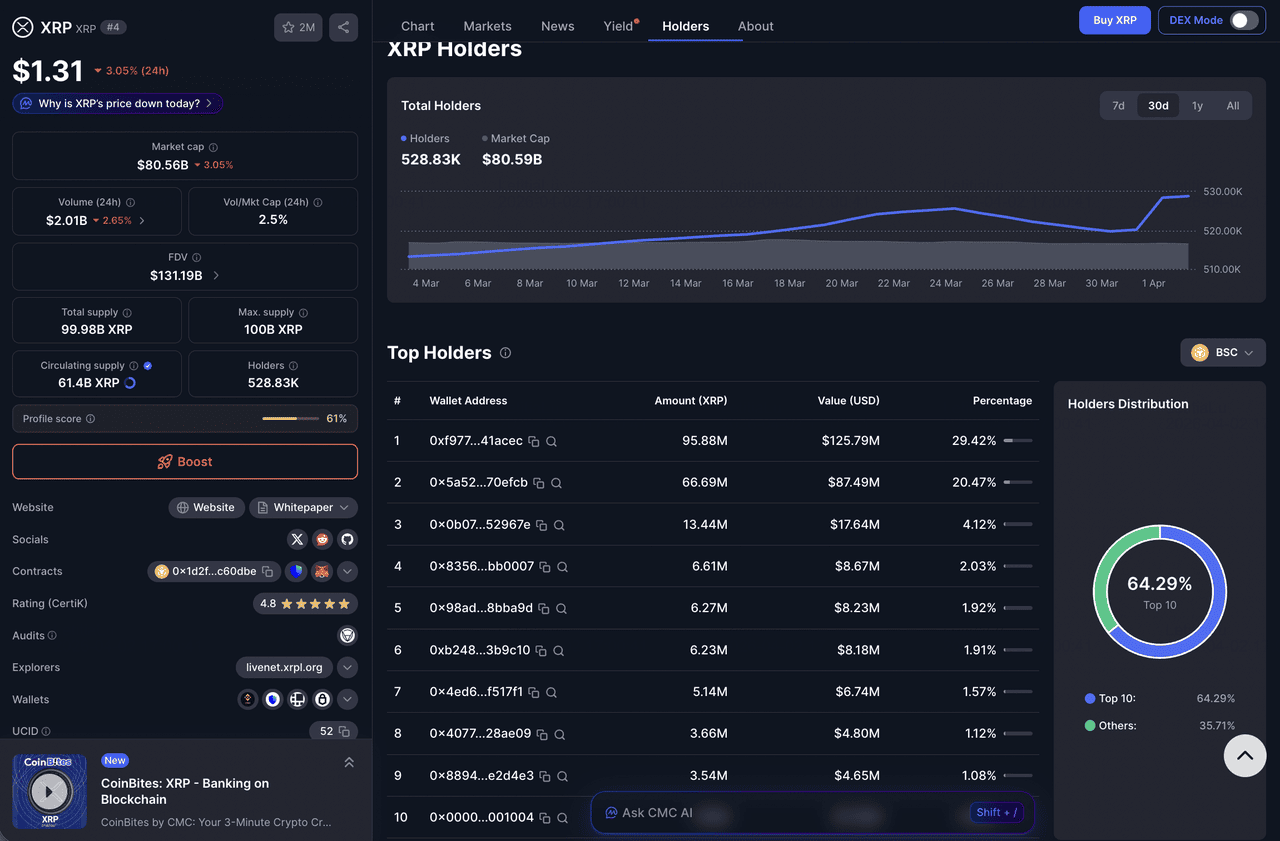
While CoinMarketCap and CoinGecko's XRP coin pages are not specialized whale monitoring tools, they provide on-chain overview data with practical value for Taiwanese users. Both platforms integrate XRP network activity indicators, such as active address counts, on-chain transaction volume, and some large transfer information, allowing users to quickly judge whether abnormal market changes have occurred without entering professional on-chain tools. For Taiwanese users who only need macro observation without tracking individual addresses, these pages serve as the most accessible entry points.
In practical use, these two platforms are more suitable as "first-layer filtering tools." When data shows abnormal changes, such as significantly increased transaction volume or active addresses, further detailed queries can be conducted using Whale Alert, XRPScan, or Bithomp to establish a more complete interpretation process.
CoinMarketCap / CoinGecko XRP Page Key Features:
- On-Chain Activity Overview: Shows XRP's 24-hour active address count and on-chain transaction volume changes. When data shows abnormal increases, it usually indicates market events or increased large holder activity, suitable as a basis for judging whether further analysis is needed.
- Large Transfer Related Data: Some pages integrate large transfer information or statistics, allowing Taiwanese users to quickly grasp recent large holder activity levels as preliminary observation indicators.
- Exchange Holding Trends: Some data from third-party integrations shows changes in exchange XRP reserve amounts, useful for judging whether capital is concentrating inflows or outflows from exchanges.
- Completely Free with Low Barrier: No setup or registration required for use, suitable for Taiwanese users just beginning to explore on-chain data as an introduction, then using other tools for deeper analysis as needed.
Full XRP Whale Monitoring Tool Comparison
|
Tool |
Core Function |
Real-Time Alerts |
Rich List / Holding Observation |
Address Labels |
Cost |
|
Whale Alert |
Real-time large transfer alerts |
Supported (Telegram / Twitter) |
Not provided |
Basic (exchange labels) |
Free / Paid API |
|
XRPScan |
XRPL native explorer, address queries |
Not provided |
Supported (via address queries) |
Partial labels |
Completely free |
|
Bithomp |
Address label identification, holding observation |
Not provided |
Supported (via addresses & labels) |
Most comprehensive |
Completely free |
|
Nansen |
Smart Money tracking, capital flow aggregated analysis |
Partially supported |
Supported (aggregated data) |
Industry's broadest |
Mainly paid subscription |
|
CoinMarketCap / CoinGecko |
On-chain activity and market overview |
Not provided |
Not provided |
Not provided |
Completely free |
How to Use XRP Whale Signals to Trade on BingX: Tracking and Trading Guide
Whale monitoring tools provide on-chain signals, but actual trading still needs to be completed on exchanges. When markets show large transfers or capital movements, being able to instantly correlate price and market reactions is key to judging whether signals have operational value. BingX provides XRP/USDT spot and perpetual contracts, along with Traditional Chinese interface and auxiliary tools, allowing Taiwanese users to complete observation, judgment, and operations within the same workflow.
If you don't have an account yet, you can register for BingX first, activate XRP spot and contract trading functions, then combine with whale monitoring tools for operations.
1. Set Up Dual Whale and Price Alerts: Subscribe to Whale Alert's Telegram notifications (@whale_alert_io) to receive XRP large transfer alerts, while setting XRP/USDT price alerts on BingX. When on-chain capital movements and price touching key levels occur simultaneously, they can serve as cross-reference indicators.
2. Confirm Fund Direction After Receiving Alerts: Whale transfers need to first determine fund direction. Inflows to exchanges usually represent potential selling pressure, while outflows tend toward holding. If address types are unclear, use Bithomp or XRPScan to check labels and further confirm signal reliability.
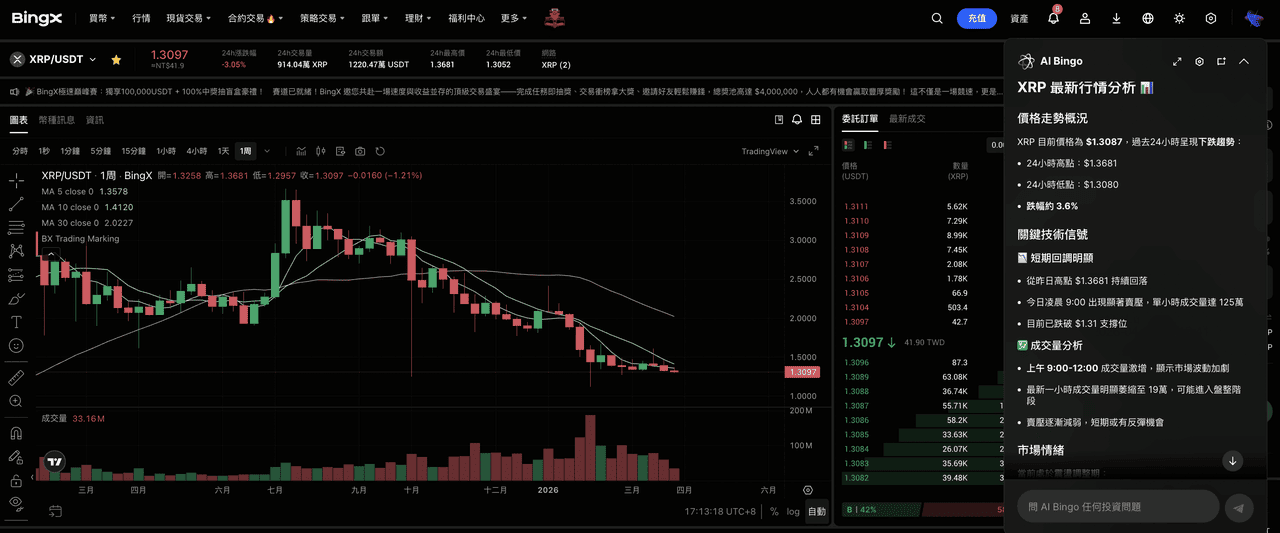
3. Check Market Conditions and AI Assistance on BingX: After entering the XRP/USDT trading page, first observe price, volume, and percentage changes. BingX has built-in TradingView charts that can be used with technical indicators; you can also refer to BingX AI analysis information to quickly organize market trends and key data as auxiliary judgment references.
4. Buy XRP Through Spot Trading: If choosing direct holding, use XRP/USDT spot trading pairs on the "Spot Trading" page for purchases. Market orders can be filled immediately, while limit orders can set ideal entry prices, suitable for waiting for more favorable price ranges after whale signals appear.
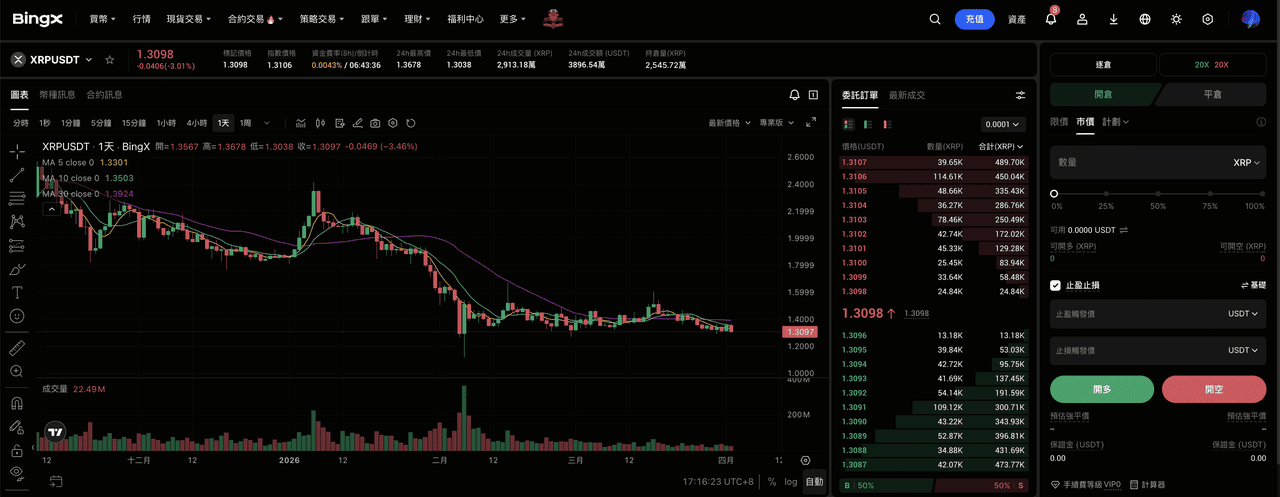
5. Use XRP Perpetual Contracts for Enhanced Trading Flexibility: If wanting to go long or short XRP, operate in the XRP/USDT perpetual contract market. Amplify exposure through leverage while setting stop-loss and take-profit conditions after opening positions, making strategy execution more disciplined. Suitable for use when whale signals align with price trend directions.
6. Observe Price Response Patterns and Manage Risk: After whale signals appear, prices may not react immediately and might show delayed or phased movements. When operating, observe trend continuation or reversal before deciding entry timing, while using stop-losses to control risk, avoiding impacts from single signal misjudgments.
How to Read XRP Whale Signals: 5 Common Misinterpretations and Tips
On-chain whale data can indeed provide valuable market references, but in practical use, there are several common misinterpretation scenarios that require special attention. For Taiwanese users, establishing correct interpretation habits is more important than simply receiving signals.
- Large Transfers Don't Equal Imminent Selling: XRP transferred to exchange addresses might indicate preparation for selling, but could also just be asset organization, cross-platform transfers, or token swapping operations. The same transfer can have completely different meanings under different circumstances. It's recommended to interpret together with address historical behavior, current price levels, and other indicators rather than just looking at the transfer itself.
- Ripple's Regular Unlocks Are Easily Misinterpreted: Ripple holds large amounts of XRP and regularly releases them from escrow accounts according to established mechanisms. Such operations frequently trigger large transfer alerts but don't represent imminent market selling pressure. Using Bithomp to confirm address labels can quickly identify whether it's routine releases, avoiding overreaction.
- Single Tools Aren't Enough, Cross-Verification Recommended: Whale Alert provides real-time alerts but doesn't provide complete background; XRPScan and Bithomp are used to supplement address and capital flow details. Using real-time signals with on-chain query tools together can improve interpretation completeness and accuracy.
- Whale Signals Usually Have Time Delays: After large transfers occur, prices don't necessarily react immediately, and markets may need time to digest information. Since most people watch the same signals simultaneously, short-term prices sometimes show reverse movements. Viewing whale signals as trend references rather than immediate entry/exit bases is usually more stable.
- Free Tools Are Sufficient for Basic Monitoring: The combination of Whale Alert (Telegram), XRPScan, and Bithomp can cover most daily observation needs. Paid tools like Nansen have advantages in capital flow and address behavior aggregated analysis, more suitable for advanced usage scenarios; general users don't necessarily need additional subscriptions.
Conclusion
The high transparency of XRP on-chain data provides Taiwanese users with relatively clear information advantages when observing large holder movements. However, what's truly valuable isn't individual large transfers, but being able to organize scattered signals into interpretable market context through correct tool combinations. A more practical daily monitoring approach is using Whale Alert's Telegram notifications as real-time alert entry points, then using Bithomp's address labeling function to confirm transfer party identities, returning to XRPScan when necessary to check complete historical records, and finally combining with BingX's XRP/USDT market pages and price alert functions to observe on-chain movements and market reactions within the same workflow.
It's particularly important to note that whale monitoring is essentially an auxiliary judgment tool and shouldn't be viewed as a standalone trading signal system. Behind every large transfer might involve selling pressure, capital adjustments, routine releases, or institutional internal transfers. Without cross-verification, it's easy to amplify misjudgment risks. For Taiwanese investors, establishing habits of multi-tool cross-verification is more beneficial for improving interpretation quality than simply tracking large holder movements, and more helpful for making stable, controllable decisions in volatile markets.
Extended Reading
- How to Track XRP Whale Activity in 2026? On-Chain Data Tools and Market Signals Guide
- Who Holds the Most XRP in 2026? Top Ten XRP Rich List Revealed
- Top 10 XRP Wallet Recommendations for 2026: Which Ripple Wallet Is Most Secure?
- What Is XRP Cloud Mining and How to Earn Rewards? (2026)
- What Is Chris Larsen's Net Worth in 2026? Ripple Co-Founder's Assets Overview