As artificial intelligence rapidly transitions from passive text-generation chatbots to autonomous execution frameworks, a major infrastructure roadblock has emerged: the missing transactional bridge between machines and financial ledgers. While modern Large Language Models (LLMs) possess the cognitive intelligence to analyze data and plan complex strategies, they remain financially isolated from traditional banking systems due to strict credit card constraints, identity verifications, and manual onboarding bottlenecks. BANK OF AI solves this structural friction by delivering an all-in-one Web3 gateway designed specifically for machine-to-machine (M2M) and autonomous agent execution.
Backed by the foundational architecture of the TRON and BNB Chain ecosystems, BANK OF AI eliminates the need for complex multi-dApp navigation, wallet switching, or hardcoded plaintext private keys. By wrapping multi-chain settlement layers, encrypted local signers, and Anthropic's Model Context Protocol (MCP) standard into a composable toolset, the platform enables any AI client to autonomously manage payments, prove its on-chain identity, and orchestrate deep DeFi transactions securely.
The Historical Evolution: From APENFT to AINFT to BANK OF AI
The rollout of BANK OF AI marks the latest milestone in a highly strategic pivot from digital art curations to full-stack decentralized artificial intelligence infrastructure.
- The APENFT Genesis Phase: Launched originally as APENFT, the project was focused primarily on registering world-class fine artworks as NFTs on the blockchain and hosting the largest NFT trading marketplace on TRON.
- The AINFT Transition (Late 2025): Recognizing the structural convergence of generative models and decentralized ledgers, the project rebranded to AINFT in October 2025. The scope widened significantly from static digital collectibles to intelligent, tokenized on-chain entities through frameworks like AINFT Nova, an AI agent launchpad, and AINFT Grid, a decentralized model training platform.
- The BANK OF AI Architecture (March-2026): Culminating in mid-2026, the migration to the BANK OF AI suite completed the transformation. Rather than focusing purely on tokenizing AI output, BANK OF AI operates as an underlying transactional engine, standardizing how AI brains interact directly with on-chain economies.
What Is BANK OF AI (NFT)?
BANK OF AI is a modular, four-layer product matrix engineered to turn standard AI models into comprehensive on-chain financial actors. At its core, the infrastructure is broken down into specific operational layers that work independently or combine into a composable workflow:
1. The Model Layer (Cognition)
The Model Layer serves as the brain of the platform via the LLM Service comprising the BANKOFAI APP and API Gateway. Instead of forcing developers and users to manage separate credit lines and accounts with OpenAI, Anthropic, Google, and DeepSeek, it aggregates every top-tier LLM into a single account. Users fund their account completely with crypto, supporting TRON, BNB Chain, Ethereum, Base, Optimism, Polygon, and Arbitrum, under a pure pay-as-you-go model with no credit cards or recurring subscription commitments.
2. The Protocol Layer (Payment and Verification)
Once the cognitive model is active, it relies on two bedrock, decentralized protocols to communicate financially:
- x402 Payment Protocol: Built on an extension of the HTTP 402 Payment Required status code, x402 enables automated, line-of-code micropayments for web and API services. When an AI agent encounters a paywalled tool or data repository, it automatically signs a tiny on-chain transaction to unlock the response instantly, streamlining agent-to-agent auto-settlement.
- 8004 Identity Protocol: Operating as a native Web3 Agent Registry + Reputation System, this framework maps an on-chain identity to an NFT-compatible identity (agentId). This ensures that as AI agents proliferate, other counterparts or users can perform pre-flight risk checks, verify endpoint ownership, and audit an agent's historical reputation before executing sensitive smart contract commands.
3. The Tool Layer (Action and Execution)
The Tool Layer gives the AI agent its hands to operate on the blockchain. It features three interconnected core components:
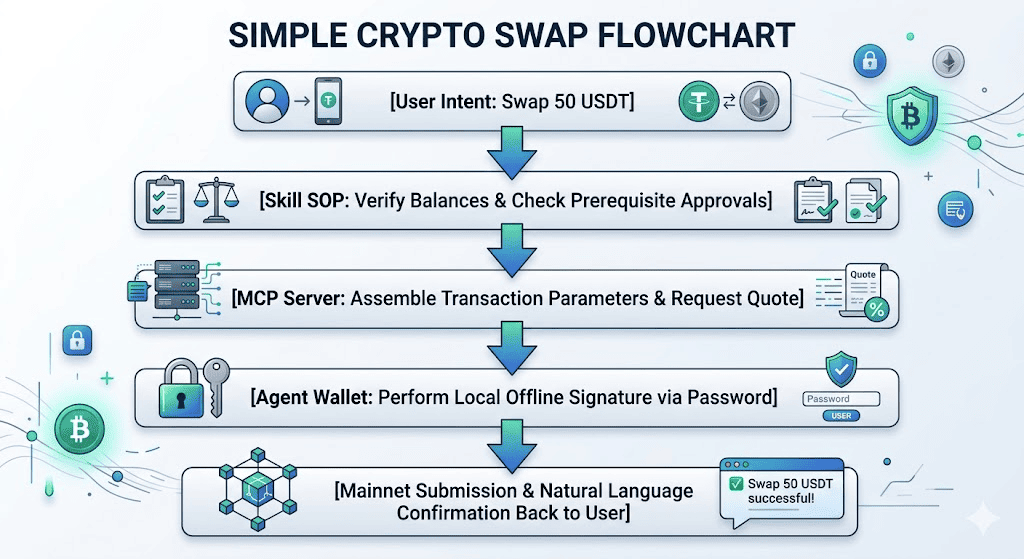
- Agent Wallet: An encrypted, local signing layer (~/.agent-wallet) that isolates private keys entirely from the outer AI application. The agent is only given an execution password to perform local offline signatures, eliminating plaintext credential leaks in server logs or repositories.
- Skills library: Standard Operating Procedures (SOPs) written for AI models to safely execute transactions step by step, e.g., automatically executing check balance $$\rightarro$$ verify token approval $$\rightarro$$ fetch best rate $$\rightarro$$ apply slippage protection $$\rightarro$$ execute trade.
- MCP Servers: Built on the standard Model Context Protocol, these act as capability providers, turning raw blockchain contracts into uniform, AI-callable tools.
4. The Ecosystem Layer (DeFi Integrations)
The topmost layer plugs first- and third-party MCP servers directly into leading multi-chain DeFi protocols, allowing agents to instantly borrow, lend, swap, or track analytics across TRON, Ethereum, and BNB Chain via natural language prompts.
Core Product Capabilities: How the BANK OF AI Stack Cooperates
|
Operational Layer |
Product Component |
Primary Responsibility |
Native Chain Compatibility |
|
Model Layer |
LLM Service |
Unified model aggregation & crypto-funded API routing |
Multi-chain (TRON, BNB, ETH, Base, etc.) |
|
Protocol Layer |
x402 & 8004 |
On-chain micropayments and verifiable agent reputation registry |
TRON, BNB Chain |
|
Tool Layer |
Agent Wallet & Skills |
Encrypted local offline signing and procedural trade safety guardrails |
TRON, All EVM Chains |
|
Ecosystem Layer |
Native & Third-party MCPs |
Direct transaction toolkits for protocols like SunSwap, JustLend DAO, and Uniswap |
TRON, Ethereum, BNB Chain |
Traditional AI chatbots often crash during on-chain actions because they lack specialized state management. For example, if a user instructs a standard AI to "swap 50 USDT for TRX," the model frequently fails because it skips the mandatory cryptographic token approval step required by decentralized exchanges.
BANK OF AI avoids this by utilizing Skills orchestration. When an intent is recognized by the Model Layer, the underlying Skill guides the execution fluidly through an immutable SOP:
How bankofai.io Works: UX, Architecture, and Developer Accessibility
A comprehensive review of the official portal (bankofai.io) reveals a site built around high technical readability, clear developer accessibility, and decentralized UX onboarding mechanics.
- One-Command Developer Tooling: The portal prioritizes immediate integration utility over promotional fluff. Terminal command installations like npx skills and BofAI/skills are prominently positioned, enabling developers to instantly load operational playbooks into tools like Claude Code, Cursor, or OpenClaw within under a minute.
- Robust Security and Custody Architecture: Rather than tracking or holding user custody, the portal emphasizes strict local sovereignty. The architecture section clearly breaks down how private keys are handled via a local dual-lock keystore mechanism (Keystore encryption + local_secure mode), giving the AI client access to an environment variable passphrase while keeping raw keys 100% offline.
- Deep Product Documentation and SDK Parity: The documentation includes deep developer SDK paths with comprehensive feature matrixes. Notably, the repository establishes TypeScript and Python parity across core Facilitator and Server roles, presenting standardized deployment guides for self-hosting remote or local instances of custom TRON and SUN MCP servers.
How to Trade BANK OF AI ($NFT) on BingX Spot
To simplify your market entry, the BingX AI trading assistant can help you instantly track depth updates, monitor order book spreads, and flag execution setups for the $NFT token. Follow this step-by-step guide to execute your spot market trades:
- Log In and Navigate to Spot: Access your account on the official BingX platform, hover over the Spot menu on the top navigation bar, and click Spot.
- Search for the NFT Pair: Type NFT into the market search bar on the upper left side of the trading terminal and select the NFT/USDT trading pair.
- Analyze the Order Book: Review the live candlestick charts, order book depth, and real-time execution flows to find an optimal entry point.
- Configure Your Order Parameters: Choose your preferred order execution type:
- Limit Order: Specify the precise target price you are willing to pay to buy or accept to sell your $NFT tokens.
- Market Order: Fill your trade instantly at the best available current market price.
- Execute the Trade: Enter the total amount of USDT you want to spend (or the amount of NFT tokens you wish to sell) and click Buy NFT or Sell NFT to finalize your spot transaction.
5 Key Considerations Before Using BANK OF AI
Before funding accounts or connecting autonomous agents to the BANK OF AI stack, carefully evaluate these core elements:
- Irreversibility of On-chain Transactions: Automated agent actions are permanent. It is highly recommended to practice operations extensively on the Nile or Shasta testnets using a small capital buffer before upgrading scripts to live mainnet environments.
- Master Password Recovery Constraints: The master password generated during local wallet creation (agent-wallet start) is shown exactly once and saved locally. If this file or password is lost or corrupted, there is absolutely no centralized backdoor, customer support recovery mechanism, or recovery phrase to retrieve locked funds.
- Perpetual Contract Risk Guardrails: While the platform's native sunperp-skill implements rigid hardcoded protection filters, such as capping maximum leverage at 20x and enforcing a mandatory 5% entry stop-loss, rapid market volatility can still result in liquidations if parameters are improperly configured.
- Private Deployment Dependency Requirements: Self-hosted or privately deployed write-type MCP servers require a fully configured and unlocked local Agent Wallet. If the wallet is disconnected or missing authorization, write actions will return terminal errors automatically.
- Third-Party Counterparty Extensions: When routing agent intent through third-party ecosystem tools, such as Etherscan or Uniswap AI components, transactions rely on external protocol availability, introducing localized smart contract and execution risks outside of BANK OF AI’s core protocols.
Final Thoughts: Is BANK OF AI ($NFT) a Good Investment?
BANK OF AI sets a sophisticated benchmark for decentralized artificial intelligence by shifting the industry paradigm away from speculative AI tokens and toward genuine, functional utility infrastructure. By designing a uniform ecosystem where an AI agent can simultaneously manage its funding, prove its validation tier, and seamlessly navigate multi-chain smart contracts without developer friction, the platform builds a solid foundation for the machine-to-machine Web3 economy.
As decentralized finance matures toward total programmatic automation, BANK OF AI delivers a highly secure, reliable, and standardized execution framework capable of keeping pace with the rapid speed of generative model advancements.
Risk Reminder: Autonomous asset management, blockchain micropayments, and developer agent configurations carry inherent smart contract, operational execution, and protocol vulnerabilities. Always conduct thorough code and parameter validation on testnets, back up your local keystore parameters securely, and never allocate more capital than you can afford to lose. BingX assumes no responsibility for external trading, developer integrations, or autonomous asset movements.
Related Reading
- What Are the Top 10 AI Agent Crypto Projects of 2026?
- Understanding Model Context Protocol (MCP): Top 5 MCP Crypto Projects to Watch in 2026
- Top x402 Payment Protocol Projects for Blockchain-Based AI Agents
- What Is SKYAI? MCP-Powered AI Data and How to Buy It On BingX
- What Is AI Rig Complex (ARC) Ryzome Universal App Store for AI Agents and How to Buy ARC?
