

Morpho (MORPHO) is a decentralized lending protocol built to make on-chain credit more efficient, modular, and usable as infrastructure for other companies rather than a single consumer app. Instead of pooling every lender and borrower into one shared market the way earlier DeFi lenders do, Morpho separates lending into isolated markets with fixed, immutable parameters, then layers curated vaults on top for users who want a simpler deposit experience. Its roots go back to August 2021, when three engineering students in Paris, Paul Frambot, Merlin Egalite, and Mathis Gontier Delaunay, set out to fix the wide interest rate spreads left on the table by pooled lending protocols like Aave and Compound.
As DeFi lending matured and exchanges, fintechs, and even regulated banks began looking for on-chain credit infrastructure they could embed directly into their own products, Morpho expanded from a rate-optimization layer into the backbone powering lending products for Coinbase, Crypto.com, Gemini, and Société Générale's digital asset arm. This guide explains what Morpho is, how the network works, how MORPHO tokenomics function, the main risks to consider, and how to trade MORPHO on BingX.
What Is Morpho (MORPHO)?
Morpho (MORPHO) is the governance token of Morpho, a decentralized lending protocol built on Ethereum and other EVM-compatible chains. The network is designed for developers and institutions that need efficient, customizable, and risk-isolated on-chain credit markets, rather than for retail users interacting directly with the base protocol. Morpho was founded by Paul Frambot, Merlin Egalite, Mathis Gontier Delaunay, and Julien Thomas, and has raised more than $70 million from investors including a16z, Ribbit Capital, Variant, Coinbase Ventures, and Pantera Capital since its 2021 founding.
Morpho started as a peer-to-peer optimization layer built on top of Aave and Compound, directly matching lenders and borrowers to shrink the spread between deposit and borrow rates while falling back to the underlying pool whenever no match was available. By 2026, the network had evolved far beyond that original design through Morpho Blue, a lightweight, immutable lending primitive that lets anyone permissionlessly deploy isolated markets, and Morpho Vaults, a curator layer that professional risk managers use to allocate deposits across those markets on behalf of depositors. Morpho V2, rolled out through 2025 and 2026, added market-driven interest rates and fixed-term, fixed-rate loans, features institutional borrowers expect from traditional credit markets.
The core idea behind Morpho is simple: on-chain lending should be split into a minimal, immutable base layer that cannot be changed by governance, with flexible, opinionated products built on top of it. Isolated markets mean that a problem in one lending market, such as a bad oracle or a volatile collateral asset, cannot cascade into other markets on the protocol. MORPHO powers this ecosystem primarily through governance, letting holders vote on which interest rate models and oracles are approved for use, and on how the DAO treasury is allocated.
Key components of the Morpho ecosystem include:
- Morpho Blue: The roughly 650-line immutable lending primitive that allows permissionless creation of isolated, custom-parameter lending markets.
- MORPHO token: The governance token used to vote on protocol upgrades, approved oracles and interest rate models, and treasury decisions.
- Morpho Vaults: The curator layer where risk managers allocate depositor funds across multiple Morpho Blue markets, giving users a simplified, passive lending experience.
- Morpho Association: The nonprofit organization that absorbed the core development team in 2025 to align long-term protocol development with the token's governance mission.
- Morpho V2: The newer layer introducing market-driven rates and fixed-term, fixed-rate lending designed for institutional-scale credit.
Read More: What Are the Top 10 DeFi Lending Protocols to Watch in 2026?
How Does Morpho Network Work?
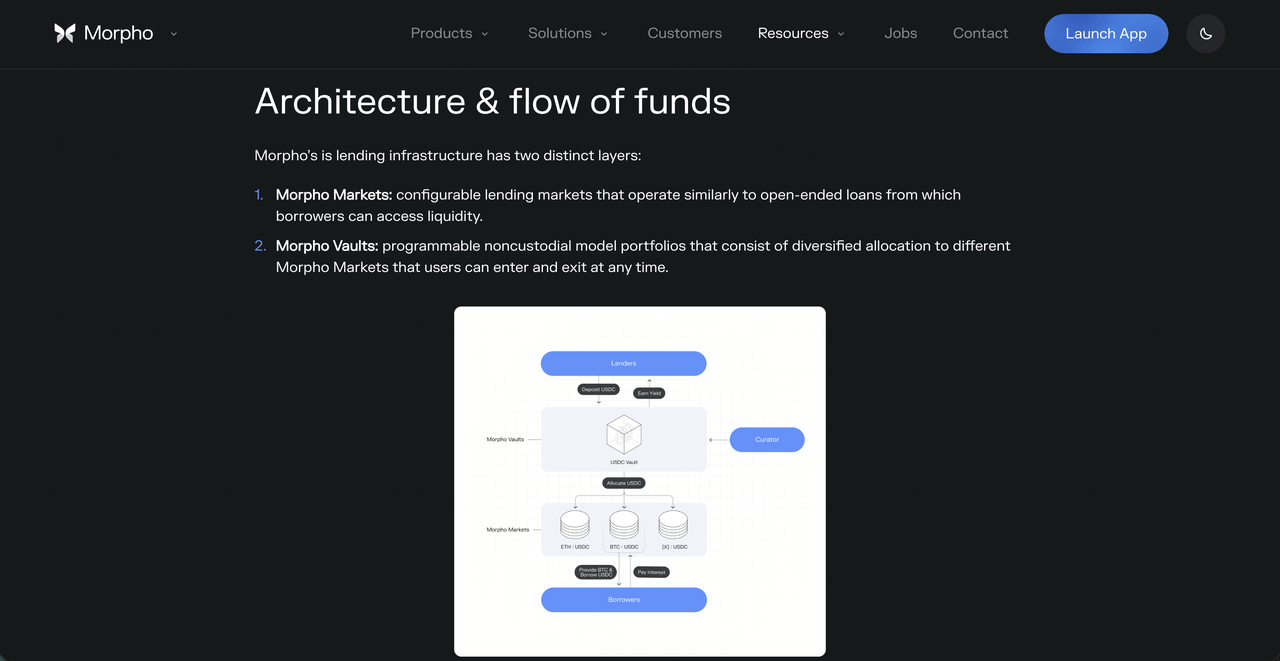
Morpho works as a layered lending network. Developers and curators deploy or select isolated markets on Morpho Blue, depositors supply funds directly or through curated vaults, and MORPHO governance oversees which building blocks are approved for use across the protocol.
Source: Morpho Blog
- Markets are defined by five fixed parameters: Every Morpho Blue market is created by specifying the loan asset, the collateral asset, the liquidation loan-to-value ratio, the oracle, and the interest rate model. Once deployed, these parameters cannot be changed, which keeps each market predictable and isolated from the others.
- Lenders and borrowers interact directly with a market: Because each market is isolated, risk in one market, such as a thinly traded collateral asset or an oracle failure, cannot spread into other markets on the protocol, unlike shared-pool lenders where all assets share the same risk surface.
- Curators build vaults on top of markets: Risk experts and institutions create Morpho Vaults that automatically allocate depositor funds across multiple Morpho Blue markets based on defined safety criteria, supply caps, and rebalancing rules, giving everyday users a single-deposit, passively managed experience.
- Positions are secured through overcollateralization and liquidation: Borrowers must post more collateral than they borrow. If a position's health falls below the market's liquidation threshold, it can be liquidated to protect lenders, with the process enforced automatically by the isolated market's smart contract.
- Governance approves new building blocks, not individual markets: MORPHO holders vote on which oracles and interest rate models can be used in new market deployments and on treasury allocation, but they cannot alter markets that are already live, since Morpho Blue contracts are immutable by design.
Morpho vs. Aave: Key Differences Between Modular and Pooled Lending
Morpho (MORPHO) and Aave (AAVE) are often compared because both are leading decentralized lending protocols competing for the same deposits. However, their underlying architecture is fundamentally different. Aave uses a shared liquidity pool model where all lenders and borrowers interact with the same market for a given asset, while Morpho splits lending into isolated markets with a separate curator layer for simplified access.
|
Category |
Morpho |
Aave |
|
Core positioning |
Modular lending infrastructure for developers, curators, and institutions |
Single, unified deposit experience with deep shared liquidity |
|
Market structure |
Isolated markets with five immutable parameters per market |
Shared liquidity pools across each supported asset |
|
Main technical focus |
Peer-to-peer style efficiency and permissionless market creation |
Deep, unified liquidity with governance-managed risk parameters |
|
Ecosystem strength |
Enterprise integrations, including Coinbase, Crypto.com, and Société Générale |
Largest DeFi lending liquidity base and long operating history |
|
Key challenge |
Requires depositors to choose a curator or vault rather than a single pool |
Shared-pool design means risk in one asset can affect the wider pool |
The main difference is that Morpho treats lending as a set of minimal, immutable building blocks that others assemble into products, while Aave offers one integrated lending experience managed directly by its own governance. For users, the comparison comes down to priorities: Aave suits people who want one simple deposit with deep liquidity, while Morpho suits people who want yield optimization through curated vaults, or builders who need custom, isolated markets.
Read More: What Is Aave DeFi Lending Protocol and How Does it Work?
Morpho Ecosystem in 2026: Institutional Adoption and the Modular Lending Stack
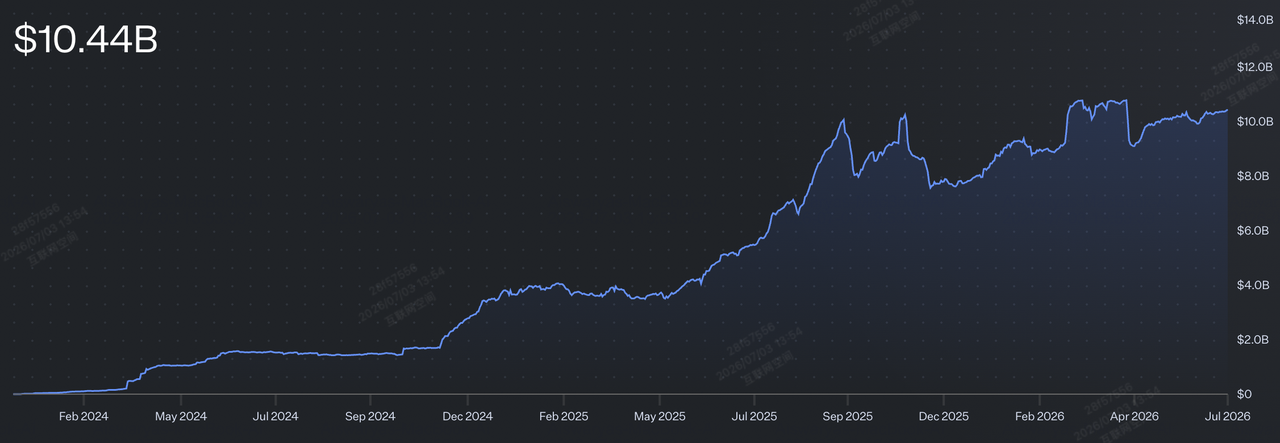
Total assets on Morpho | Source: Morpho Network Data
Morpho has evolved from a rate-optimization layer into infrastructure that banks, exchanges, and fintechs use to power their own lending products. Its 2026 adoption story is defined by a wave of institutional integrations and a sharp jump in usage across deposits, active loans, and users.
|
Timeline |
Key Development |
Why It Matters |
|
2021-2022 |
Morpho founded and early protocol development begins |
Started as a peer-to-peer optimization layer built on top of Aave and Compound |
|
2023-2024 |
Morpho Blue and vault architecture expand |
Shifted Morpho from a rate optimizer into modular lending infrastructure |
|
2024 |
MORPHO becomes transferable |
Opened the governance token to broader market participation |
|
2025 |
Coinbase lending integration launches |
Helped position Morpho as backend infrastructure for consumer-facing crypto lending products |
|
2025-2026 |
More institutional and exchange integrations |
Strengthened Morpho’s role as embedded credit infrastructure |
|
2025-2026 |
Morpho V2 rollout |
Added fixed-term and fixed-rate lending features aimed at more advanced credit markets |
According to Morpho's own 2026 update, the network's user base grew from roughly 67,000 to more than 1.4 million over the course of a year, deposits grew from about $5 billion to $13 billion, and active loans reached $4.5 billion, with total real-world asset (RWA) deposits climbing from near zero to $400 million by the third quarter of 2025. These figures reflect Morpho's stated strategy of becoming embedded infrastructure inside other companies' products rather than growing as a standalone consumer destination.
What Are the Morpho (MORPHO) Tokenomics?
MORPHO tokenomics center on a fixed maximum supply, governance-first utility, and multi-year vesting across the DAO, founders, strategic partners, contributors, and early users. The token is designed to govern Morpho’s infrastructure rather than control every market directly.
MORPHO Token Utility and Supply Mechanisms
MORPHO is the governance asset of the Morpho protocol. Unlike tokens that control every operational parameter of their network, MORPHO's governance scope is deliberately limited.
- Governance: MORPHO holders vote on which interest rate models and oracles are approved for use in new market deployments, and on how the DAO treasury is allocated. A minimum of 500,000 tokens is required to submit a governance proposal.
- Limited scope by design: Governance cannot alter markets that are already deployed on Morpho Blue, since those contracts are immutable. This means the security of any specific market depends on the parameters set at deployment, not on ongoing governance decisions.
- Ecosystem incentives: MORPHO can be distributed as rewards to depositors and borrowers through mechanisms such as the Universal Rewards Distributor, encouraging early liquidity and adoption of specific markets.
- Potential fee switch: Morpho governance can activate a protocol fee, capped at 25% of interest generated, which would route a share of protocol revenue to the DAO treasury if enabled.
- Fixed maximum supply: MORPHO has a hard cap of 1 billion tokens with no further issuance beyond that cap, in contrast to inflationary token models used by some other DeFi protocols.
MORPHO Token Allocation
Source: Morpho Docs
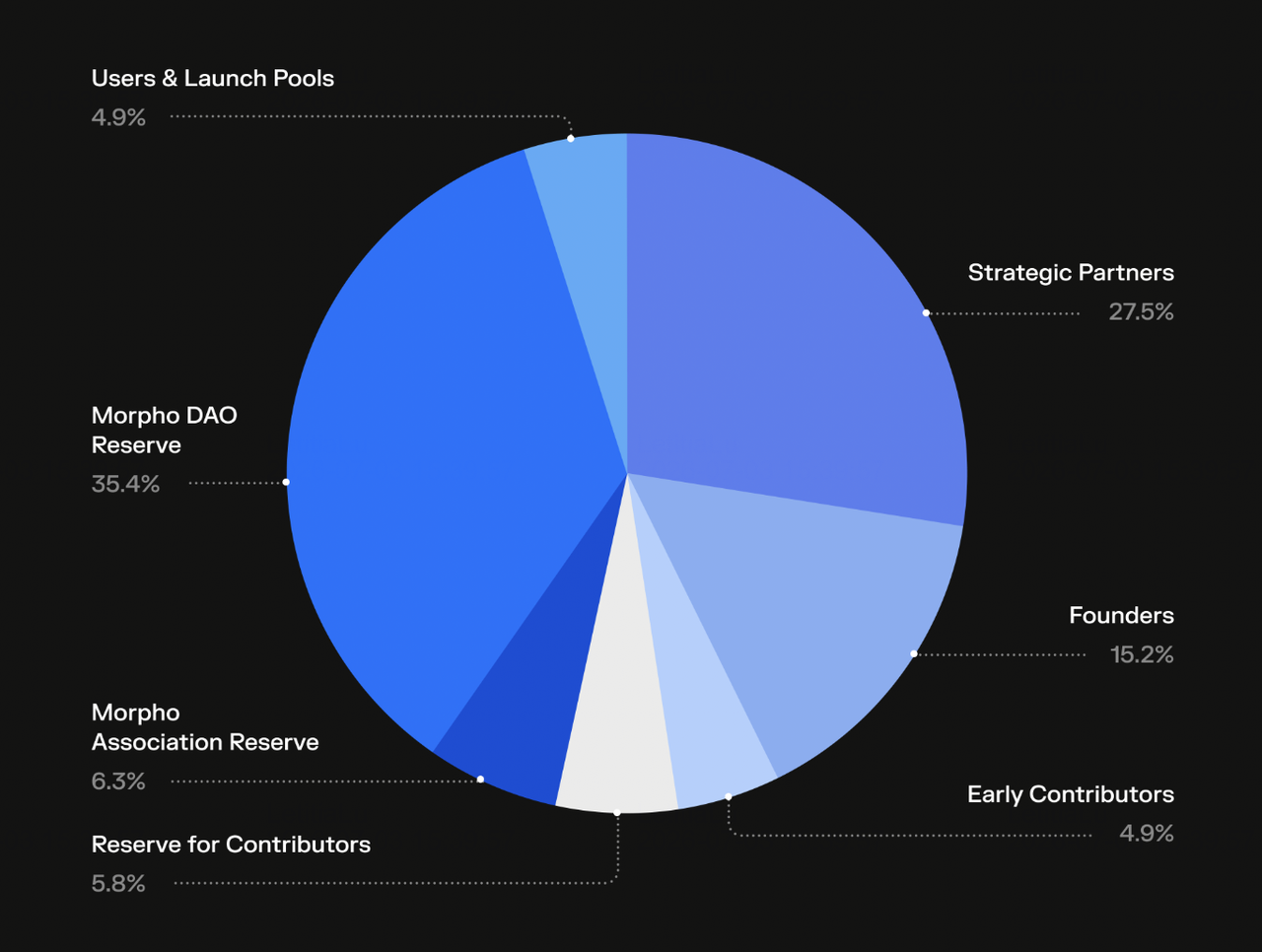
MORPHO's total supply is capped at 1 billion tokens, with the majority still subject to multi-year vesting schedules that extend into 2028 and 2029 for some cohorts.
|
Holder Category |
Allocation |
Description |
|
Morpho DAO |
35.40% |
Controlled by governance for protocol development, incentives, and treasury decisions |
|
Strategic Partners |
27.50% |
Allocated to early backers across three cohorts with vesting schedules extending to 2027 |
|
Founders |
15.20% |
Subject to a lockup and linear vesting schedule, with full vesting by May 2028 |
|
Morpho Association Reserve |
6.30% |
Reserved for the nonprofit association overseeing the protocol's long-term mission |
|
Reserve for Contributors |
5.80% |
Set aside for future contributors to the protocol |
|
Early Contributors |
4.90% |
Allocated to Morpho Association contributors, researchers, and advisors under 3 to 4 year vesting schedules |
|
Users and Launch Pools |
4.90% |
Distributed to early users and liquidity providers through launch incentive programs |
As of mid-2026, roughly 63% to 65% of MORPHO's total supply has been unlocked and is in circulation, with the remaining tokens continuing to vest through 2029 for the longest-dated allocations. Because Strategic Partner and Founder tokens make up more than 40% of total supply combined, ongoing unlocks from these categories remain one of the most closely watched factors in MORPHO's supply dynamics.
How to Trade Morpho (MORPHO) on BingX
BingX offers two practical ways to gain exposure to Morpho, depending on whether the goal is direct ownership or short-term trading. Spot trading is better suited for users who want to buy and hold MORPHO directly, while futures trading is designed for active traders who want long or short exposure to MORPHO price movements.
Spot Trading: Buy and Own MORPHO Directly
Spot trading is the most straightforward way to buy Morpho on BingX. When users buy MORPHO on the spot market, they own the asset directly and can hold it in the BingX spot account, transfer it, or withdraw it to a self-custody wallet.
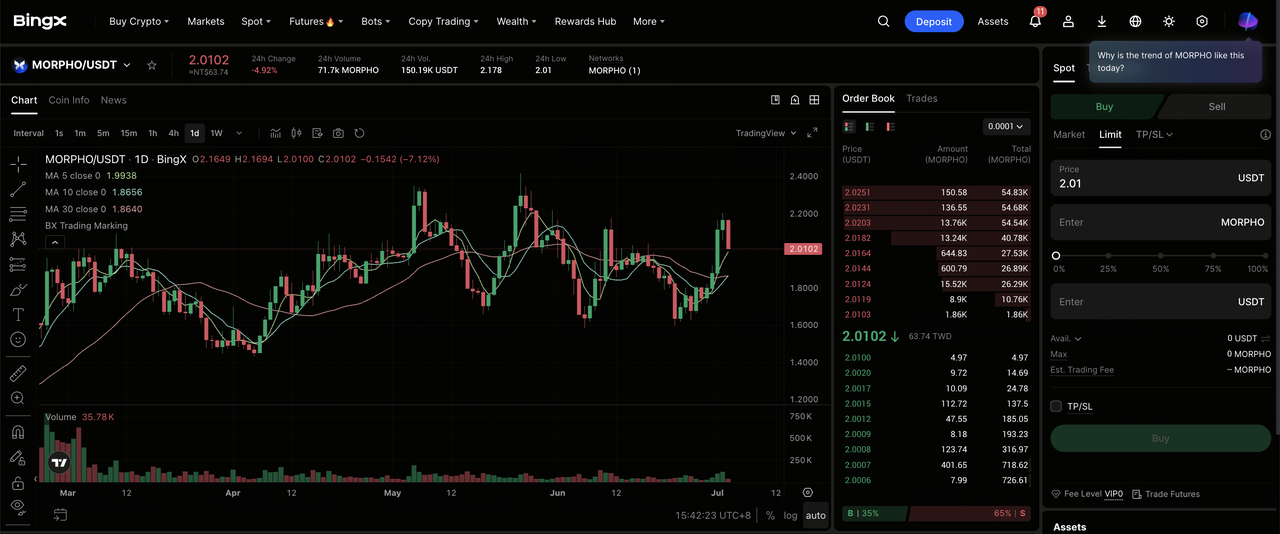
Step 1: Account setup and security. Sign up and log into your BingX account, complete the identity verification (KYC) required in your region, and enable two-factor authentication.
Step 2: Fund your spot account. Deposit USDT or another supported asset into your BingX spot account. Where available, users can also use supported fiat on-ramp options.
Step 3: Navigate to the spot market. Search for the MORPHO/USDT trading pair.
Step 4: Place your order. Choose a market order to buy MORPHO immediately at the current price, or use a limit order to set the price you want to pay.
Step 5: Manage your MORPHO. Once filled, your MORPHO appears in your spot account. You can keep it on BingX for convenience or withdraw it to a self-custody wallet for governance participation.
Futures Trading: Trade MORPHO Price Movements
For active traders, BingX offers USDT-margined MORPHO perpetual futures. Futures allow users to trade MORPHO price movements without holding the underlying asset, with the flexibility to open long positions if they expect MORPHO to rise or short positions if they expect MORPHO to fall.
Because futures involve leverage, they can amplify both gains and losses. This approach is more suitable for traders who already have a clear risk plan and understand liquidation risk, particularly for an asset like MORPHO that is sensitive to token unlock schedules, DeFi TVL trends, and institutional adoption headlines.
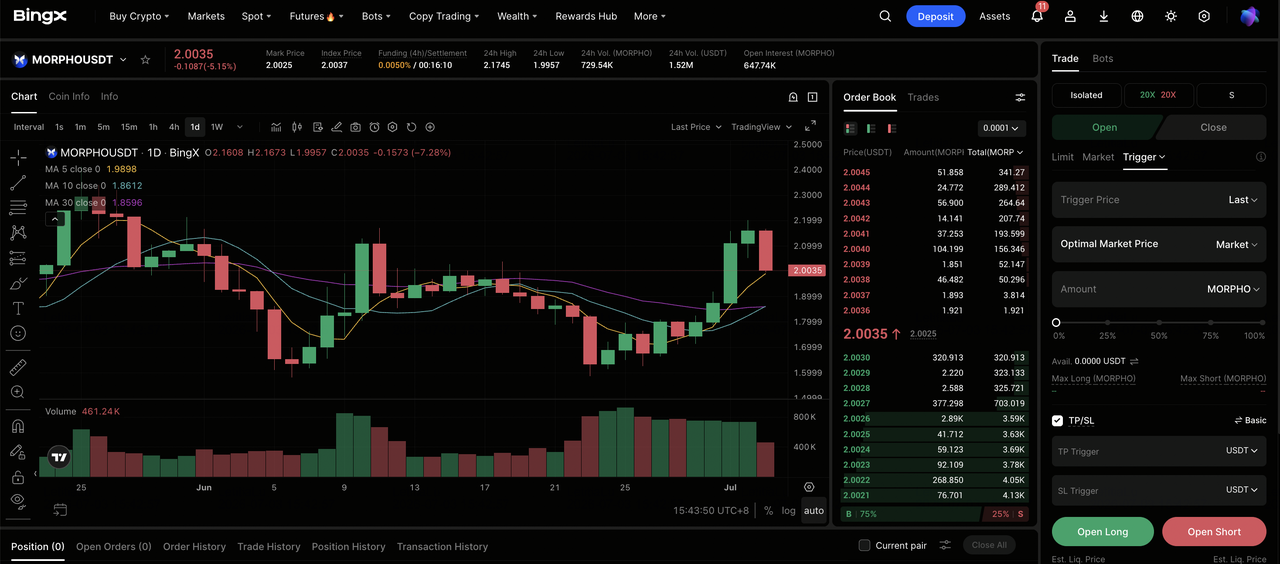
Step 1: Transfer collateral. Move USDT from your spot account into your futures account, where it will serve as margin.
Step 2: Select the contract. Search for the MORPHO-USDT perpetual contract.
Step 3: Set direction and leverage. Open long if you expect MORPHO to rise, or open short if you expect MORPHO to decline. Choose leverage based on your risk tolerance and position size.
Step 4: Execute the trade. Enter the order amount and choose a market or limit order depending on your trading plan.
Step 5: Manage risk. Set stop-loss and take-profit orders before or immediately after entering the position. Profit and loss settle dynamically in USDT.
Risks and Considerations Before Investing in Morpho (MORPHO)
Morpho has real institutional adoption, a fixed token supply, and a growing list of enterprise integrations. However, MORPHO still carries risks tied to token unlocks, smart contract security, competition, and the limits of its governance model.
- Large token unlocks are still ahead: With Strategic Partners and Founders together holding more than 40% of total supply, and vesting schedules extending to 2027 and 2028, ongoing unlocks remain a meaningful source of potential sell pressure.
- Isolated markets do not eliminate smart contract risk: In April 2025, Morpho faced an attempted $2.6 million exploit tied to a frontend vulnerability, which was intercepted by a white-hat operator before funds were lost. The incident is a reminder that frontend and integration risk exists alongside core protocol risk.
- Vault and curator risk sits outside the immutable base layer: While Morpho Blue markets are immutable, the vaults built on top depend on the judgment of individual curators. Poor curation, concentrated allocations, or liquidity mismatches in a specific vault can still affect depositors in that vault.
- Governance has a limited, narrow scope: Because MORPHO governance cannot alter already-deployed markets, the token's ability to directly influence protocol economics is more limited than in some competing DeFi tokens, which can affect how the market prices governance rights.
- Competition remains intense: Morpho competes directly with Aave, the largest DeFi lending protocol by liquidity, along with Compound and other emerging modular lending designs. Aave's deep liquidity and long operating history remain a structural advantage in attracting large depositors.
- MORPHO has traded well below its all-time high: MORPHO reached an all-time high near $4.16 in January 2025 and has traded well below that level through much of 2026, reflecting both token unlocks and broader DeFi market cycles.
Final Thoughts: Is Morpho Crypto a Good Investment in 2026?
Morpho has positioned itself as foundational, embedded infrastructure for on-chain lending rather than a standalone consumer app, and its 2026 integration list, including Coinbase, Crypto.com, Gemini, and Société Générale's digital asset arm, reflects real institutional demand for that infrastructure. The protocol's isolated-market design and immutable base layer also give it a distinct security model compared with shared-pool lenders like Aave.
The key question for 2026 is whether Morpho can keep converting enterprise integrations into sustained deposits and fee revenue while managing a token supply that is still less than two-thirds unlocked. Morpho V2's fixed-rate, fixed-term lending and its growing real-world asset deposits point toward a strategy of extending beyond crypto-native users into the wider financial system. For investors and traders, the most important metrics to watch are total deposits, active loans, real-world asset growth, vault curator performance, and the pace of remaining token unlocks.
Related Reading
- What Are the Top 10 DeFi Lending Protocols to Watch in 2026?
- What Is Aave DeFi Lending Protocol and How Does it Work?
- What Is DeFi (Decentralized Finance)? 8 Types of DeFi Protocols to Know
- What Is Echelon Protocol (ELON), the Universal Lending Layer for the Move Ecosystem?
- What Are the Top 10 Ways to Earn Passive Income from Crypto in 2026?
FAQs About Morpho (MORPHO)
1. What makes Morpho different from other DeFi lending protocols?
Morpho splits lending into an immutable base layer of isolated markets and a separate curator layer of vaults built on top. This design limits how far risk in any single market can spread, and lets governance approve new building blocks without being able to alter markets that are already live.
2. Is Morpho a competitor to Aave?
Yes, in the sense that both compete for lending deposits, but their designs serve different needs. Aave offers one shared, deep liquidity pool per asset, while Morpho offers isolated, customizable markets and curated vaults. Many institutions and treasuries use both.
3. Which platforms are built on Morpho?
Morpho powers lending products for several major platforms, including Coinbase's USDC lending and crypto-backed loans, Crypto.com, Gemini, and Société Générale Forge's MiCA-compliant stablecoin lending. Morpho functions as backend infrastructure for these products rather than a consumer-facing brand in most of these integrations.
4. Is Morpho a DeFi Protocol?
Yes. Morpho is a DeFi lending protocol that lets users lend, borrow, and build credit markets on-chain. Its design is more modular than traditional pooled lending protocols because it separates isolated lending markets from curated vaults.
5. Is Morpho Built on Ethereum?
Yes. Morpho was originally built on Ethereum and is also available on other EVM-compatible networks. Its core architecture is designed for Ethereum-style smart contracts, with Morpho Blue markets and vaults deployed across supported chains.
