Targeting a staggering $1.75 trillion valuation to raise $75 billion to $80 billion, SpaceX is scheduled to price its shares on June 11, 2026, and debut on the Nasdaq and Nasdaq Texas under the ticker symbol SPCX as early as June 12, 2026.
Historically, participating in a mega-cap asset of this caliber before its public listing was strictly reserved for venture capital firms and ultra-high-net-worth individuals. BingX democratizes this access by offering everyday retail investors three distinct, high-liquidity paths to trade and gain exposure to SpaceX’s valuation ahead of its historic public debut.
What Is the SpaceX IPO and When Is SpaceX Going Public?
The SpaceX IPO marks the transition of Elon Musk’s aerospace and telecommunications giant into the public equity markets in what is poised to be the largest listing in financial history. Officially filing its S-1 registration statement with the SEC on May 20, 2026, followed by a detailed amendment on June 1, SpaceX is seeking to raise between $75 billion and $80 billion.
The offering targets a massive $1.75 trillion valuation, roughly 94 times its FY2025 revenue of $18.7 billion. Uniquely structured to capture massive retail interest, the deal breaks institutional norms by allocating 30% of its shares to ordinary investors, while reserving an additional 5% for a directed employee, friends, and family program completely exempt from lock-up restrictions.
Wall Street is operating on an accelerated timeline for the company’s public debut on the Nasdaq and Nasdaq Texas exchanges under the ticker symbol SPCX. Following an intensive institutional roadshow scheduled from June 4 to June 8, 2026, SpaceX plans to finalize its official share pricing on June 11, with public trading slated to begin as early as Friday, June 12, 2026.
Because updated index rules allow mega-caps of this scale to bypass standard multi-month seasoning periods, passive index funds like QQQ and VOO will face mandatory structural buying pressure to include SPCX within just 15 trading days of its listing. This compressed timeline creates an immediate, high-liquidity window for traders to position themselves ahead of the opening bell.
3 Ways to Trade SpaceX Pre-IPO on BingX
BingX provides a comprehensive suite of options spanning its Futures and Pre-IPO markets, giving users 24/7 flexibility to capture pre-listing momentum.
|
Product Name |
Trading Pair & Link |
Market Type / Product Nature |
|
SpaceX Venture Token |
Synthetic RWA Derivative on BingX Futures |
|
|
SpaceX PreStocks |
Synthetic RWA Derivative on BingX Futures |
|
|
SPCX Pre-IPO Product |
BingX Pre-IPO Market Asset (Direct Pre-Listing Exposure) |
SpaceX Venture Token ($VNTL) and SpaceX PreStocks Stock Futures
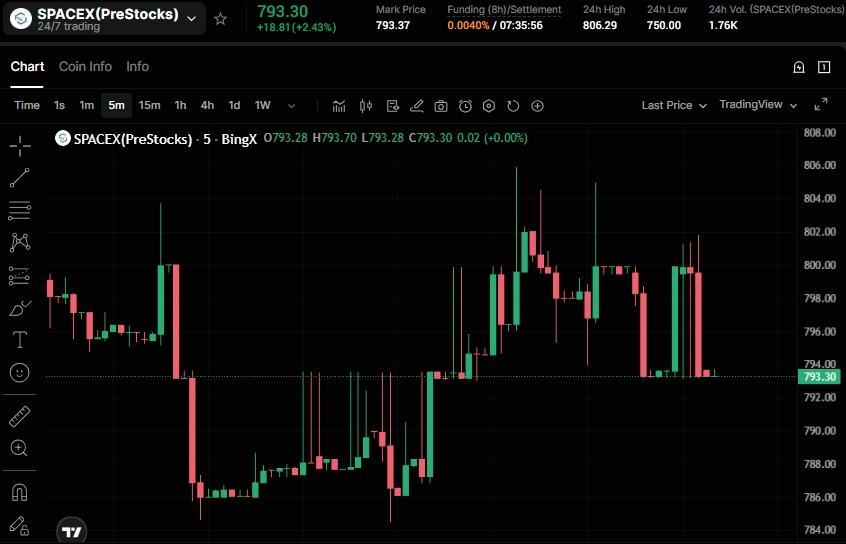
SpaceX PreStock on BingX futures market
The first two options function as high-performance, tokenized Real-World Assets (RWAs) hosted within the BingX Futures ecosystem. These assets mirror the economic performance and price action of SpaceX's private equity valuation, which saw secondary market employee tender offers trade near $185 per share earlier in the year. They allow traders to utilize leverage, e.g., 2x to 20x, and trade fractionally with as little as 10 USDT, completely bypassing traditional accredited investor hurdles.
SpaceX (SPCX) on BingX Pre-IPO
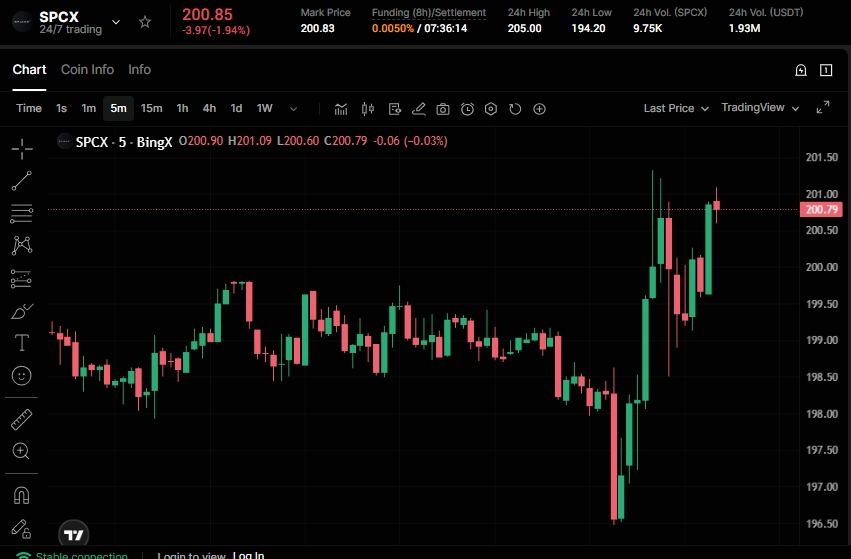
SpaceX (SPCX) on BingX pre-IPO
The third option sits directly in the specialized BingX Pre-IPO Zone. This product specifically tracks the upcoming public instrument SPCX under its officially filed Nasdaq ticker. It provides direct, speculative exposure to the impending June 12 listing dynamics, allowing traders to buy or short the asset based on fast-moving news surrounding the IPO roadshow, pricing expectations, and index inclusion updates.
Why Participate in SpaceX IPO: Understanding the Ecosystem and Business Model
SpaceX is no longer just a rocket launch provider. By 2026, it has successfully transitioned into a fully integrated aerospace, global telecommunications, and industrial AI infrastructure powerhouse.
SpaceX's Core Revenue Sources
- Connectivity (Starlink): The company’s primary cash engine. Operating a constellation of approximately 9,600 low-Earth orbit satellites, Starlink serves 10.3 million global subscribers across 160+ countries. The S-1 filing revealed that Starlink generates the lion's share of SpaceX's $18.7 billion FY2025 revenue, operating at a highly lucrative 62.9% adjusted EBITDA margin.
- Launch Services: SpaceX holds a dominant, unrivaled share of the global commercial space launch industry. Utilizing the reusable Falcon 9 and Falcon Heavy platforms, it handles cargo and crew transport for NASA, the U.S. Space Force, and private enterprise payload clients.
- AI Infrastructure and Data Synergy: In a massive paradigm shift, SpaceX’s valuation is heavily tied to its integration of Elon Musk's xAI and the Grok platform. The S-1 filing disclosed an extraordinary cloud/compute arrangement with Anthropic, utilizing a cluster of 325,000 Nvidia GPUs yielding a $1.25 billion per month contract through 2029. This positions SpaceX as a crucial player in physical, planetary-scale AI delivery.
- Deep-Space Government Contracts: Multi-billion dollar backlog structures, including NASA’s Artemis lunar landing program and the military-centric Starshield secure defense network.
Primary Growth Drivers
- Planetary AI Infrastructure: As noted by industry analysts, AI has shifted from a software race to a physical infrastructure race. SpaceX is leveraging its low-cost launch capabilities to deploy orbital (space-based) data centers targeted for execution as early as 2028, rendering it a sovereign compute and real-time decision engine.
- The Space Highway and Full Reusability: Over 400 successful Falcon launches and routine first-stage booster reuses have lowered launch costs by up to 70%. The active testing and scaling of Starship aims to unlock a 100-ton-class payload capacity, dramatically accelerating both Starlink V3 deployments and future Mars colonization economics.
- Unprecedented Index Inclusion Rules: Traditional equity rules require a lengthy seasoning period before a new stock joins major trackers. However, Nasdaq and S&P Dow Jones have adjusted fast-track frameworks allowing rapid index entry within 15 trading days for mega-cap firms of this scale. This rule modification means passive funds like QQQ and VOO ETFs will be subject to billions of dollars in mandatory buying pressure shortly after SPCX debuts.
SpaceX's Fundamental Analysis: Pros and Cons for Investors
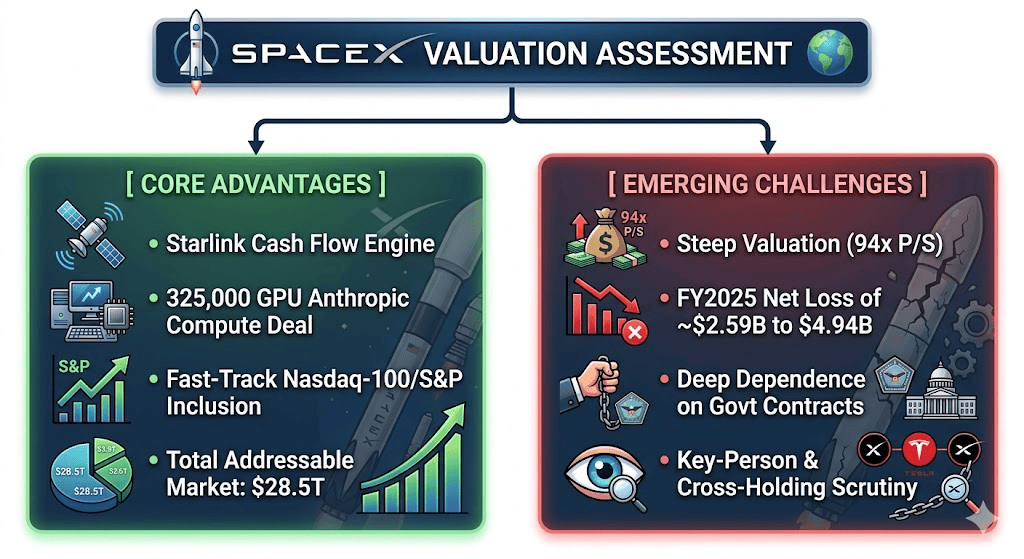
Core Advantages of SpaceX (SPCX) Stock
- Unmatched Structural Moat: SpaceX's flight heritage, 99.5%+ launch success rate, and mature booster recovery put it years ahead of commercial competitors like Blue Origin or Kuiper.
- Diverse Cash Generation: While rocket development is capital intensive, Starlink's high-margin subscription base effectively subsidizes ongoing Starship R&D and AI data center expansions.
- Monopoly Launch Mechanics: SpaceX commands a dominant percentage of the global orbital payload market, executing more launches annually than all other global entities and state space programs combined.
Emerging Challenges and Criticisms to Consider Before Investing in SpaceX IPO
- Aggressive Valuation Multiples: At a $1.75 trillion valuation against $18.7 billion in FY2025 revenue, SpaceX is entering the public market at an aggressive 94x price-to-sales ratio. Historical market precedents suggest companies debuting at extreme multiples face intense pressure to sustain impeccable execution.
- Deep Financial Resource Burn: Due to aggressive infrastructure deployment, GPU procurement, and deep-space hardware R&D, SpaceX reported a net loss between $2.59 billion and $4.94 billion for FY2025.
- Corporate Cross-Holdings and Governance: The cashless structural integration of xAI, Grok, and X (formerly Twitter) into the corporate architecture has drawn scrutiny from critics. Furthermore, the dual-class share structure ensures Elon Musk retains around 85% of total voting power, giving public shareholders minimal governance control.
- Retail Allocation Alterations: In a departure from typical mega-cap IPOs, which generally allocate 90% to institutions and 10% to retail, SpaceX is allocating up to 30% of its allocation to retail investors while reserving an additional 5% for employees and insiders under a directed share program exempt from immediate lock-ups.
How to Trade SpaceX IPO on BingX
If you are looking to long or short SpaceX ahead of its June 11 pricing and June 12 trading debut, follow this step-by-step framework on BingX:
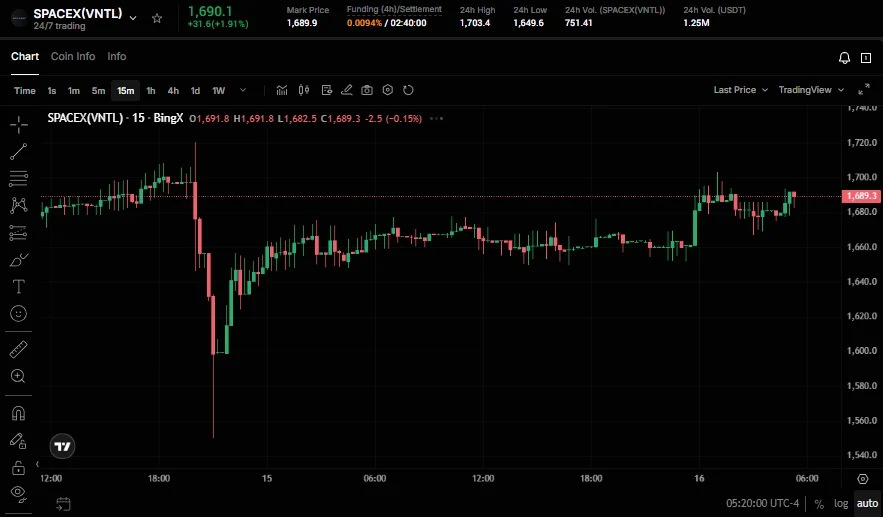
VNTL/USDT perpetual contract on BingX futures market
Step 1: Locate Your Preferred Instrument
Log in to your BingX app or desktop terminal. Navigate to the Futures Market or the dedicated Pre-IPO Zone. Use the search bar to input your target ticker based on your strategy:
- Search SpaceX(VNTL) or SpaceX(PreStocks) for stock futures exposure.
- Search SPCX-USDT perpetual contract for direct tracking of the upcoming Nasdaq vehicle.
Step 2: Fund Your Trading Account
Ensure you have sufficient USDT in your account. Use the internal Transfer interface to move capital from your Spot wallet into your Perpetual Futures account.
Step 3: Configure Margin and Leverage Parameters
- Isolated Margin Mode: Best for risk-averse strategies, limiting potential downside exposure exclusively to the margin assigned to that specific trade.
- Cross Margin Mode: Utilizes your broader account balance to buffer against short-term volatility and avoid unwanted liquidation.
Note: Select a conservative leverage multiplier ranging from 2x to 20x that accounts for the heightened volatility expected around the June roadshow dates.
Step 4: Execute Your Market Thesis
- Buy / Long: If you believe the intense forced buying from passive index funds, structural compute revenue from Anthropic, and retail demand will create an explosive post-listing rally.
- Sell / Short: If you anticipate that the aggressive 94x price-to-sales multiple, steep annual net losses, and cross-holding governance issues will lead to a post-IPO cooling period.
Step 5: Implement Risk Controls
Pre-IPO derivatives operate independently of standard crypto fluctuations and are highly sensitive to regulatory announcements, SEC updates, and launch milestones. Always deploy clear Stop-Loss (SL) and Take-Profit (TP) parameters immediately upon opening a position.
Final Thoughts: Should You Trade SpaceX Pre-IPO?
The impending SpaceX public listing is undoubtedly the financial event of 2026, combining planetary-scale aerospace dominance with heavy AI infrastructure hype. While the core operational metrics of Starlink remain exceptionally robust, the unprecedented valuation premium leaves very little margin for error.
By leveraging the BingX Stock Futures and Pre-IPO Zones, retail market participants have been handed an institutional-grade toolkit to actively trade, hedge, and position themselves ahead of the public opening bell on June 12. Trade cautiously, monitor the final SEC pricing releases on June 11, and manage your capital risk strictly.
Disclaimer: Tokenized stocks and pre-IPO derivative contracts carry substantial financial and counterparty risks. Price feeds may fluctuate wildly based on private equity rumors, indexing changes, and macroeconomic shifts. Conduct your own thorough research. BingX assumes no liability for individual trading outcomes.
Related Reading
- What Is Anthropic Pre-IPO and How to Trade It on BingX?
- SpaceX Will File for Historic $75 Billion IPO at $1.75 Trillion Valuation on June 12, 2026
- Anthropic Fires Confidential IPO Rocket to Crush OpenAI: Inside the Trillion Dollar AI Race
- Rocket Lab (RKLB) Sinks 14.7%: High-Flying Space Stock Hits a Sector-Wide Reality Check