
Tron’s rise is closely tied to one specific use case: moving USDT quickly and cheaply. While many blockchains compete to become general-purpose smart contract platforms, Tron has found its strongest role as a stablecoin settlement network, especially for retail-sized transfers, remittances, payments, and dollar-based savings in emerging markets. Its low fees and fast confirmations make it practical for everyday on-chain value transfer.
To understand Tron, it helps to separate the network from the asset. Tron is the blockchain where stablecoin transfers, smart contracts, DeFi applications, and other on-chain activity take place. TRX is the native cryptocurrency used to pay for network resources, vote in governance, and support the chain’s economic model. This guide explains what Tron is, how it works, why USDT became central to the network, how TRX tokenomics function, and how to trade TRX on BingX.
What Is Tron?
Tron (TRX) is a decentralized, open-source blockchain network designed for smart contracts , decentralized applications (dApps), and high-volume transactions. It was founded by Justin Sun, with the TRX token launched through an initial coin offering in 2017 and the Tron mainnet going live in 2018. While Tron’s early vision focused on decentralized digital content and entertainment, its real-world role has shifted toward payments, stablecoin transfers, and low-cost value settlement.
The easiest way to understand Tron is to compare it with Ethereum:
- Ethereum: Ethereum is a general-purpose smart contract platform with the largest and most diverse decentralized application ecosystem. It prioritizes decentralization, security, and settlement, but has historically faced higher fees and lower base-layer throughput.
- Tron: Tron is optimized for fast and low-cost transactions at scale. It is especially well suited for high-volume, lower-value transfers such as USDT payments, remittances, and stablecoin settlement. The trade-off is that Tron has a more concentrated validator structure than Ethereum.
This focus is why Tron found its niche. Instead of competing with Ethereum across every category of decentralized applications, Tron became one of the dominant networks for a specific, widely used activity: moving stablecoins cheaply and quickly.
Read More: Top TRON Ecosystem Projects & dApps to Watch in 2026
Tron Network vs. TRX Coin
- Tron the network: Tron is the blockchain platform where stablecoin transfers, smart contracts, decentralized applications, DeFi protocols, and other on-chain activity take place. It is the infrastructure layer that supports the Tron ecosystem.
- TRX the coin: TRX is the native cryptocurrency of the Tron network. It is used to pay for energy and bandwidth, reward Super Representatives, secure the network through staking, and provide voting power in Tron governance.
How Does Tron Work?
At its core, Tron is a high-throughput blockchain designed to process transactions quickly and cheaply. It records balances, executes smart contracts, and supports decentralized applications through a resource model built for speed and cost efficiency. Four concepts explain how it works:
- The Tron Virtual Machine (TVM): The TVM is the environment that executes smart contracts on Tron. It is compatible with the Ethereum Virtual Machine (EVM), which means developers can move Ethereum-based smart contracts and tools to Tron with limited changes. This helped Tron build a DeFi and stablecoin ecosystem using familiar standards such as TRC-20.
- Energy and bandwidth: Tron uses energy and bandwidth instead of a simple gas-fee model. Bandwidth covers basic transaction data, while energy covers smart contract computation, including TRC-20 token transfers like USDT. Users can obtain these resources by staking TRX or pay a small amount of TRX when resources are not enough.
- Speed and low fees: Tron produces a new block roughly every three seconds, allowing transactions to confirm quickly. Combined with very low fees, this makes Tron practical for frequent stablecoin transfers, remittances, payments, and smaller transactions.
- Tron accounts: Tron has user-controlled wallet accounts and smart contract accounts. Wallet accounts are managed by private keys, while contract accounts are controlled by code. Their interaction allows Tron applications and large-scale stablecoin transfers to function.
Read More: Best TRON Wallets in 2026: Top 7 Picks for Security, Speed, and Features
Major Tron Developments: From Content Platform to Stablecoin Settlement
Tron’s history is less about major technical overhauls and more about a clear shift in real-world usage. It began as a blockchain project focused on digital content and entertainment, but over time became one of the most important networks for stablecoin transfers, especially USDT. The table below gives a quick overview, followed by a short walkthrough of each milestone.
|
Milestone |
Date |
Main Purpose |
|
Token ICO |
2017 |
Tron raised funds and launched TRX as an ERC-20 token |
|
Mainnet Launch |
2018 |
Tron became an independent blockchain |
|
BitTorrent Acquisition |
2018 |
Added one of the largest peer-to-peer networks, 100M+ users |
|
USDT on Tron Growth |
2019 onward |
Tron became a primary network for USDT transfers |
|
DeFi Ecosystem |
2020 onward |
JustLend, SUN.io, and other protocols launched |
|
USDD Stablecoin |
2022 |
Tron launched its own algorithmic stablecoin |
|
SEC Settlement |
March 2026 |
Civil case resolved with a $10M fine, no admission |
- Token ICO (2017). Tron raised capital through an initial coin offering, with TRX first issued as an ERC-20 token on Ethereum before Tron launched its own blockchain.
- Mainnet Launch (2018). Tron launched its independent mainnet and migrated TRX from Ethereum to the native Tron network, establishing itself as a standalone Layer 1 blockchain.
- BitTorrent Acquisition (2018). Tron acquired BitTorrent, one of the world’s largest peer-to-peer file-sharing protocols. The deal expanded Tron’s reach and added the BTT token to its broader ecosystem.
- USDT on Tron Growth (2019 onward). This became the defining development in Tron’s history. Low fees and fast settlement made Tron one of the preferred networks for USDT transfers, especially for retail payments, remittances, and stablecoin usage in emerging markets.
- DeFi Ecosystem Expansion (2020 onward). Tron built out its own DeFi ecosystem through protocols such as JustLend, SUN.io, and JustStables. These applications gave users ways to lend, borrow, trade, and earn yield on-chain.
- USDD Stablecoin (2022). Tron launched USDD, an algorithmic stablecoin managed by the Tron DAO Reserve. While USDD added another stablecoin layer to the ecosystem, it remains much smaller than USDT on Tron and has faced scrutiny because of its algorithmic design.
- SEC Settlement (March 2026). A long-running U.S. regulatory case involving Justin Sun and Tron-related entities was resolved, with Rainberry Inc. paying a $10 million civil penalty and no admission of wrongdoing. The settlement helped remove a major regulatory overhang from the network.
Read More: What Is USDD Over-Collateralized Stablecoin and How to Earn Yield Rewards?
What Is the Tron Delegated Proof of Stake: How Super Representatives Secure the Network
Tron is secured by Delegated Proof of Stake (DPoS), a consensus system designed for speed, low fees, and high transaction throughput. Unlike Bitcoin’s Proof of Work or Ethereum’s Proof of Stake, Tron does not ask every validator to compete or participate directly. Instead, TRX holders vote for a small group of elected block producers called Super Representatives.
The Tron network is run by 27 active Super Representatives. TRX holders can stake their tokens to gain voting power, then vote for the candidates they want to produce blocks. The top 27 candidates become active block producers, and this list can change as votes shift. Super Representatives earn TRX rewards for producing blocks and often share part of those rewards with voters, giving TRX holders an incentive to participate in governance.
The DPoS model shapes Tron in three key ways:
- Fast block production: With only 27 active producers coordinating the network, Tron can maintain high throughput and predictable block times of roughly three seconds.
- Low transaction costs: A smaller validator set makes coordination more efficient, helping Tron keep transaction fees extremely low. This is one reason it became popular for retail-sized USDT transfers.
- Token-holder governance: TRX holders can participate by staking and voting for Super Representatives. In return, they may receive a share of block rewards as staking yield.
The trade-off is decentralization. Tron’s DPoS model is faster and cheaper, but block production is concentrated among a small group of elected validators. Supporters see this as a practical design for payments and stablecoin transfers, while critics argue it gives Tron a more centralized structure than networks with thousands of validators.
Tron Ecosystem and Adoption: Stablecoins, DeFi, and Global Payments
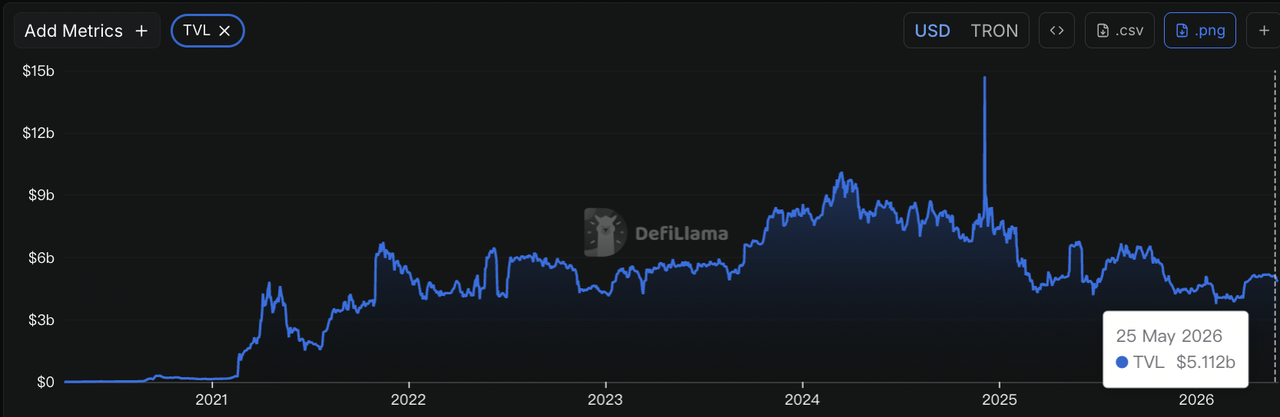
Tron’s adoption is best measured by real transaction usage, especially stablecoin transfers. As of early 2026, Tron has roughly $5.11 billion in total value locked (TVL) across its DeFi ecosystem, while its stablecoin activity remains far larger and more central to the network’s real-world usage. USDT continues to dominate stablecoin activity on Tron, making the network one of the most important settlement layers for on-chain dollar transfers, especially retail payments, remittances, and users in emerging markets.
Source: DefiLlama
Tron’s role is increasingly centered on payments and low-cost settlement rather than broad DeFi dominance. Stablecoin transfers, DeFi applications, and ecosystem tools all benefit from the network’s low fees and fast confirmations. While Tron’s DeFi TVL is smaller than its stablecoin footprint, its strongest position remains clear: moving dollar-pegged value quickly and cheaply at scale.
1. Stablecoin Settlement and USDT Dominance
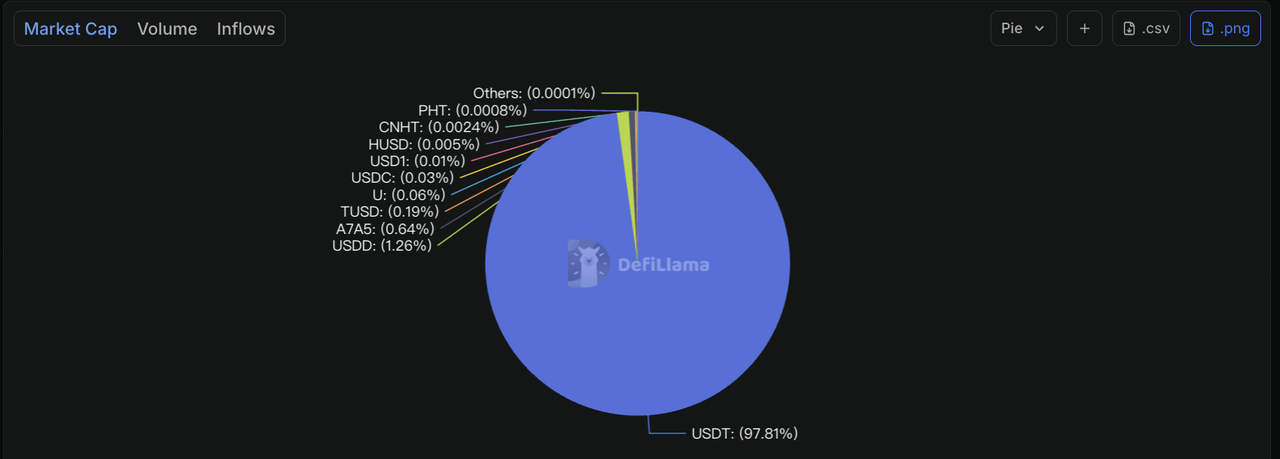
Tron’s most important use case is USDT transfer activity. With low fees and roughly three-second confirmations, Tron is practical for everyday payments, remittances, and savings in countries where users want access to dollar-based value.
Source: DefiLlama
- USDT dominance: USDT makes up nearly all stablecoin value on Tron, giving the network a clear identity as a stablecoin settlement rail.
- Retail-sized transfers: Tron processes a large share of global USDT transfers under $1,000, making it especially relevant for everyday stablecoin payments.
- Low-cost settlement: Near-zero fees make small transfers economically practical, which is one reason Tron is widely used for remittances and peer-to-peer payments.
- Key risk: Tron’s heavy dependence on USDT also creates concentration risk. Changes in Tether policy or stablecoin regulation could directly affect network activity.
2. DeFi, BitTorrent, and Broader Ecosystem
Beyond stablecoins, Tron also supports a broader ecosystem of DeFi protocols, content-related assets, and developer initiatives. These use cases add activity to the network, but they remain secondary to Tron’s core role in payments and stablecoin settlement.
- TRON DeFi protocols: JustLend, SUN.io, Sunpump, and JustStables allow users to lend, borrow, trade, and access stablecoin-related services on-chain.
- BitTorrent integration: Tron’s 2018 acquisition of BitTorrent expanded its ecosystem reach and added the BTT token.
- USDD stablecoin: USDD remains part of the Tron ecosystem, though it is much smaller than USDT on Tron.
- Ecosystem grants and AI initiatives: Tron DAO continues to support developer programs and ecosystem expansion.
- Main takeaway: Tron’s broader ecosystem supports its payments identity, but the network’s strongest product-market fit remains stablecoin transfers.
Read More: Top DeFi Projects for Yield Farming on TRON Network
Tron Tokenomics Explained: TRX Supply, Burn, and Staking
Tron’s tokenomics are closely tied to network usage. Unlike Bitcoin, which has a fixed maximum supply, TRX has no hard cap. Its supply changes based on the balance between new TRX issued to Super Representatives and TRX burned when users pay for network resources. When activity is high, TRX can become deflationary; when activity is lower, supply may grow modestly.
TRX supply is shaped by three main mechanisms:
- Block reward issuance: New TRX is created as rewards for Super Representatives who produce blocks and help secure the network. This is the main source of new TRX entering circulation.
- Resource burn: TRX is burned when users pay for energy and bandwidth, especially when interacting with smart contracts or transferring TRC-20 tokens like USDT. Higher network usage means more TRX can be removed from circulation.
- Staking lock-up: TRX holders can stake, or “freeze,” their tokens to receive energy, bandwidth, and voting power. Staked TRX is not destroyed, but it becomes less liquid and can reduce near-term sell pressure.
The key point is that TRX has a usage-sensitive monetary model. Because Tron is heavily used for USDT transfers, and those transfers require energy or TRX payments, stablecoin activity creates ongoing demand for TRX beyond simple speculation.
How to Trade Tron (TRX) on BingX
BingX offers three practical ways to gain exposure to Tron, depending on whether the goal is direct ownership, short-term trading, or steady accumulation over time. Spot trading is better suited for users who want to buy and hold TRX directly. Futures trading is designed for active traders who want long or short exposure to TRX price movements. Dollar-cost averaging (DCA) is useful for users who want to build a TRX position gradually without trying to time every market move.
Spot Trading: Buy and Own TRX Directly
Spot trading is the most straightforward way to buy Tron on BingX. When users buy TRX on the spot market, they own the asset directly and can hold it in the BingX spot account, transfer it, or withdraw it to a self-custody wallet.
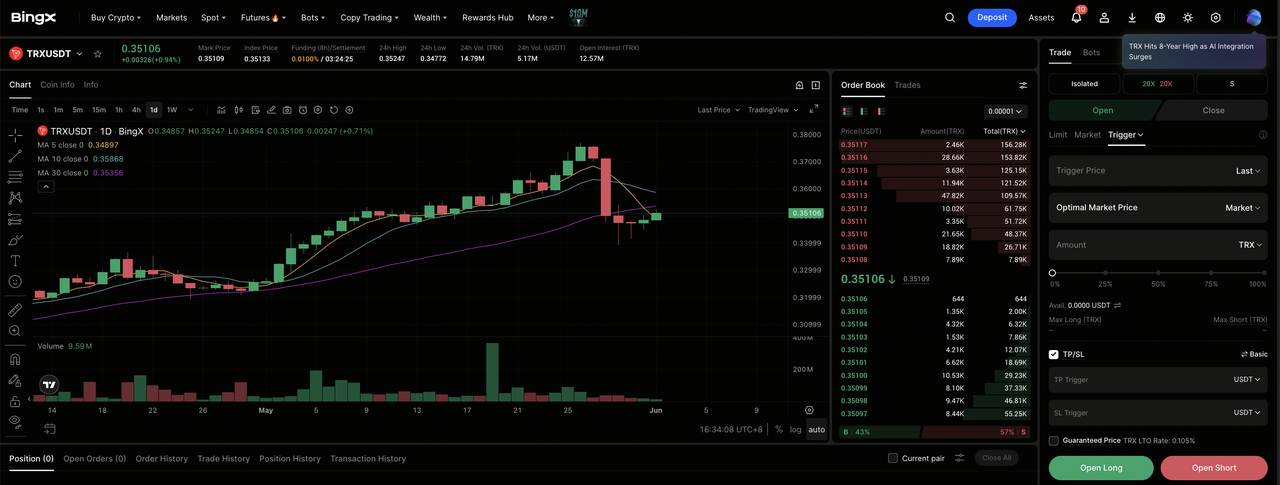
Step 1: Account setup and security. Sign up and log into your BingX account, complete the identity verification (KYC) required in your region, and enable two-factor authentication.
Step 2: Fund your spot account. Deposit USDT or another supported asset into your BingX spot account. Where available, users can also use supported fiat on-ramp options.
Step 3: Navigate to the spot market. Search for the TRX/USDT trading pair.
Step 4: Place your order. Choose a market order to buy TRX immediately at the current price, or use a limit order to set the price you want to pay.
Step 5: Manage your TRX. Once filled, your TRX appears in your spot account. You can keep it on BingX for convenience or withdraw it to a personal wallet for self-custody.
Futures Trading: Trade TRX Price Movements
For active traders, BingX offers USDT-margined TRX perpetual futures. Futures allow users to trade TRX price movements without holding the underlying asset, with the flexibility to open long positions if they expect TRX to rise or short positions if they expect TRX to fall.
Because futures involve leverage, they can amplify both gains and losses. This approach is more suitable for traders who already have a clear risk plan and understand liquidation risk.
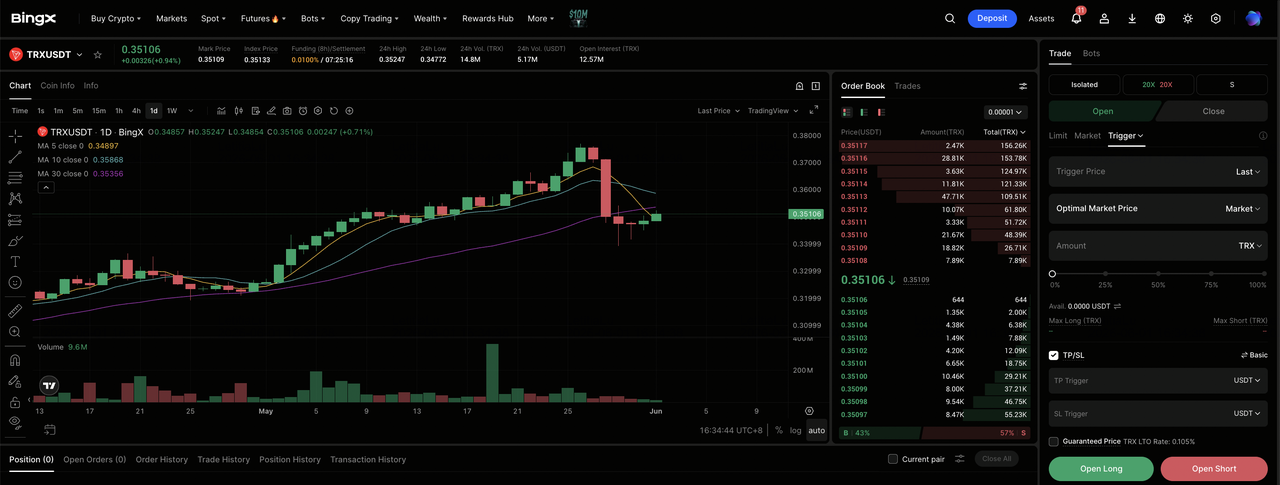
Step 1: Transfer collateral. Move USDT from your spot account into your futures account, where it will serve as margin.
Step 2: Select the contract. Search for the TRX-USDT perpetual contract.
Step 3: Set direction and leverage. Open long if you expect TRX to rise, or open short if you expect TRX to decline. Choose leverage based on your risk tolerance and position size.
Step 4: Execute the trade. Enter the order amount and choose a market or limit order depending on your trading plan.
Step 5: Manage risk. Set stop-loss and take-profit orders before or immediately after entering the position. Profit and loss settle dynamically in USDT.
Dollar-Cost Averaging (DCA): Build a TRX Position Over Time
Dollar-cost averaging (DCA) means buying a fixed amount of TRX at regular intervals, regardless of short-term price movement. Instead of trying to find the perfect entry, users can gradually build exposure over time. This approach is often used by long-term investors who want TRX exposure but prefer to reduce emotional decision-making during volatile markets.
BingX’s recurring-buy ffeature can help automate this process by purchasing a set amount of TRX on a schedule chosen by the user, such as weekly, biweekly, or monthly.
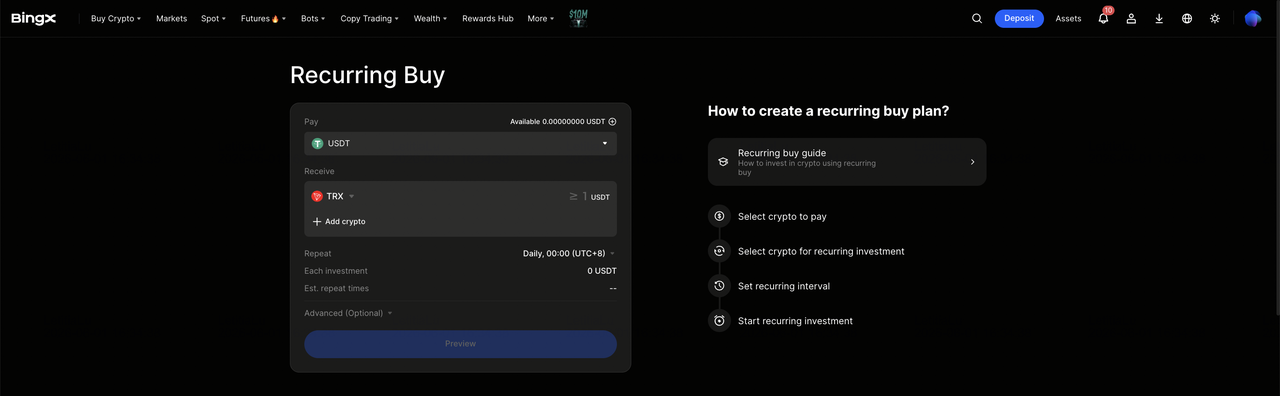
Step 1: Select TRX as the target asset. Open the recurring buy or DCA feature on BingX and choose TRX as the cryptocurrency to accumulate.
Step 2: Set amount and frequency. Enter the fixed amount to invest each time and choose the purchase schedule, such as weekly or monthly.
Step 3: Confirm the funding source. Make sure your selected wallet or payment source has enough balance to support the recurring purchases.
Step 4: Review and activate the plan. Check the asset, amount, frequency, and execution details, then confirm the DCA plan.
Step 5: Monitor and adjust when needed. Review the plan periodically and adjust the amount or frequency based on your budget, market outlook, or investment goals.
Final Thoughts: Should You Invest in Tron in 2026?
Tron has built one of the clearest real-world use cases in crypto: stablecoin settlement. Its low fees, fast confirmations, and high USDT transfer volume have made it a practical network for payments, remittances, and dollar-based savings, especially in emerging markets. This gives TRX demand a usage-driven foundation beyond speculation alone.
For anyone evaluating TRX in 2026, the key is to understand the trade-off. TRX powers network resources, Super Representative voting, and activity across stablecoin payments and DeFi, but Tron also has a more concentrated DPoS model, heavy dependence on USDT, and a history closely tied to Justin Sun. Whether users buy TRX through spot, build a position with DCA, or trade futures, understanding the network behind the asset is essential.
Related Reading
- Top DeFi Projects for Yield Farming on TRON Network
- Top TRON Ecosystem Projects & dApps to Watch in 2026
- Best TRON Wallets in 2026: Top 7 Picks for Security, Speed, and Features
- How to Install and Create a TronLink Wallet in 2026
- What Is SunPump Launchpad and How to Launch a TRON Memecoin on It?
- What Is USDD Over-Collateralized Stablecoin and How to Earn Yield Rewards?
- Top TRON Memecoins to Watch in 2026 and How to Buy Them
