

By late June 2026, World Liberty Financial has firmly anchored itself as a major, yet highly volatile, player in the Real-World Asset (RWA) and stablecoin sectors. While the token has suffered an aggressive downward cycle from its historic highs, dropping over 80% from its peak distribution zones down to the $0.058–$0.060 liquidity pocket, the underlying protocol has continued to push substantial on-chain adoption.
Backed by highly publicized 178 million WLFI incentive campaigns on leading exchanges, the protocol's fiat-backed stablecoin, USD1, has successfully maintained deep market penetration. However, with the token trading at a market capitalization of $1.85 billion and ranked #36 globally as of June 2026, market participants remain intensely divided.
The WLFI price prediction for 2026 has established two starkly distinct camps: the Ecosystem Realists who project a fundamental floor backed by programmatic buybacks, deflationary burns, and an impending National Trust Bank Charter, and the Regulatory Bears who warn of a severe political overhang as Senate Democrats freeze the landmark CLARITY Act over Trump-family conflict-of-interest disputes.
This guide explores data-driven forecasts from algorithmic models, independent crypto analytics platforms, technical indicators to map out the exact price targets for WLFI in 2026, and how to trade World Liberty Financial (WLFI) on BingX.
Top 5 Things to Know About World Liberty Financial (WLFI) in June 2026
- The $1.85 Billion Baseline: WLFI currently trades in a compressed technical bracket between $0.058 and $0.060, consolidating above its absolute macro support floor of $0.051.
- The CLARITY Act Deadlock: Progress on the U.S. Digital Asset Market Clarity Act has stalled in the Senate due to fierce Democratic pushback regarding ethics clauses specifically aimed at restricting Trump-backed crypto ventures like WLFI.
- Binance Incentives Engine: To drive deep liquidity for the protocol's USD1 stablecoin, a massive 178 million WLFI airdrop campaign was extended through July 10, 2026, offering up to 8.39% boosted APR for on-chain positions.
- The Trust Charter Race: Co-founder Zach Witkoff confirmed that the protocol is in the final administrative stages of securing a conditional U.S. National Trust Bank Charter, which would allow it to legally operate a stablecoin-centric banking institution.
- Deflationary Buyback Pivot: To counteract heavy structural token emissions, WLFI has implemented a programmatic buyback and burn framework funded entirely by protocol transaction fees generated across its lending and forex remittance architectures.
What Is World Liberty Financial (WLFI)?
World Liberty Financial is an enterprise-grade, hybrid finance protocol engineered to merge traditional banking frameworks with decentralized finance liquidity. Built natively on top of the battle-tested Aave v3 infrastructure, the protocol functions as an institutional gateway for capital deployment, cross-chain borrowing, and automated credit facilities.
Rather than operating as a speculative meme ecosystem, WLFI distinguishes itself by utilizing strict Know-Your-Customer (KYC) onboarding rails and institutional-grade digital asset custody partners like BitGo Trust to guarantee multi-jurisdictional compliance.
The backbone of the entire economic architecture is USD1, a fully reserved payment stablecoin pegged 1:1 to the U.S. dollar and backed transparently by cash equivalents and short-term U.S. Treasury reserves. To eliminate the standard trust deficits that plague opaque stablecoin structures, the protocol has integrated Chainlink’s automated Proof-of-Reserves (PoR) oracle network. This system provides continuous, tamper-proof, on-chain verifications of the physical collateral underlying USD1.
Furthermore, the protocol’s recent April 2026 upgrade introduced gasless transaction options alongside an optimized AgentPay SDK, enabling autonomous AI agents to legally execute cross-chain settlement, clear funds, and manage capital pools under pre-programmed corporate policy restrictions.
An Overview of WLFI Token Utility and Tokenomics
The WLFI token is an Ethereum-based ERC-20 token that functions strictly as the native governance engine for the decentralized protocol.
- Pure Decentralized Governance: Unlike standard utility tokens, WLFI is engineered primarily as a non-transferable governance asset. It grants holders binding voting rights over key structural parameters of the protocol, including transaction fee configurations, liquidation ratios, risk parameters, cross-chain integrations, and future collateral additions.
- The Anti-Whale Moat: To prevent heavy capital concentration from monopolizing protocol decisions, the platform implements a strict per-wallet voting power cap, forcing a more decentralized distribution of consensus control.
- Fee-Driven Deflationary Burns: While early token allocations to team members, partners, and initial presale participants raised dilution concerns, the community successfully passed a structural token management proposal. This mechanism routes protocol revenues directly toward buying back and burning WLFI tokens on the open market, establishing a structural supply-side counterweight against future vesting schedules.
What Makes World Liberty Financial Different From Traditional DeFi Protocols?
World Liberty Financial differentiates itself by executing an aggressive CeDeFi (Centralized-Decentralized Finance) vertical alignment, operating as a highly regulated financial application layer rather than an anonymous, permissionless yield farm. While traditional DeFi protocols operate in a legal grey zone, WLFI’s active application for a U.S. National Trust Bank Charter represents a strategic attempt to establish a permanent regulatory moat within the traditional banking system.
|
Feature |
World Liberty Financial (WLFI) |
Typical DeFi Protocol |
|
Regulatory Framework |
Strict KYC/AML & Institutional Custody |
Anonymous / Permissionless |
|
Stablecoin Infrastructure |
USD1 (Chainlink Proof-of-Reserves) |
Unbacked or Algorithmically Pegged |
|
Ecosystem Integrations |
AgentPay AI SDK & TradFi Moats |
Crypto-Native Smart Contracts Only |
|
Primary Token Utility |
Pure Capped Governance (Non-Transferable) |
Speculative Trading & Yield Emissions |
|
Total Token Supply |
100,000,000,000 WLFI |
Varies by Project |
From an operational standpoint, WLFI behaves less like a standard automated market maker (AMM) and more like a tokenized prime brokerage. By combining its credit markets with World Swap, a high-throughput foreign exchange (Forex) remittance engine, the protocol targets the multi-trillion-dollar global cross-border payment market. This architecture allows sovereign corporate entities to deploy traditional capital directly into yield-bearing web3 environments under the security of audited, fully compliant code bases.
WLFI 2026 Forecast: A Dip to $0.035 or Jump to $0.15?
The macro price trajectory for WLFI throughout the remainder of 2026 has set up a high-stakes tug-of-war between institutional integration milestones and severe political headwinds in Washington. Traders are actively navigating three distinct price regimes, determined by regulatory outcomes, adoption metrics, and broader crypto liquidity cycles.
The Bull Case: Banking Charter Approval Ignites a Trend Reversal ($0.080 – $0.150)
The primary catalyst for the hyper-bullish scenario depends directly on the successful approval of the U.S. National Trust Bank Charter. If federal regulators grant conditional clearance to the protocol in late 2026, it would instantly unlock an unprecedented level of institutional legitimacy. This milestone would allow traditional corporate treasuries to legally onboard into the USD1 ecosystem, driving on-chain transaction metrics and accelerating the protocol’s fee-funded WLFI buyback-and-burn flywheel.
Simultaneously, if White House crypto adviser Patrick Witt successfully negotiates a compromise on the stalled CLARITY Act, resolving the current partisan standstill over elected officials' crypto ownership, WLFI would shed its significant political risk premium. A clean break above the immediate $0.080 technical resistance barrier would invalidate the macro downtrend, opening up a rapid liquidity gap-fill toward the $0.150 region as institutional capital flows in.
The Base Case: Extended Consolidation via Incentive Campaigns ($0.050 – $0.080)
The base case scenario projects a prolonged period of range-bound consolidation within a healthy, ascending structural bracket. In this scenario, the CLARITY Act remains bogged down in legislative gridlock ahead of the mid-term elections, leaving WLFI exposed to continuous political media cycles.
However, the token's downside remains firmly supported by aggressive, multi-platform liquidity campaigns. The ongoing 178 million WLFI distribution pool on Binance, alongside expansive spot trading pairs across Top-Tier venues like Gate.io, guarantees a steady baseline of trading volume and retail user acquisition. Under these conditions, the programmatic fee-buybacks successfully offset normal market sell pressure, locking WLFI into a predictable trading band between $0.050 and $0.080.
The Bear Case: Political Sanctions and Governance Contagion ($0.035 – $0.045)
The bearish outlook focuses on the risk of heightened political and regulatory scrutiny. Should senior Senate Democrats successfully weaponize the high-profile, $500 million Abu Dhabi-linked investment to force hostile congressional oversight hearings, institutional confidence in the protocol could completely evaporate.
This headwind could be worsened by internal governance friction. If prominent stakeholders, like Justin Sun, launch legal actions against the protocol’s long-term vesting structures, market sentiment could drop into the extreme fear territory. If a macro risk-off cycle sweeps the broader crypto markets, driving Bitcoin back into key distribution baselines, WLFI would likely fail to maintain its critical psychological support at $0.050. This breakdown would trigger an aggressive liquidity hunt down toward the historical support pocket between $0.035 and $0.045.
WLFI Price Predictions for 2026: Institutional and Algorithmic Outlook
Multi-platform consensus targets reflect a cautious, highly calculation-driven market environment for the remainder of 2026.
|
Entity/Analytics Platform |
2026 Price Range Target |
Overall Market Outlook |
|
Traders Union (Consensus) |
$0.055 – $0.067 |
Neutral/Buy: Predicts steady short-term accumulation driven by Binance airdrop extensions. |
|
CoinCodex Model |
$0.040 – $0.047 |
Bearish: Algorithmic projection based on historical token distribution dilution. |
|
Coinpedia Analytics |
$0.300 – $0.460 |
Highly Optimistic: Speculative target dependent on full regulatory clearance and mainnet super-app launch. |
|
Coinbase Analytics Tool |
$0.080 – $0.100 |
Moderate (5% Growth Model): Long-term projection factoring in consistent stablecoin adoption. |
How to Trade World Liberty Financial (WLFI) on BingX
Navigating a highly volatile asset like WLFI requires a disciplined, structured approach across spot and derivatives markets.
Capitalizing on WLFI's Volatility via the Spot Market
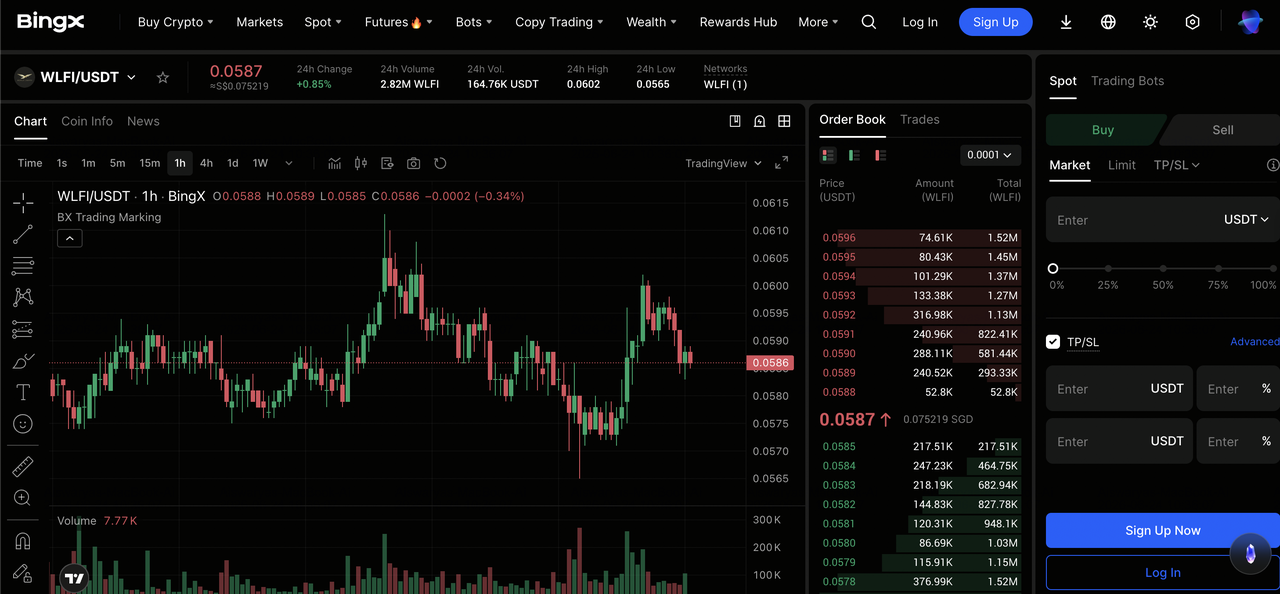
WLFI/USDT trading pair on BingX spot market
Spot market trading is ideal for market participants focused on long-term accumulation, allowing traders to acquire exposure to the protocol's governance layer without navigating the constant risk of sudden futures market liquidations.
- Access your verified trading account and navigate directly to the Spot Trading terminal.
- Enter WLFI into the asset search bar to open up the active, real-time order book of the WLFI/USDT trading pair.
- Evaluate the macro market structure and select your optimal execution parameter: utilize a Limit Order to specify a precise entry price near key support structures, or a Market Order to execute immediately at current market rates.
- Input the precise amount of capital you wish to allocate, carefully review the order parameters, and confirm your transaction.
Read more: How to Buy World Liberty Financial (WLFI) Token in 2026: Official Exchanges and Trading Pairs
Long or Short WLFI Perpetuals on the Futures Market
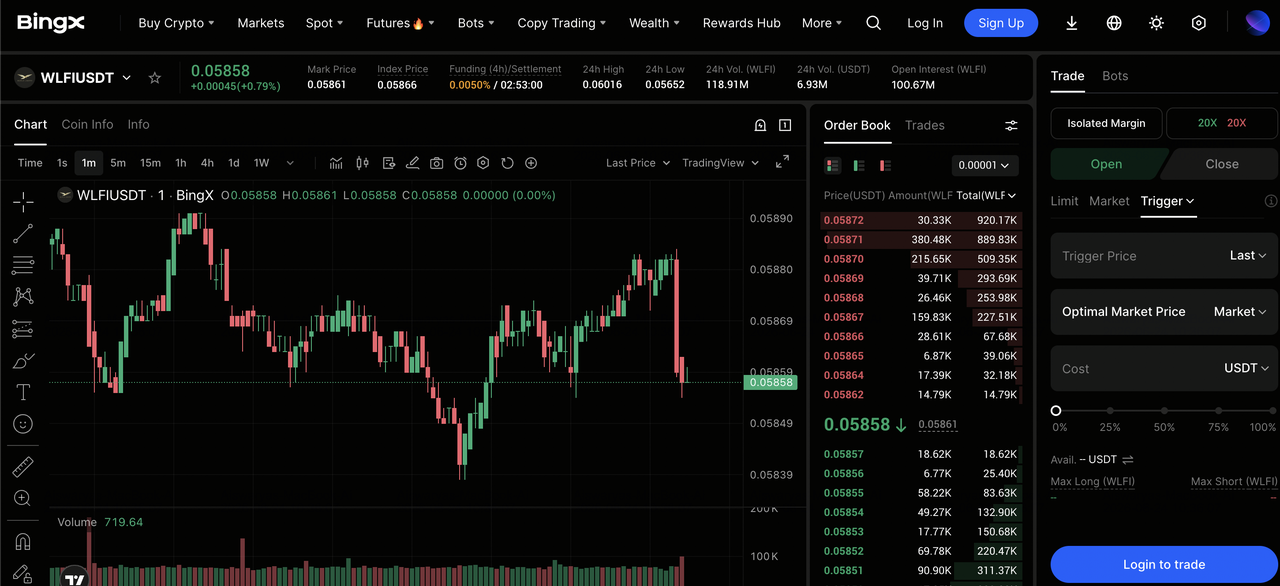
WLFI/USDT perpetual contract on BingX futures market
For sophisticated, short-term tactical traders, utilizing USDT-margined perpetual futures contracts allows you to capitalize on rapid price movements or actively hedge your spot positions against unexpected political headline risks.
- Navigate to the Futures and Perpetual Futures terminal.
- Select the WLFI/USDT perpetuals or WLFI/USDC perpetual contract pair to load the real-time technical indicators, funding rates, and open interest metrics.
- Configure your preferred Margin Mode: execute via Isolated Margin to strictly confine your capital risk to an individual trade, or Cross Margin to utilize your broader account balance as unified collateral.
- Select an appropriate leverage multiplier. Given the asset's high sensitivity to political news, strict risk parameters dictate keeping leverage low, e.g., 2x–5x.
- Deploy mandatory Take-Profit (TP) and Stop-Loss (SL) orders within your execution interface to insulate your collateral from unexpected liquidity sweeps.
- Execute Open Long if your technical analysis points to a breakout above macro resistance, or Open Short to profit from continued down-trending cycles.
5 Key Risks for WLFI Traders to Watch
While the protocol's institutional expansions provide a fundamental floor, traders must carefully navigate a unique matrix of regulatory, structural, and macroeconomic hazards to protect their capital in 2026.
- The Political Risk Premium: WLFI is directly exposed to U.S. political developments. Sudden changes in regulatory stances or congressional investigations can cause severe, unexpected price shifts.
- The Token Unlock Overhang: While multi-year team lockup schedules provide near-term relief, long-term token emissions represent a structural dilution risk that the market must eventually absorb.
- Stablecoin Competition: The success of the governance token is heavily dependent on the market adoption of USD1. If established competitors like USDT or USDC choke off USD1's market share growth, the protocol's fundamental value proposition weakens.
- Governance Discontent: Contentious proposals regarding mandatory token lockup adjustments can fragment community trust and trigger legal disputes with major seed investors.
- Thin Liquidity Profiles: Compared to older altcoins, WLFI operates on lower relative daily spot volumes. This thin liquidity profile means that large single-wallet distributions can cause significant slippage and erratic price swings.
Conclusion: Is WLFI a Strategic Buy in 2026?
Determining whether to acquire WLFI in late June 2026 requires a clear distinction between short-term narrative momentum and long-term fundamental execution. In the immediate term, the asset represents a compelling, highly reactive beta play on U.S. regulatory and political outcomes.
The $0.051–$0.055 range remains the definitive macro support floor. As long as the protocol holds this level, the ongoing staking incentives on major global exchanges provide an attractive accumulation zone for active participants looking to benefit from high-yield ecosystem rewards.
For long-term market participants, the investment thesis must move past the initial marketing hype and focus strictly on tangible milestones. WLFI's true valuation will ultimately decouple from speculative altcoin cycles only if the protocol successfully secures its U.S. National Trust Bank Charter and expands the utility of its AgentPay AI framework.
Traders should maintain strict risk management parameters, treating the asset as a speculative satellite position rather than a core portfolio holding, while continuously tracking on-chain USD1 volume as the primary indicator of authentic protocol growth.
Risk Reminder: Digital asset trading carries an exceptionally high level of capital risk. The protocol's fee-funded buyback mechanism depends completely on sustained on-chain volume. If stablecoin adoption stalls, the asset remains vulnerable to the same downward pressures as any other altcoin. Never deploy capital you cannot afford to lose.
Related Reading
- Hyperliquid (HYPE) Price Prediction 2026: The $150 Revenue Thesis vs. The $40 Baseline
- Pi Network (PI) Price Prediction 2026: The AI Human-Infrastructure Thesis vs. The 163M Token Unlock
- Chiliz (CHZ) Price Prediction 2026: World Cup Deflation Flywheel vs. $0.14 Resistance Neckline
- Everything You Should Know About WLFI: Tokenomics, Listing Plans, and More
- How to Buy World Liberty Financial (WLFI) Token in 2026: Official Exchanges and Trading Pairs
