

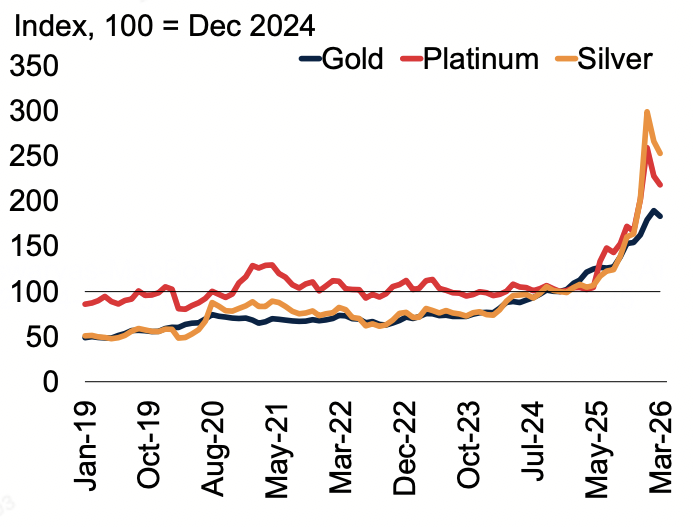
In late April 2026, Platinum (PL) sits at a pivotal macroeconomic junction. After a blistering rally that saw prices touch $2,920 in February, the white metal is currently consolidating near the $2,000 level. While the market remains in its fourth consecutive year of structural deficit, recent data from UBS and the World Bank suggest that the extreme physical tightness seen in Q1 is beginning to ease. Investors are now balancing a significant 11% projected growth in industrial demand against a higher-for-longer U.S. interest rate environment that raises the opportunity cost of holding non-yielding bullion.
As the energy transition accelerates, platinum’s role in PEM electrolyzers and fuel-cell technology is shifting from speculative hype to a strategic necessity. With the Strait of Hormuz disruption entering its 60th day, the broader commodity complex is coiling for its next major move. This guide breaks down the Platinum price prediction for 2026 using data from the World Platinum Investment Council (WPIC), Bank of America, UBS, and Reuters.
You will also discover how to trade Platinum futures with USDT through BingX TradFi.
Top 5 Things for Platinum Traders to Know in 2026
As Platinum navigates a high-stakes environment of supply constraints and green energy mandates, traders must monitor these five market-moving factors.
- The Structural Deficit: The WPIC forecasts a 2026 supply shortfall of roughly 240,000 ounces, following a massive 1.08 million-ounce deficit in 2025. Above-ground stocks are at historic lows.
- Geopolitical Supply Risk: Over 70% of global platinum mine supply originates from South Africa and Russia. With South African power grids (Eskom) remaining unreliable and Russian sanctions persistent, mine-supply elasticity is virtually zero.
- The Hydrogen Multiplier: Platinum is non-substitutable in PEM electrolyzers. As Europe and China codify green hydrogen targets into law, this sector is expected to account for 11% of total demand by 2030.
- The Gold-Platinum Ratio: Historically, platinum traded at a premium to gold. In 2026, investors are increasingly viewing platinum as a catch-up value play as gold hits fresh record highs.
- Lease Rate Volatility: Platinum three-month lease rates have fallen from 19% in early 2026 to approximately 6% in April, signaling that the immediate physical squeeze may be normalizing.
What Is Platinum (XPT)?
Platinum is a dense, stable, and highly rare precious metal. While often associated with jewelry, its primary value in 2026 is industrial. It is a critical component in catalytic converters for hybrid and internal combustion vehicles (ICEs), as well as in chemical refining and glass manufacturing.
As of April 2026, the platinum market is defined by inelastic supply. Unlike copper or aluminum, platinum cannot be easily substituted in its most critical high-heat and electrochemical applications. On the BingX TradFi platform, traders can speculate on these price movements through Platinum (PL) CFDs, allowing for both long and short positions without the need for physical storage.
Trading platinum in 2026 utilizes a specialized ecosystem of tickers, primarily benchmarked by the international spot price XPT/USD and NYMEX futures (PL). Investors can access the market through physically-backed ETFs like PPLT and PLTM, or gain indirect, leveraged exposure via major mining equities such as Anglo American Platinum (AMS) and Sibanye-Stillwater (SBSW). BingX TradFi lets you trade Platinum futures with Tether (USDT).
As the metal trades near $1,925/oz, these instruments serve as critical vehicles for navigating platinum's high volatility, driven by its dual role as a precious safe-haven and a strategic industrial component in the global green energy transition.
Platinum's Performance in 2025: A Review
In 2025, Platinum was a standout performer in the commodity complex, delivering a total return of approximately 120%. The year was defined by a perfect storm: falling mine grades in the South African Bushveld, 7% output declines from Russia’s Norilsk Nickel, and a surge in investment demand for physical bars and coins.
By December 2025, Platinum had surged from $910 to $1,766 per ounce. This momentum carried into early 2026, driven by the U.S. Geological Survey (USGS) officially adding Platinum Group Metals (PGMs) to the Critical Minerals List, citing high supply-chain risk.
Platinum’s 2026 Strategy: How to Navigate Commodity Volatility
- The $1,900 Floor: Technical analysts identify $1,900–$2,000 as a psychological and technical support zone. As long as PL holds this level, the multi-year bull trend remains intact.
- The Dollar Inverse: Like most commodities, Platinum maintains a strong inverse correlation with the DXY. A firmer U.S. Dollar in Q2 2026 has acted as a temporary ceiling on prices.
- China Import Data: In March 2026, Chinese platinum imports rebounded to above 10 metric tons, signaling that the world's largest consumer is aggressively stockpiling at these levels.
Platinum 2026 Investment Outlook: $2,500 Breakout vs. $1,500 Mean Reversion
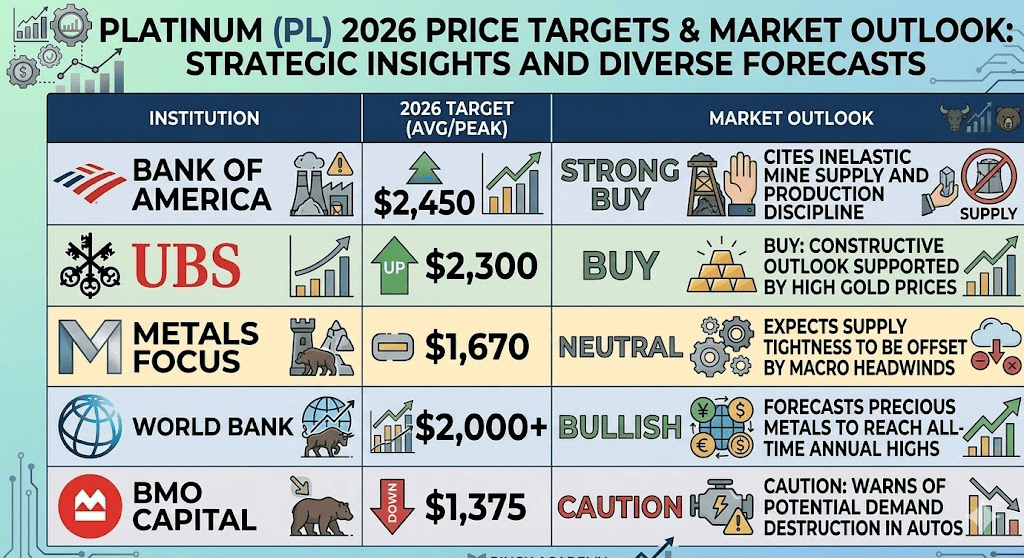
Platinum forecast 2026 by various analysts
Navigating the Platinum market in 2026 requires a balanced understanding of three distinct probability-weighted outcomes driven by industrial scarcity and global macro shifts.
The Bull Case: The $2,500 Structural Breakout
The bullish narrative, championed by Bank of America and UBS, centers on the Hydrogen Multiplier entering a phase of exponential growth. As Proton Exchange Membrane (PEM) electrolyzers move into mass deployment across Europe and China, hydrogen-related demand is projected to climb toward 11% of total annual consumption. This surge coincides with a critical supply-side failure; South African mine output has contracted by 5% year-on-year due to Eskom’s ongoing power instability, potentially widening the 2026 deficit far beyond the baseline 240,000-ounce forecast.
For traders, this scenario transforms Platinum from a mere industrial metal into a high-alpha safe-haven. With above-ground stocks at historic lows, any break above the $2,200 technical resistance could trigger an aggressive short squeeze. In this environment, institutional rotation from overextended Gold (XAU) positions into undervalued Platinum (PL) becomes the primary driver, providing the momentum needed to target the $2,450–$2,500 zone by year-end.
The Base Case: $1,800 – $2,100 Consolidation
The base case envisions a Distribution Phase as the market digests the explosive gains of early 2026. While the fundamental deficit remains, analysts at TD Securities and Reuters note that current price levels near $2,000 have begun to activate price elasticity in secondary markets. Recycled platinum supply is expected to rise by 3–5% as higher scrap valuations draw metal back into the system, effectively acting as a pressure-relief valve for the physical market and preventing a runaway price spike.
Practically, this results in a high-volatility, range-bound environment defined by the $1,800 support and $2,100 resistance levels. In this stock-picker’s commodity market, focus shifts to the China import rebound, which saw volumes exceed 10 metric tons in March, serving as a floor for prices. Investors should expect choppy consolidation as the market balances sustained industrial demand against a firmer U.S. Dollar and a Federal Reserve that remains hesitant to cut rates.
The Bear Case: The $1,500 Demand Destruction Trap
The bearish scenario, warned by BMO Capital Markets, is triggered by a Macro-Skunk event where sustained high interest rates finally fracture global consumer discretionary spending. As the automotive sector, which accounts for 50% of platinum demand, faces a sharp contraction in new vehicle sales, the demand for autocatalysts would plummet. This cyclical downturn would be exacerbated by a potential substitution reversal, where manufacturers pivot back to lower-cost Palladium (PA) to preserve tightening margins.
Technically, the bear case is confirmed by a decisive daily close below the $1,800 line in the sand. A breach of this level would likely activate systematic trend-following sell programs, liquidating the speculative length built up during the Q1 rally. In this hard-landing environment, the market would shift from a supply-deficit focus to a demand-surplus reality, opening the door for a rapid retest of the $1,400–$1,500 support zone as the 2025–2026 commodity shock premiums are fully erased.
Platinum Price Forecasts for 2026 by Leading Analysts
|
Institution |
2026 Target (Avg/Peak) |
Market Outlook |
|
Bank of America |
$2,450 |
Strong Buy: Cites inelastic mine supply and production discipline. |
|
UBS |
$2,300 |
Buy: Constructive outlook supported by high gold prices. |
|
Metals Focus |
$1,670 |
Neutral: Expects supply tightness to be offset by macro headwinds. |
|
World Bank |
$2,000+ |
Bullish: Forecasts precious metals to reach all-time annual highs. |
|
BMO Capital |
$1,375 |
Caution: Warns of potential demand destruction in autos. |
How to Trade Platinum (XPT) Futures on BingX TradFi
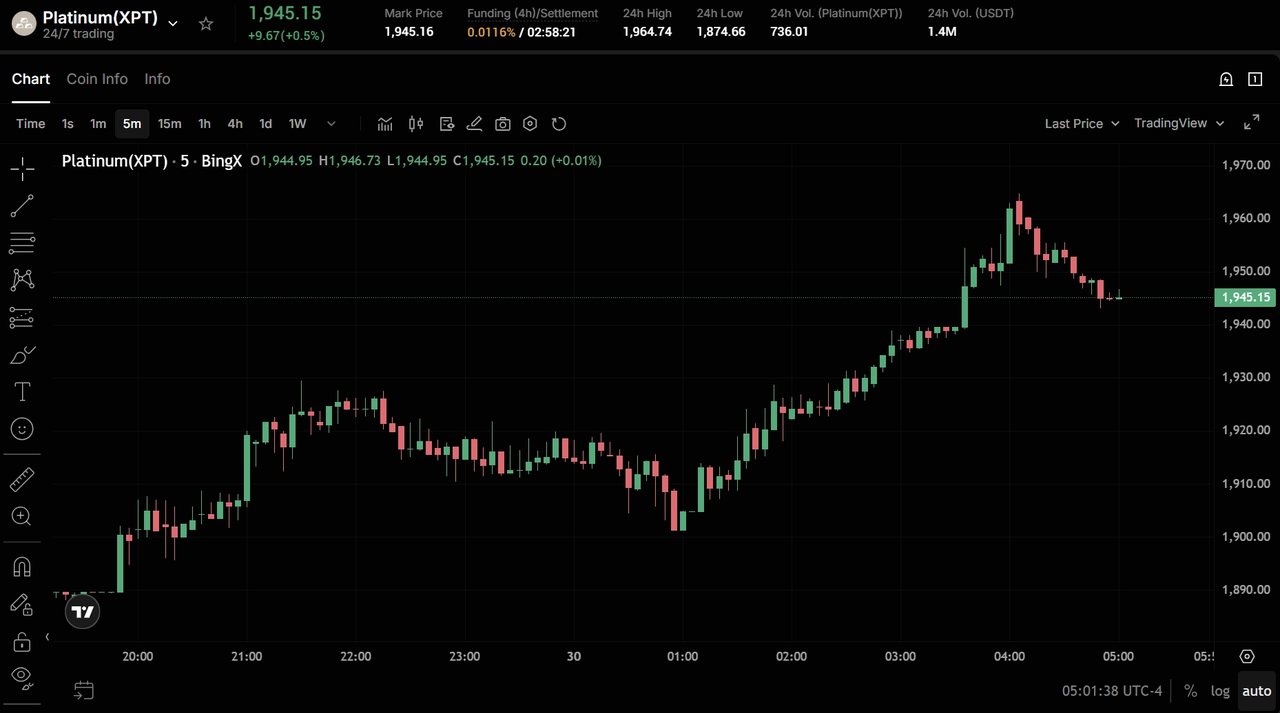
Capitalize on platinum’s volatility using BingX TradFi and the predictive power of BingX AI. Whether you are betting on the green hydrogen revolution or hedging against a cyclical downturn, BingX provides the integrated tools and AI-driven market sentiment analysis needed to trade the world's rarest precious metal with precision.
- Access BingX TradFi: Navigate to the Commodities section.
- Select Platinum (PL): Choose the PLATINUM(XPT)-USDT perpetual or CFD contract.
- Choose Your Direction: Select Open Long if you anticipate supply deficits driving prices higher, or Open Short to trade the bearish mean-reversion case.
- Manage Risk: Use the BingX TP/SL tools to protect your capital against the 2026 commodity coiling effect.
Top 5 Risks to Watch for Platinum Traders in 2026
While the fundamental backdrop for platinum remains historically tight, traders must navigate a complex landscape of macroeconomic and technical headwinds that could derail the current bullish trend.
- Substitution Risk: High platinum prices may force automakers to switch back to lower-cost Palladium (PA) for certain catalytic applications.
- The Paper Sell-off: Large swings in speculative positioning on the NYMEX can trigger flash crashes regardless of physical supply.
- Monetary Policy: If the Fed raises rates unexpectedly to combat energy inflation, non-yielding metals will face immediate selling pressure.
- EV Acceleration: A faster-than-expected transition to Battery Electric Vehicles (BEVs) would reduce the need for platinum-based autocatalysts.
- Recycling Surges: Higher prices incentivize urban mining or recycling, which could provide a surprise cushion to the supply deficit.
Final Thoughts: Is Platinum a Buy at $2,000 in 2026?
As of April 2026, Platinum has transitioned from a niche luxury metal into a strategic industrial asset essential for the global energy pivot. At the $2,000 level, the metal is trading close to the marginal cost of production for high-cost, deep-level mines in South Africa, suggesting a fundamental floor is forming. For long-term portfolios, the combination of a fourth consecutive supply deficit and the non-substitutable demand from the hydrogen sector creates a compelling value proposition relative to Gold.
For tactical traders, however, the immediate outlook is defined by technical consolidation. The current market requires a disciplined approach: monitoring the $1,900 support level is critical, as a breach could signal a shift in speculative sentiment, while a move above $2,100 would likely confirm the next leg of the structural bull run. Utilizing BingX AI to track real-time inventory drawdowns and USD strength will be key to timing entries in this high-volatility environment.
Risk Reminder: Trading precious metals involves significant capital risk due to high price volatility and geopolitical sensitivity. Platinum's smaller market size compared to Gold can lead to rapid price swings and reduced liquidity during economic shifts. Always implement strict stop-loss orders and never trade with capital you cannot afford to lose.
Related Reading
- Is Gold a Good Investment in 2026? Risks & Returns Explained
- Silver Price Prediction for 2026: Can XAG Surge Above $200 or Face a Correction?
- Is Copper (XCU) a Good Investment in 2026?
- Crude Oil Price Forecast 2026: $140 War Premium or $60 Surplus Baseline?
- How to Trade Commodities With Crypto in 2026 as Oil, Gold, Silver, and TradFi Go On-Chain
