On April 29, 2026, Solidus AI Tech announced its evolution into the AITECH Cloud Network (ACN). This transition marks a strategic shift toward supporting production-level AI systems at scale. With the rise of autonomous agents, ACN provides the necessary hardware-to-logic bridge, offering a transparent, GPU-powered environment for builders and enterprises.
This article examines the three-layer architecture of the ACN Engine, the technical drivers behind the Ethereum migration, the utility of the $ACN token, and how to trade AITECH Cloud Network (ACN) on BingX.
What Is AITECH Cloud Network (ACN)?
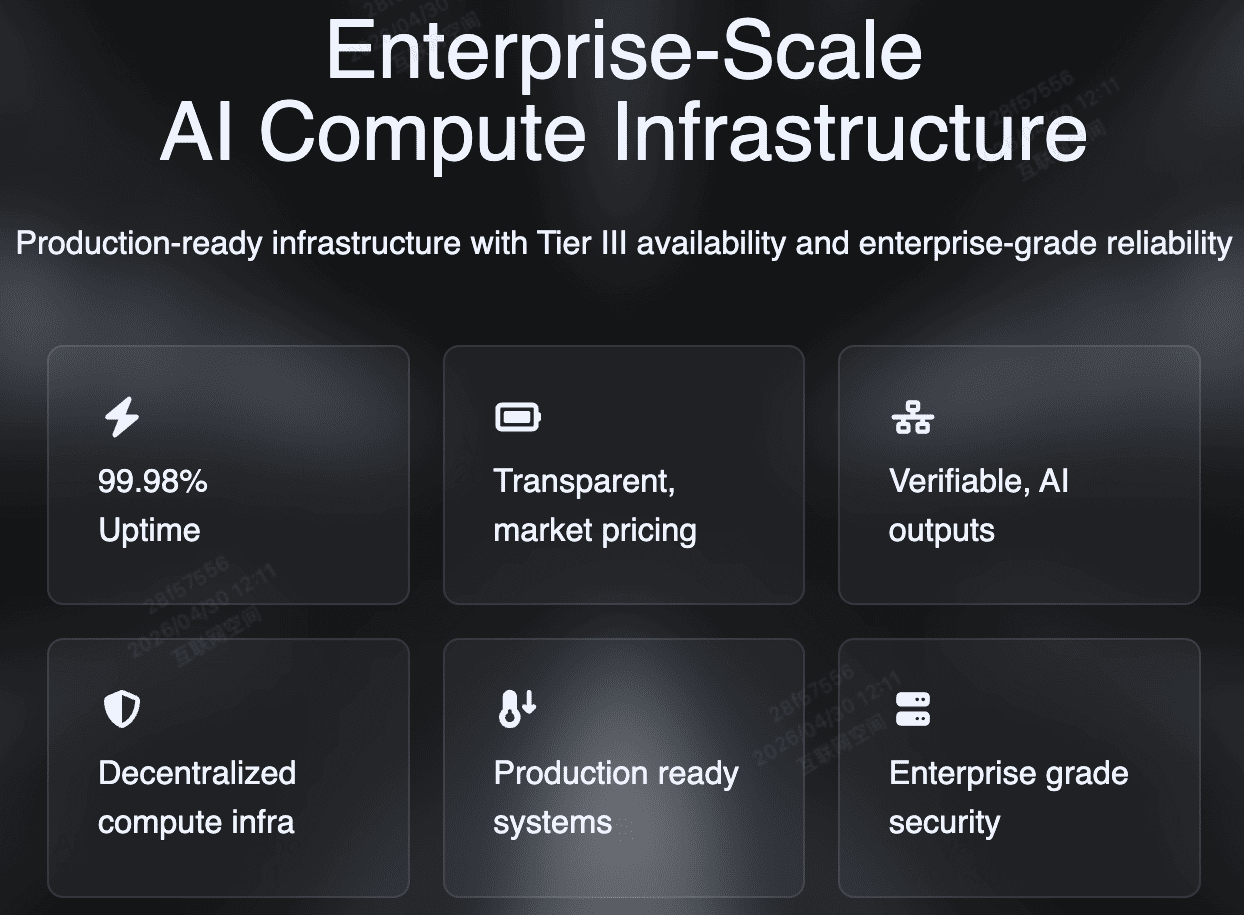
Key benefits of AITECH Cloud Network | Source: ACN
AITECH Cloud Network (ACN) is a modular AI infrastructure provider that aggregates distributed computing power to support AI training, inference, and complex autonomous workflows. Originally known for its high-performance data centers, the rebrand to ACN reflects a shift from providing isolated tools to offering a unified, end-to-end operational system.
The platform’s core mission is to solve the fragmentation in the AI industry, where compute and execution logic often sit in siloed environments. ACN addresses this through:
- On-Demand Enterprise GPUs: Access to H200, H100, and A100 clusters without the centralized constraints of traditional cloud providers.
- No-Code Agent Orchestration: A framework (Agent Forge) that allows users to build AI agents capable of planning and executing multi-step tasks.
- Machine-Native Economics: A payment protocol that allows AI agents to pay for their own compute and services autonomously using on-chain assets.
How Does the ACN Ecosystem Work?
The ACN ecosystem operates through the ACN Engine, a centralized coordination system that manages three distinct, yet economically aligned, layers:
1. The Compute Layer: Infrastructure
The backbone of the network is a distributed GPU marketplace. Unlike centralized black box providers, ACN leverages a network of Tier III data centers and individual providers. This layer is optimized for high-intensity workloads, including Large Language Model (LLM) training and real-time rendering, offering a pay-as-you-go model that eliminates idle resource costs.
2. The AI Agent Orchestration Layer: Agent Forge
Sitting above the hardware is Agent Forge, a no-code orchestration platform. It enables the design of autonomous workflows that can interact with external APIs, data sources, and other blockchain protocols. It supports emerging standards like x402 for payments and ERC-8004 for agent identity, ensuring that agents are interoperable across the broader Agentic Web.
3. The Economic Layer: ACN Token
The $ACN token acts as the fuel for the entire network. All services, from renting a H100 GPU to executing a single agent workflow, require ACN. The system uses a revenue-backed deflationary model: as platform usage increases, a portion of the revenue is used to buy back and burn tokens, directly linking token supply to network productivity.
What Is AITECH Cloud Network (ACN) Tokenomics After Migration?
The $ACN token follows a strict 1:1 migration ratio from the original $AITECH token.
|
Feature |
Detail |
|
Total Supply |
2,000,000,000 (Capped) |
|
Migration Ratio |
1:1 ($AITECH to $ACN) |
|
Deflationary Mechanism |
Revenue-linked token burn |
|
Migration Portal |
Only via official aitech.io website |
The transition from AITECH to ACN represents a structural evolution from a product-specific utility token on the BNB Chain to a foundational infrastructure asset on Ethereum. While AITECH primarily facilitated isolated service payments, ACN introduces native integration with the x402 protocol for machine-native payments and ERC-8004 for agent identity, enabling autonomous AI agents to manage their own economic lifecycles.
The migration maintains a 1:1 supply ratio but shifts the economic model to a revenue-backed deflationary cycle, where a percentage of all GPU marketplace and Agent Forge fees are used to buy back and burn ACN, directly linking token scarcity to real-world network throughput.
What Is the ACN Token Utility?
The post-migration tokenomics of ACN are designed to transition the ecosystem into a Pay-as-you-Execute economy. By moving to Ethereum, ACN leverages a more robust institutional environment and advanced smart contract standards to support complex, multi-step AI workflows.
1. Unified Utility and The Fuel Model
The $ACN token serves as the universal medium of exchange across three architectural layers. The network operates on a Fuel logic: the ACN Engine consumes tokens to power compute training and agent orchestration.
- Compute Access: Used to pay for on-demand GPU clusters like H100, H200, etc..
- Agentic Transactions: Enables agents to transact with one another autonomously via the x402 standard.
- Marketplace Fees: Facilitates the licensing and deployment of specialized AI models within Agent Forge.
2. Deflationary Revenue-Backed Burn
Unlike traditional inflationary models, ACN’s supply is managed through a direct link to platform revenue.
- The Mechanism: A portion of all revenue generated from the Compute Marketplace and Agent Forge is allocated to an automated buyback-and-burn program.
- The Impact: This creates a direct correlation between network adoption and token scarcity. As enterprises scale their AI workloads on ACN, the circulating supply of $ACN decreases proportionally.
3. Staking and Compute Discount Certificates (CDCs)
To incentivize long-term holding and network stability, ACN introduces a unique staking-for-utility model:
- Incentive: Stakers earn yield and Compute Discount Certificates (CDCs).
- Practical Use: CDCs can be applied to significantly reduce the per-hour cost of high-performance GPU rentals, making the ecosystem more cost-effective for heavy-duty AI researchers and developers compared to traditional cloud providers.
4. Governance and Registry Rights
The ACN token provides holders with a seat at the table for the Agentic Web's evolution. Holders vote on hardware eligibility, protocol fee structures, and ecosystem grants. Furthermore, developers must stake ACN to register their agents on the ERC-8004-compliant registry, ensuring a high-quality, skin-in-the-game environment for autonomous services.
How Does AITECH Cloud Network Differ From Traditional Cloud Providers?
|
Feature |
AITECH Cloud Network (ACN) |
Traditional Cloud (AWS/GCP) |
|
Pricing Model |
Transparent, usage-based credits |
Complex, variable billing |
|
Accessibility |
Global, permissionless access |
Regional restrictions & KYC |
|
Orchestration |
Integrated AI Agent Forge |
Fragmented 3rd-party tools |
|
Token Incentives |
Deflationary $ACN utility |
None (Shareholder dividends only) |
Traditional cloud providers like AWS, Azure, and GCP operate as centralized black box silos where pricing is often opaque, and users are subject to vendor lock-in through proprietary APIs and high data egress fees. In contrast, AITECH Cloud Network (ACN) functions as a decentralized marketplace that aggregates high-performance GPU power, including H200 and A100 clusters, from a global network of Tier III data centers. This structure allows ACN to offer 99.98% uptime and market-driven, transparent pricing that is significantly more cost-effective for large-scale AI training, as users bypass the heavy institutional overhead and regional availability constraints typical of the Big Three.
Practically, while traditional clouds provide raw infrastructure that requires fragmented third-party tools for AI orchestration, ACN integrates a native AI Agent Orchestration Layer (Agent Forge) directly into its stack. This allows for a pay-as-you-execute model where compute consumption is tied to specific autonomous workflows rather than just active server time. Furthermore, ACN utilizes a revenue-backed deflationary token on Ethereum, enabling machine-native payments via the x402 protocol. This means agents can autonomously rent and pay for their own compute power, a capability that is fundamentally impossible within the fiat-based, account-restricted billing systems of legacy cloud environments.
How to Trade AITECH Cloud Network (ACN) on BingX
BingX provides a streamlined interface for participating in the AI sector’s growth through $ACN.
Buy, Sell, or HODL ACN on the Spot Market
- Access the Terminal: Log in to BingX, go to Spot, and search for the ACN/USDT pair. Ensure you are using the migrated contract address.
- Select Order Type: Use a Market Order for instant execution or a Limit Order to target a specific entry price.
- Confirm: Enter the amount of USDT and tap Buy ACN. Your tokens will be stored in your Fund Account, ready for staking or transfer.
5 Key Considerations Before Investing in ACN
Before allocating capital to the $ACN ecosystem, it is essential to evaluate the structural risks of its decentralized compute model and the technical nuances of the newly migrated Ethereum infrastructure.
- Migration Security: Always use the official ACN migration portal. Avoid any third-party links claiming to offer early swaps.
- Ethereum Gas Fees: While Ethereum offers higher security and institutional alignment, users should be mindful of gas costs for on-chain staking and claims.
- GPU Market Dynamics: The value of the compute layer depends on the global demand and supply of high-end NVIDIA chips.
- Adoption Rate: ACN token's deflationary burn is tied to usage. If the number of agent executions or compute tasks drops, the burn rate slows.
- Regulatory Shifts: As a provider of GPU power, ACN may be subject to evolving global regulations regarding AI compute export and usage.
Final Thoughts: Is AITECH Cloud Network the Engine of the Agentic Web?
AITECH Cloud Network (ACN) has effectively positioned itself as a foundational utility layer for the emerging Agentic Web by consolidating decentralized compute and autonomous orchestration into a single execution environment. By standardizing high-performance GPU access and integrating the x402 payment protocol, the network provides the technical plumbing necessary for AI agents to operate as independent economic actors. The platform’s transition to Ethereum and its revenue-linked deflationary model move the ecosystem away from purely speculative value, instead anchoring the $ACN token to the measurable throughput of AI training and automated workflows.
From a practical perspective, ACN’s viability depends on its ability to sustain high-density compute demand and maintain seamless interoperability across diverse agent standards like ERC-8004. For enterprises and developers, the value lies in the platform’s pay-as-you-execute efficiency and its reduction of the technical barriers typical of fragmented legacy cloud systems. As AI moves from experimentation to production-level autonomy, ACN offers a scalable infrastructure stack designed to support continuous, verifiable, and economically sovereign AI operations.
Risk Reminder: AI-sector tokens involve high technical complexity and market volatility. Always perform your own research and monitor official ACN channels for migration updates. BingX is not responsible for any trading losses.
Related Reading
- What Are the Top 10 AI Agent Crypto Projects of 2026?
- Top x402 Payment Protocol Projects for Blockchain-Based AI Agents
- Top 7 AI Agent Tokens on Solana to Watch in 2026 Amid the Rise of the Machine Economy
- What Are the Top 10 Base AI Agent Projects to Know in 2026?
- What Is AI Rig Complex (ARC) Ryzome Universal App Store for AI Agents and How to Buy ARC?
